0:00 / 0:00

3D Coordinate System

2D space R2\colorOne{R^2}:

  • We have the x and y axes
  • Our points have coordinates(x,y)\left(x,y\right)
  • The equation involving xx and yy describes a curve in R2R^2

3D space R3\colorOne{R^3}:

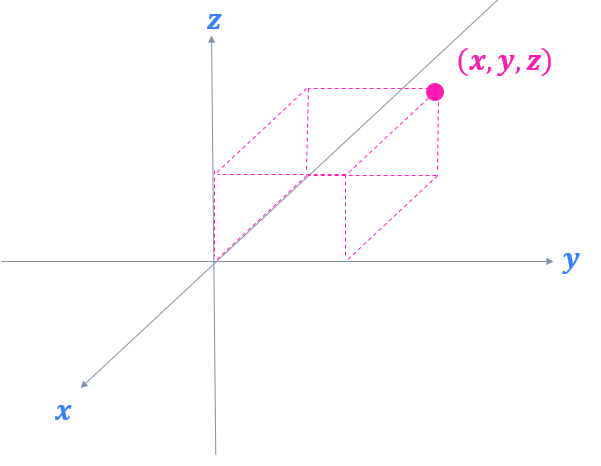
  • We have the x, y, and z axes
  • Our points have coordinates (x,y,z)\left(x,y,z\right)
  • The equation involving x, yx,\ y and zz describes a surface in R3R^3
  • Ex. The equation of a sphere in R3R^3 is (xh)2+(yk)2+(zl)2=r2\left(x-h\right)^2+\left(y-k\right)^2+\left(z-l\right)^2=r^2 -- the graph of this surface will be all the points that are on the surface of this sphere
  • The distance between two points P1(x1, y1, z1)P_1\left(x_1,\ y_1,\ z_1\right) and P2(x2,y2,z2)P_2\left(x_2,y_2,z_2\right) is P1P2=(x2x1)2+(y2y1)2+(z2z1)2\left|P_1P_2\right|=\sqrt{\left(x_2-x_1\right)^2+\left(y_2-y_1\right)^2+\left(z_2-z_1\right)^2}

Example
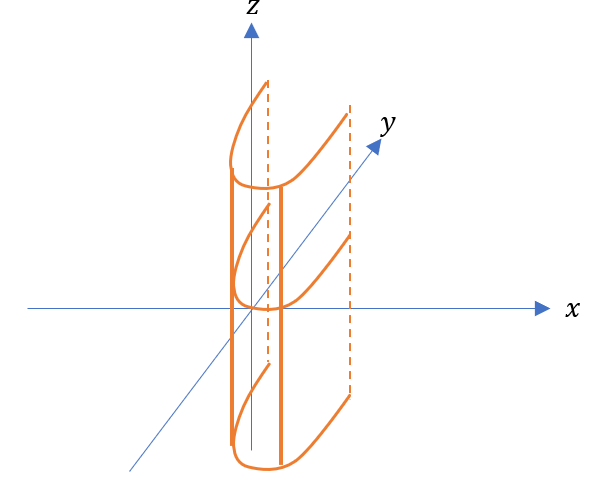
Describe the surface represented by the equation y=x2y=x^2 in R3R^3
In the R2R^2 space, y=x2y=x^2 describes a parabola with vertex at the origin (0, 0)
So, in R3R^3 space, this describes the stack of identical parabolas with vertices on the z-axis
0:00 / 0:00

Vectors

[Everything we discuss in this lesson applies to vectors in any space RnR^n]

A vector in R3R^3 is represented by v=x,y,z\vec{v}=\left\langle x,y,z\right\rangle
*x,y,zx, y, z are called the components of this vector

Geometrically

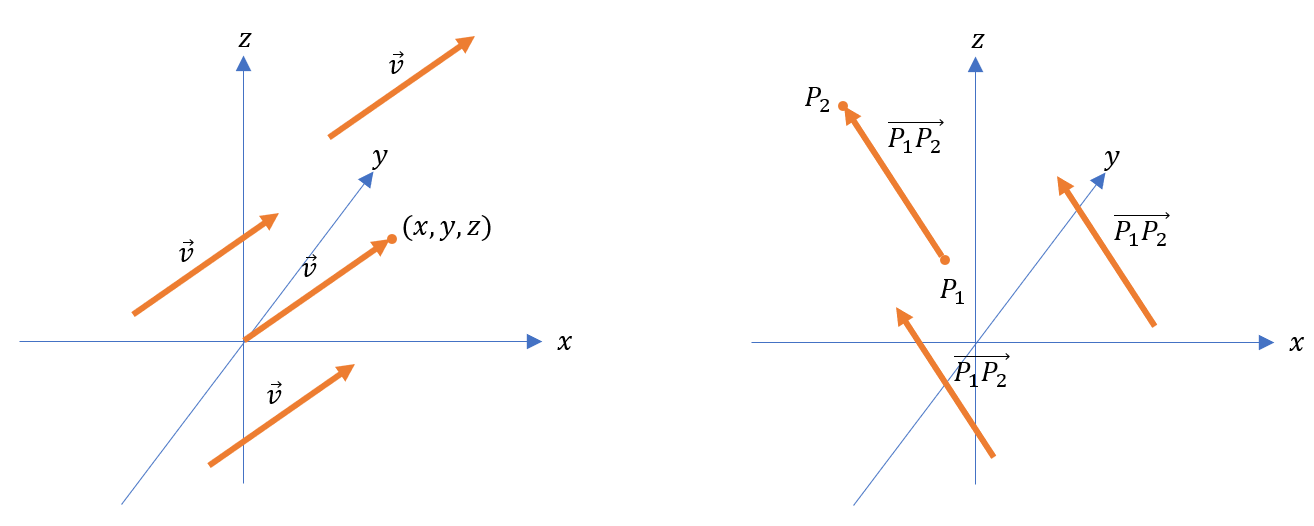
A vector v=x,y,z\vec{v}=\left\langle x,y,z\right\rangle is a directed line segment that goes from the origin (0,0,0)(0,0,0) and points to the point (x,y,z)(x,y,z), but this line segment (vector) can be moved around in space

Given any two points P1(x1,y1,z1)P_1\left(x_1,y_1,z_1\right) and P2(x2,y2,z2)P_2\left(x_2,y_2,z_2\right), the position vector P1P2=x2x1, y2y1, z2z1\overrightarrow{P_1P_2}=\left\langle x_2-x_1,\ y_2-y_1,\ z_2-z_1\right\rangle is the vector that starts at P1P_1 and points to P2P_2

Vector Operations

  • Length of a vector: a,b,c=a2+b2+c2\left|\left\langle a,b,c\right\rangle\right|=\sqrt{a^2+b^2+c^2}
  • Scalar multiplication: ka,b,c=ka, kb, kck\left\langle a,b,c\right\rangle=\left\langle ka,\ kb,\ kc\right\rangle
  • Vector addition/subtraction: a,b,c±p,q,r=a±p, b±q, c±r\left\langle a,b,c\right\rangle\pm\left\langle p,q,r\right\rangle=\left\langle a\pm p,\ b\pm q,\ c\pm r\right\rangle
  • A unit vector in the same direction as v\vec{v} is defined as vv\frac{\vec{v}}{\left|\vec{v}\right|}
PAGE BREAK

Properties

u, v, w\vec{u},\ \vec{v},\ \vec{w} are vectors in R3R^3 and c, dc,\ d are scalars
Additionu+v=v+uu+(v+w)=(u+v)+wScalar Multiplication(cd)u=c(du)c(u+v)=cu+cv(c+d)u=cu+duThe 0 and 1 in Vectors1u=uu+(u)=0u+0=u where 0=0,0,0\begin{array}{|lll|} \hline \underline{\text{Addition}}\\ \vec{u}+\vec{v}=\vec{v}+\vec{u}& \vec{u}+\left(\vec{v}+\vec{w}\right)=\left(\vec{u}+\vec{v}\right)+\vec{w}\\\\ \hline \underline{\text{Scalar Multiplication}}\\ \left(cd\right)\vec{u}=c\left(d\vec{u}\right)& c\left(\vec{u}+\vec{v}\right)=c\vec{u}+c\vec{v}& \left(c+d\right)\vec{u}=c\vec{u}+d\vec{u}\\\\ \hline \underline{\text{The 0 and 1 in Vectors}}\\ 1\vec u=\vec u&\vec u+(-\vec u)=\vec 0&\vec{u}+\vec{0}=\vec{u}\text{ where }\vec 0=\langle0,0,0\rangle\\\\\hline \end{array}

Standard basis vectors

These are vectors with length 1 (unit vector) that point in the direction along the positive x, y, z axes
  • i=1,0,0i=\left\langle1,0,0\right\rangle
  • j=0,1,0j=\left\langle0,1,0\right\rangle
  • k=0,0,1k=\left\langle0,0,1\right\rangle
0:00 / 0:00

Dot Product

The dot product between two vectors in R3R^3 is defined as a,b,cp,q,r=ap+bq+cr\left\langle a,b,c\right\rangle\cdot\left\langle p,q,r\right\rangle=ap+bq+cr
*The result is a number!

Properties

  1. uv=vu\vec{u}\cdot\vec{v}=\vec{v}\cdot\vec{u}
  2. u(v+w)=uv+uw\vec{u}\cdot\left(\vec{v}+\vec{w}\right)=\vec{u}\cdot\vec{v}+\vec{u}\cdot\vec{w}
  3. (cu)v=c(uv)=u(cv)\left(c\vec{u}\right)\cdot\vec{v}=c\left(\vec{u}\cdot\vec{v}\right)=\vec{u}\cdot\left(c\vec{v}\right)
  4. uu=u2\vec{u}\cdot\vec{u}=\left|\vec{u}\right|^2
  5. 0u=0\vec{0}\cdot\vec{u}=0
  6. cosθ=uvuv\cos\theta=\frac{\vec{u}\cdot\vec{v}}{\left|\vec{u}\right|\left|\vec{v}\right|} where θ\theta is the acute angle between the vectors
Example
If u=1,3,6\vec{u}=\left\langle1,3,\sqrt 6\right\rangle and v=3,0,4\vec{v}=\left\langle3,0,-4\right\rangle, find the cosine of the angle between these two vectors.
cosθ=1,3,63,0,41,3,63,0,4=346(4)(5)=34620\displaystyle \cos\theta=\frac{\left\langle1,3,\sqrt{6}\right\rangle\cdot\left\langle3,0,-4\right\rangle}{\left|\left\langle1,3,\sqrt{6}\right\rangle\right|\left|\left\langle3,0,-4\right\rangle\right|}=\frac{3-4\sqrt 6}{(4)(5)}=\frac{3-4\sqrt 6}{20}


Orthogonal Vectors

Two vectors are orthogonal (perpendicular) if and only if their dot product is 0


PAGE BREAK

Directional Cosines & Angles

The angle that a non-zero vector v=a,b,c\vec{v}=\left\langle a,b,c\right\rangle forms with the x, y, and z axes are given below
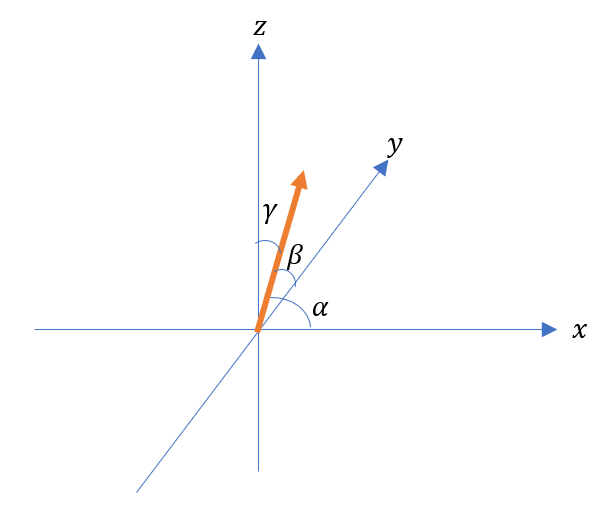
  • cosα=av\cos\alpha=\frac{a}{\left|\vec{v}\right|}  α=cos1(av)\to\ \alpha=\cos^{-1}\left(\frac{a}{\left|\vec{v}\right|}\right)
  • cosβ=bv\cos\beta=\frac{b}{\left|\vec{v}\right|}  β=cos1(bv)\to\ \beta=\cos^{-1}\left(\frac{b}{\left|\vec{v}\right|}\right)
  • cosγ=cv\cos\gamma=\frac{c}{\left|\vec{v}\right|}  γ=cos1(cv)\to\ \gamma=\cos^{-1}\left(\frac{c}{\left|\vec{v}\right|}\right)

PAGE BREAK

Projections

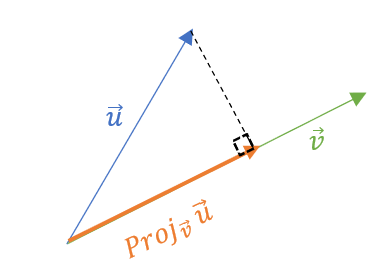
The projection of u\vec{u} onto v\vec{v} is denoted by projvu\text{proj}_{\vec{v}}\vec{u}, and it describes the "shadow" u\vec{u} casts on v\vec{v}
  • Vector projection: projvu=(vuv2)v\displaystyle \operatorname{proj}_{\vec{v}}\vec{u}=\left(\frac{\vec{v}\cdot\vec{u}}{\left|\vec{v}\right|^2}\right)\vec{v}
  • Scalar projection (length of the projection): compvu=vuv\displaystyle \text{comp}_{\vec{v}}\vec{u}=\frac{\vec{v}\cdot\vec{u}}{\left|\vec{v}\right|}
Example
Find the projection of 1,2,3\left\langle1,2,3\right\rangle onto 4,0,1\left\langle4,0,-1\right\rangle
The vector projection is: proj4,0,11,2,3=(117)4,0,1 or 417,0,117\operatorname{proj}_{\left\langle4,0,-1\right\rangle}\left\langle1,2,3\right\rangle=\left(\frac{1}{17}\right)\left\langle4,0,-1\right\rangle\ or\ \left\langle\frac{4}{17},0,-\frac{1}{17}\right\rangle

The scalar projection is comp4,0,11,2,3=117\text{comp}_{\left\langle4,0,1\right\rangle}\left\langle1,2,3\right\rangle=\frac{1}{17}
0:00 / 0:00

Cross Product

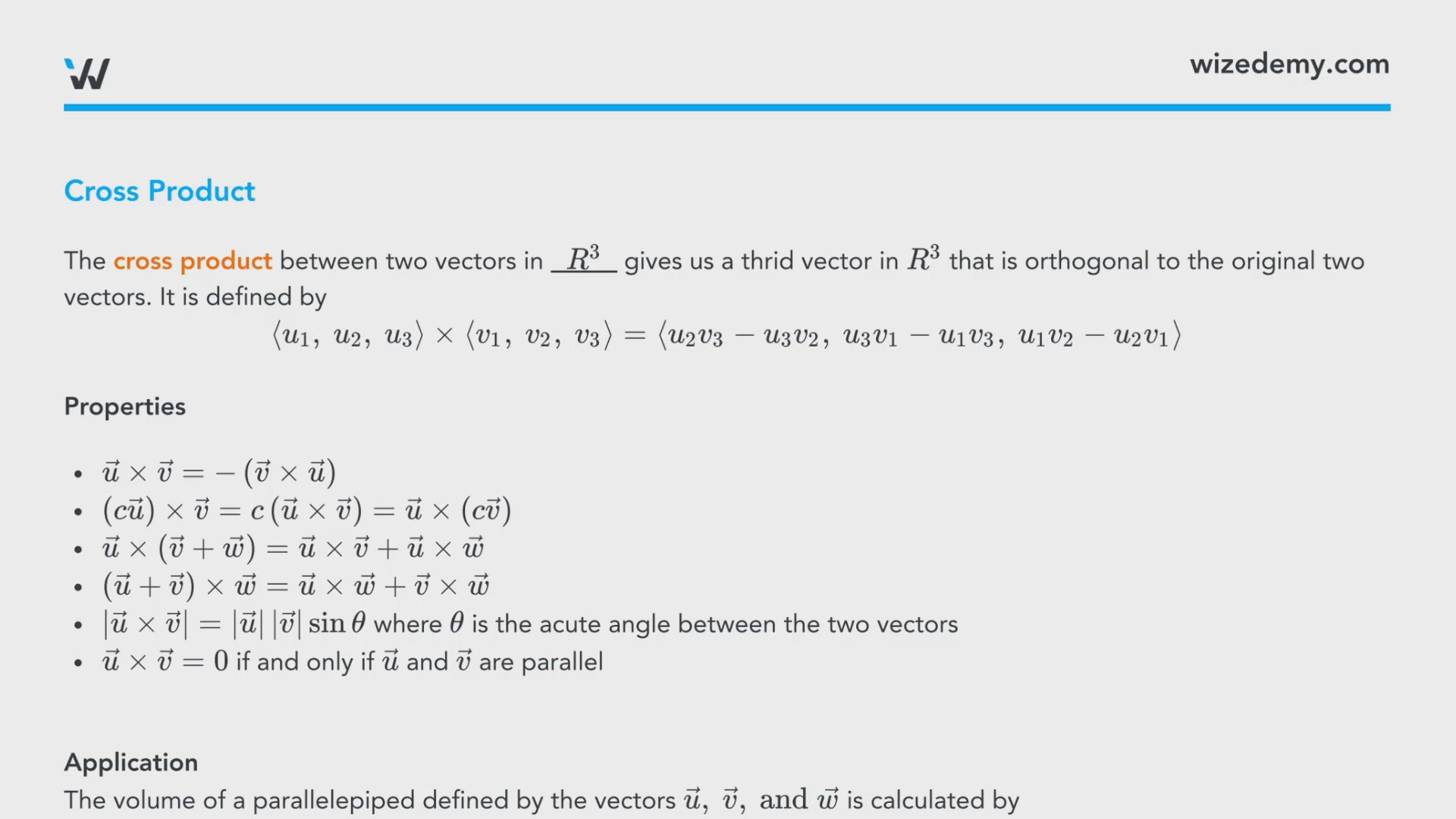
The cross product between two vectors in   R3  \underline{\ \ R^3\ \ } gives us a thrid vector in R3R^3 that is orthogonal to the original two vectors. It is defined by
u1, u2, u3×v1, v2, v3=u2v3u3v2, u3v1u1v3, u1v2u2v1\left\langle u_1,\ u_2,\ u_3\right\rangle\times\left\langle v_1,\ v_2,\ v_3\right\rangle=\left\langle u_2v_3-u_3v_2,\ u_3v_1-u_1v_3,\ u_1v_2-u_2v_1\right\rangle

Properties

  • u×v=(v×u)\vec{u}\times\vec{v}=-\left(\vec{v}\times\vec{u}\right)
  • (cu)×v=c(u×v)=u×(cv)\left(c\vec{u}\right)\times\vec{v}=c\left(\vec{u}\times\vec{v}\right)=\vec{u}\times\left(c\vec{v}\right)
  • u×(v+w)=u×v+u×w\vec{u}\times\left(\vec{v}+\vec{w}\right)=\vec{u}\times\vec{v}+\vec{u}\times\vec{w}
  • (u+v)×w=u×w+v×w\left(\vec{u}+\vec{v}\right)\times\vec{w}=\vec{u}\times\vec{w}+\vec{v}\times\vec{w}
  • u×v=uvsinθ\left|\vec{u}\times\vec{v}\right|=\left|\vec{u}\right|\left|\vec{v}\right|\sin\theta where θ\theta is the acute angle between the two vectors
  • u×v=0\vec{u}\times\vec{v}=0 if and only if u\vec{u} and v\vec{v} are parallel

Application

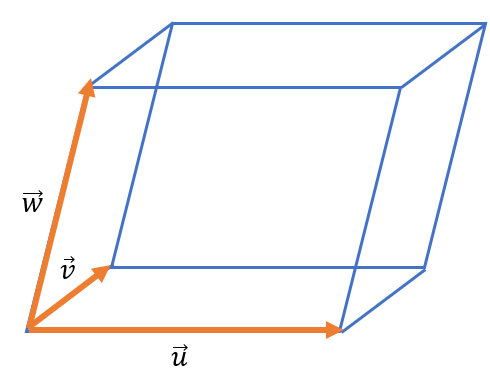
The volume of a parallelepiped defined by the vectors u, v, and w\vec{u},\ \vec{v},\ \text{and}\ \vec{w} is calculated by
V=u(v×w)V=\left|\vec{u}\cdot\left(\vec{v}\times\vec{w}\right)\right|
*Choose the simpler looking vectors to perform the cross product

Example
Find the volume of the parallelpiped defined by the vecotrs 1,2,0, 1,4,5, 0,1,1\left\langle1,2,0\right\rangle,\ \left\langle-1,4,5\right\rangle,\ \left\langle0,1,1\right\rangle
V=1,4,5(1,2,0×0,1,1)V=\left|\left\langle-1,4,5\right\rangle\cdot(\langle1,2,0\rangle\times\langle0,1,1\rangle)\right|
V=1,4,52,1,1V=\left|\left\langle-1,4,5\right\rangle\cdot\left\langle2,-1,1\right\rangle\right|
V= 1V=\ \left|-1\right|
V=1V=1
0:00 / 0:00

Equations of Lines & Planes

The equation of a line or plane gives us all the points on that line or plane

Lines in R3

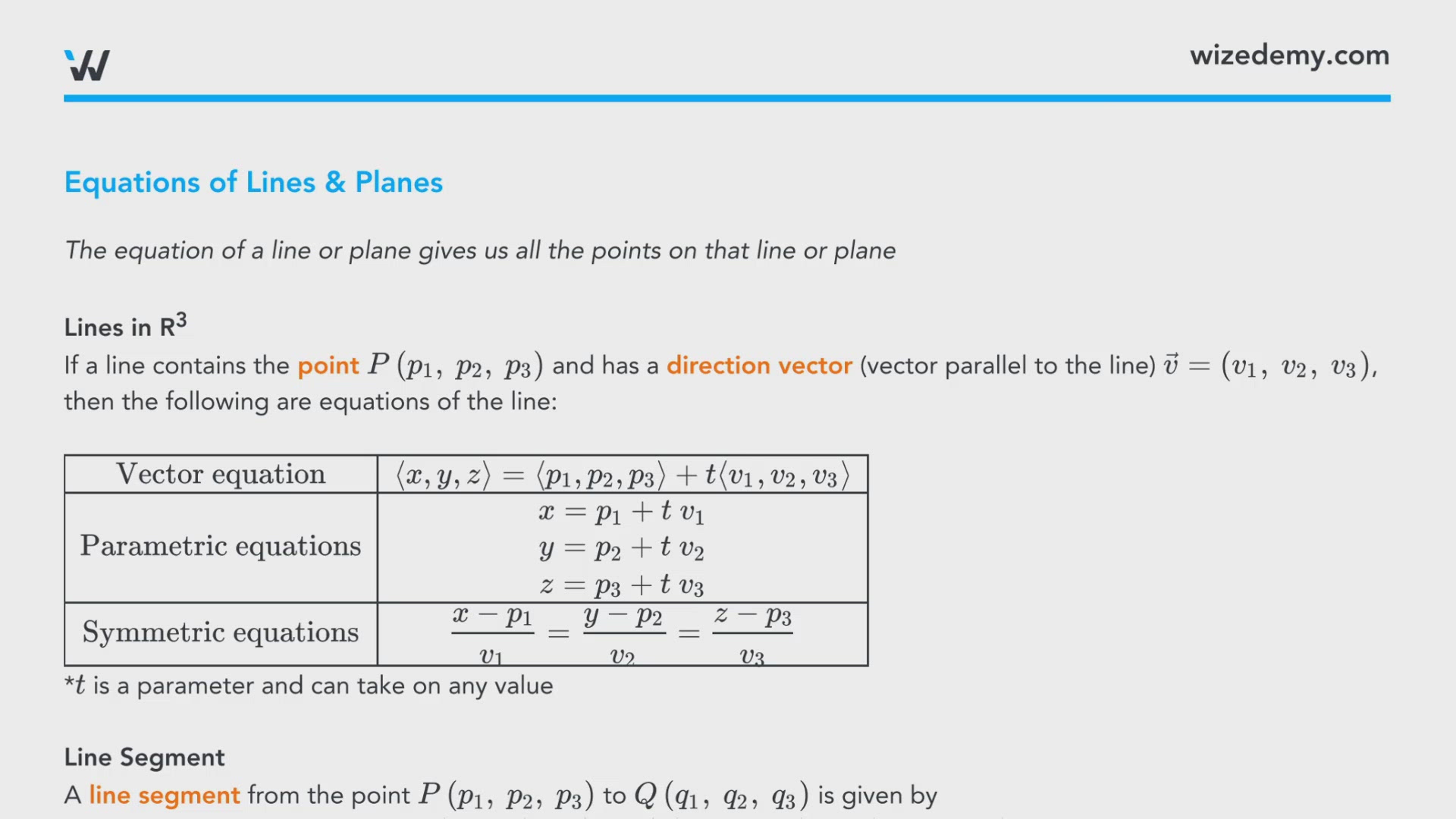
If a line contains the point P(p1, p2, p3)P\left(p_1,\ p_2,\ p_3\right) and has a direction vector (vector parallel to the line) v=(v1, v2, v3)\vec{v}=\left(v_1,\ v_2,\ v_3\right), then the following are equations of the line:

Vector equationx,y,z=p1,p2,p3+tv1,v2,v3Parametric equationsx=p1+t v1y=p2+t v2z=p3+t v3Symmetric equationsxp1v1=yp2v2=zp3v3\begin{array}{|c|c|} \hline \text{Vector equation}&\langle x,y,z\rangle=\langle p_1,p_2,p_3\rangle+t\langle v_1,v_2,v_3\rangle\\ \hline \text{Parametric equations}&\begin{array}{c}x=p_1+t \ v_1\\y=p_2+t \ v_2\\z=p_3+t \ v_3\end{array}\\ \hline \text{Symmetric equations}&\displaystyle \frac{x-p_1}{v_1}=\frac{y-p_2}{v_2}=\frac{z-p_3}{v_3}\\ \hline \end{array}
*tt is a parameter and can take on any value

Line Segment

A line segment from the point P(p1, p2, p3)P\left(p_1,\ p_2,\ p_3\right) to Q(q1, q2, q3)Q\left(q_1,\ q_2,\ q_3\right) is given by
x,y,z=(1t)p1, p2, p3+tq1, q2, q3\left\langle x,y,z\right\rangle=\left(1-t\right)\left\langle p_{1,}\ p_2,\ p_3\right\rangle+t\left\langle q_1,\ q_2,\ q_3\right\rangle
where 0t10\le t\le1

Example
a.) Find the equation of the line that passes through the point (1,2,3)\left(1,2,3\right) and is parallel to the line 0,1,3+s2,6,4\left\langle0,-1,3\right\rangle+s\left\langle2,6,-4\right\rangle
We need a point on the line and the direction vector of the line:
  • Point: (1,2,3)(1,2,3)
  • Direction vector: any vector parallel to 2,6,4\left\langle2,6,-4\right\rangle --> 1,3,2\left\langle1,3,-2\right\rangle
The vector equation of the line is 1,2,3+t1,3,2\left\langle1,2,3\right\rangle+t\left\langle1,3,-2\right\rangle
The parametric equations are x=1+t, y=2+3t, z=32tx=1+t,\ y=2+3t,\ z=3-2t
The symmetric equations are x11=y23=z32\frac{x-1}{1}=\frac{y-2}{3}=\frac{z-3}{-2}

b.) Determine if the point (3,8,1)\left(3,8,1\right) is on the line described in part a.)
Solving the parametric equations, we get
  • 3=1+tt=23=1+t\to t=2
  • 8=2+3tt=28=2+3t\to t=2
  • 1=32tt=11=3-2t\to t=1
Since not all of the equations result in the same t value, the point is not on the line.
PAGE BREAK

Planes in R3

If a line contains the point P(p1, p2, p3)P\left(p_1,\ p_2,\ p_3\right) and has a normal vector (vector orthogonal to the plane) n=a, b, c\vec{n}=\left\langle a,\ b,\ c\right\rangle, then the following are equations of the plane:
Vector Equation/Point-Normal Forma, b, c(x, y, zp1, p2, p3)=0Scalar Equation/Standard forma(xp1)+b(yp2)+c(zp3)=0orax+by+cz+d=0, where d=a,b,cp1,p2,p3\begin{array}{|c|c|} \hline \begin{array}{c}\text{Vector Equation/}\\\text{Point-Normal Form}\end{array}&\langle a,\ b,\ c\rangle\cdot (\langle x,\ y,\ z\rangle-\langle p_1,\ p_2,\ p_3\rangle)=0\\ \hline \begin{array}{c}\text{Scalar Equation/}\\\text{Standard form}\end{array}&\begin{array}{c}a(x-p_1)+b(y-p_2)+c(z-p_3)=0\\\text{or}\\ax+by+cz+d=0\text{, where }d=-\langle a,b,c\rangle\cdot\langle p_1,p_2,p_3\rangle\end{array}\\\hline \end{array}

Distance

The distance from a point (p1, p2, p3)(p_1,\ p_2,\ p_3) to the plane ax+by+cz+d=0ax+by+cz+d=0 is
D=a(p1)+b(p2)+c(p3)+da2+b2+c2\displaystyle D=\frac{\left|a\left(p_1\right)+b\left(p_2\right)+c\left(p_3\right)+d\right|}{\sqrt{a^2+b^2+c^2}}

Example
a. Find the equation of the plane that contains the points A(0, 2, 1)A\left(0,\ 2,\ 1\right), B(1, 1, 2)B\left(1,\ 1,\ 2\right) and C(1, 0, 1)C\left(1,\ 0,\ 1\right)
b. Find the distance between the point (1, 1, 1)\left(1,\ 1,\ 1\right) and the plane found in part a.)

a. AB=1, 1, 1\overrightarrow{AB}=\left\langle1,\ -1,\ 1\right\rangle and AC=1,2,0\overrightarrow{AC}=\left\langle1,-2,0\right\rangle are direction vectors parallel to the plane.
To find the normal vector to the plane, we find AB×AC=2,1,1\overrightarrow{AB}\times\overrightarrow{AC}=\left\langle2,1,-1\right\rangle
We can pick any one of the 3 given points to use in our equation of the plane: 2x+yz2,1,10,2,1=02x+y-z-\left\langle2,1,-1\right\rangle\cdot\left\langle0,2,1\right\rangle=0
Therefore, the equation of the plane is 2x+yz=12x+y-z=1

b. Using the distance formula: D=2(1)+(1)(1)122+12+12=16D=\frac{\left|2\left(1\right)+\left(1\right)-\left(1\right)-1\right|}{\sqrt{2^2+1^2+1^2}}=\frac{1}{\sqrt{6}}

Cylinder & Quadric Surfaces

Cylinders

Cylinders are 3D surfaces that have uniform cross sections.

Examples


Although not always true, typically, the equations will only involve 2 variables. For example
  • y=x2y=x^2
  • z=x2+5z=x^2+5
  • y2+z2=4y^2+z^2=4
PAGE BREAK

Quadric Surfaces

In 3D space, quadric surfaces are a set of points with general (x,y,z)(x,y,z) coordinates satisfying a polynomial equation. We can sketch these surfaces by using traces which are curves generated by intersection of the surface with the planes parallel to the coordinate planes.
This will allow us to classify the surfaces using the following table from your textbook:

  • Traces are also known as level surface. To find level surfaces you should takes one variable constant. For example, if we take z=kz=k, then we will have a curve in the plane z=kz=k.

0:00 / 0:00
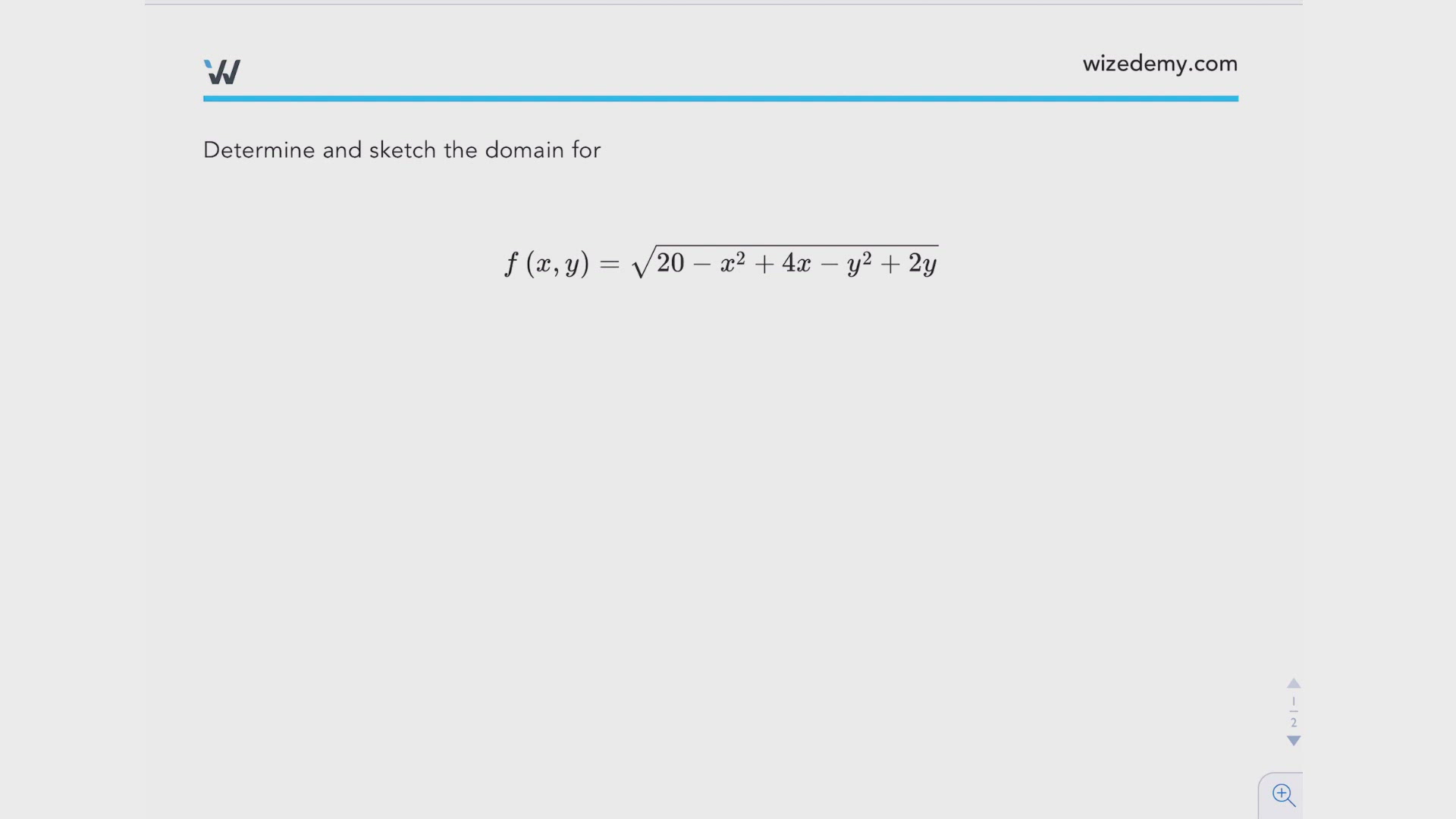
Determine and sketch the domain for

f(x,y)=20x2+4xy2+2yf\left(x,y\right)=\sqrt{20-x^2+4x-y^2+2y}

z=20x2+4xy2+2yz=\sqrt{20-x^2+4x-y^2+2y}
 z2=20x2+4xy2+2y\Rightarrow\ z^2=20-x^2+4x-y^2+2y

from complete square method:
x2+ax=(x+a2)2a24x^2+ax=\left(x+\frac{a}{2}\right)^{^2}-\frac{a^2}{4}

 z2=20(x2)2+4(y1)2+1\Rightarrow\ z^2=20-(x-2)^2+4-(y-1)^2+1
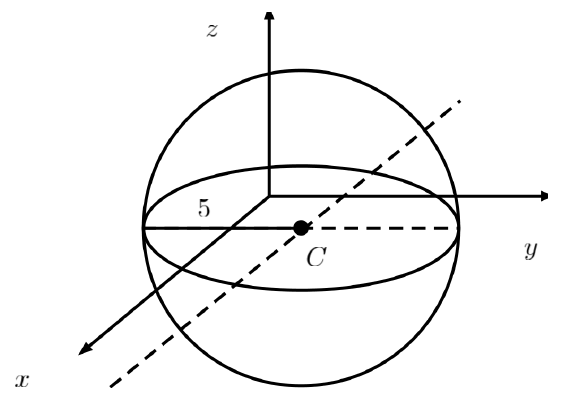
 z2+(x2)2+(y1)2=25\Rightarrow\ z^2+(x-2)^2+(y-1)^2=25

Sphere with center C=(2,1,0)C=(2,1,0), with radius R=5R=5


0:00 / 0:00
Find the equation of a sphere with centre C(3,5,2)C\left(3,-5,-2\right) and radius 7. What is the intersection of this sphere with the xyxy-plane?

Generally (xa)2+(yb)2+(zc)2=R2(x-a)^2+(y-b)^2+(z-c)^2=R^2, C(a,b,c)C(a,b,c)
 (x3)2+(y+5)2+(z+2)2=49\Rightarrow\ (x-3)^2+(y+5)^2+(z+2)^2=49
xyxy-plain: z=0z=0
(x3)2+(y+5)2+22=49(x3)2+(y+5)2=45\Rightarrow (x-3)^2+(y+5)^2+2^2=49 \Rightarrow (x-3)^2+(y+5)^2=45

this is a circle at C(3,5)C(3,-5)with radius R=45R=\sqrt{45}.

Cylindrical & Spherical Coordinates

In 3-space, a point can be represented using the Cartesian coordinates (x,y,z)(x,y,z).

Cylindrical Coordinates

If we rewrite the coordinates of this point (x,y,z)(x,y,z) on the xy-plane into polar coordinates and keep the z coordinate as our height, we get cylindfrical coordinates.
  • θ\theta is the angle measured counter clockwise from the positive x-axis to the point (x,y)(x,y) on the xy-plane
  • rr is the length of the line segment from the origin to the point (x,y)(x,y) on the xy-plane
  • zz is the "height" of the point (the original z-coordinate)

Cylindrical ➡ Cartesian coordinates: x=rcosθ       y=rsinθ       z=z\boxed{x=r\cos\theta~~~~~~~y=r\sin\theta~~~~~~~z=z}

Cartesian ➡ Cylindrical coordinates: r2=x2+y2       tanθ=yx       z=z\boxed{r^2=x^2+y^2~~~~~~~\tan\theta=\dfrac{y}{x}~~~~~~~z=z}

PAGE BREAK

Spherical Coordinates

If we draw a line segment connecting our point (x,y,z)(x,y,z) to the origin, and measure the angle this line makes with the positive z-axis, we get spherical coordinates.
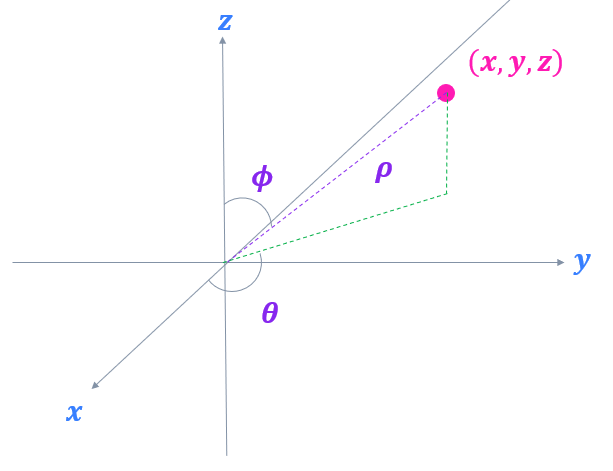
  • θ\theta is the angle measured counter clockwise from the positive x-axis to the point (x,y)(x,y) on the xy-plane
  • ρ\rho is the length of the line segment connecting the origin to the point (x,y,z)(x,y,z) in R3
  • ϕ\phi is the angle that is between 0 and π\pi measured from the positive z-axis to the line segment connecting the origin to the point (x,y,z)(x,y,z)
Spherical ➡ Cartesian coordinates: x=ρsinϕcosθ       y=ρsinϕsinθ       z=ρcosθ\boxed{x=\rho\sin\phi\cos\theta~~~~~~~y=\rho\sin\phi\sin\theta~~~~~~~z=\rho\cos\theta}

We also know that