0:00 / 0:00

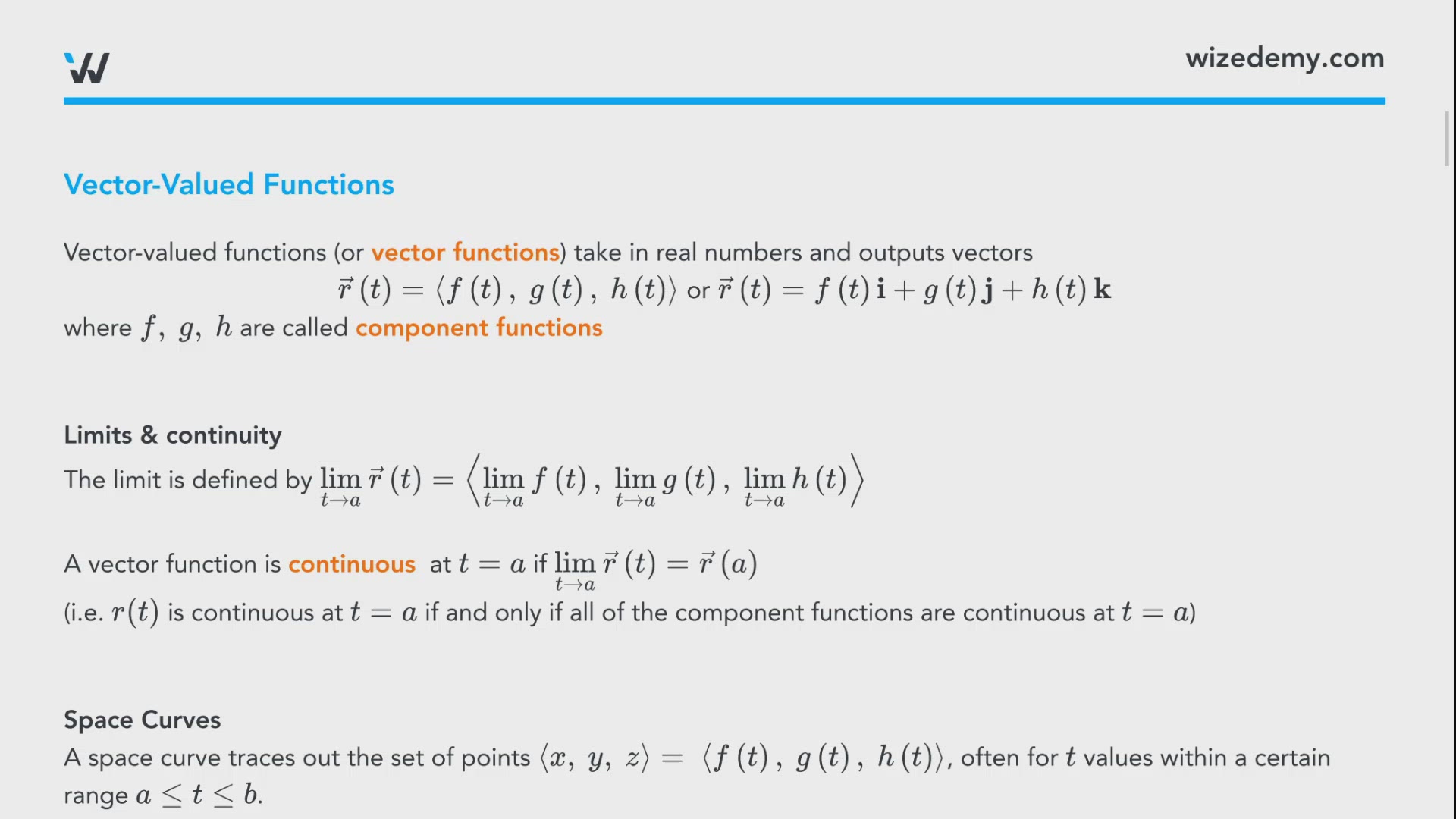
Vector-Valued Functions

Vector-valued functions (or vector functions) take in real numbers and outputs vectors
r(t)=f(t), g(t), h(t)\vec r\left(t\right)=\left\langle f\left(t\right),\ g\left(t\right),\ h\left(t\right)\right\rangle or r(t)=f(t)i+g(t)j+h(t)k\vec{r}\left(t\right)=f\left(t\right)\bold{i}+g\left(t\right)\bold{j}+h\left(t\right)\bold{k}
where f, g, hf,\ g,\ h are called component functions


Limits & continuity

The limit is defined by limtar(t)=limtaf(t), limtag(t), limtah(t)\displaystyle \lim_{t\to a}\vec r\left(t\right)=\left\langle\lim_{t\to a}f\left(t\right),\ \lim_{t\to a}g\left(t\right),\ \lim_{t\to a}h\left(t\right)\right\rangle

A vector function is continuous at t=at=a if limtar(t)=r(a)\displaystyle \lim_{t\to a}\vec r\left(t\right)=\vec r\left(a\right)
(i.e. r(t)r(t) is continuous at t=at=a if and only if all of the component functions are continuous at t=at=a)


Space Curves

A space curve traces out the set of points x, y, z= f(t), g(t), h(t)\left\langle x,\ y,\ z\right\rangle=\ \left\langle f\left(t\right),\ g\left(t\right),\ h\left(t\right)\right\rangle, often for tt values within a certain range atba\le t\le b.


Sometimes the question will give you two different versions of the same vector function, or they will ask kyou to rewrite the vector function using different component functions. This is called reparametrization of the curve

Example
r(t)=t, 2t, 3t\vec{r}\left(t\right)=\left\langle t,\ 2t,\ 3t\right\rangle, 0t10\le t\le1 and r(s)=s14, 2s14, 3s14\vec{r}\left(s\right)=\left\langle\frac{s}{\sqrt{14}},\ \frac{2s}{\sqrt{14}},\ \frac{3s}{\sqrt{14}}\right\rangle, 0s140\le s\le\sqrt{14} are two parametrizations of the same space curve.
PAGE BREAK

Derivatives

The derivative or tangent vector to the curve at the point tt is defined by
drdt or r(t)=limh0r(t+h)r(t)h=f(t), g(t), h(t)\displaystyle \frac{d\vec r}{dt}\ \text{or}\ \vec r'\left(t\right)=\lim_{h\to0}\frac{\vec r\left(t+h\right)-\vec r\left(t\right)}{h}=\langle f'(t),\ g'(t),\ h'(t)\rangle


Derivative Rules

  • ddt[u(t)±v(t)]=u(t)+v(t)\displaystyle \frac{d}{dt}\left[\vec{u}\left(t\right)\pm\vec{v}\left(t\right)\right]=\vec{u}'\left(t\right)+\vec{v}'\left(t\right)
  • ddt[cu(t)]=cu(t)\displaystyle \frac{d}{dt}\left[c\vec{u}\left(t\right)\right]=c\vec{u}'\left(t\right)
  • ddt[u(t) v(t)]=u(t) v(t)+u(t) v(t)\displaystyle \frac{d}{dt}\left[\vec{u}\left(t\right)\ \vec{v}\left(t\right)\right]=\vec{u}'\left(t\right)\ \vec{v}\left(t\right)+\vec{u}\left(t\right)\ \vec{v}'\left(t\right) *this rule is true for dot and cross products as well
  • ddt[u(f(t))]=u(f(t)) f(t)\displaystyle \frac{d}{dt}\left[\vec{u}\left(f\left(t\right)\right)\right]=\vec{u}'\left(f\left(t\right)\right)\ f'\left(t\right)


Integrals

The indefinite integral is defined as
r(t)dt=f(t)dt,  g(t)dt,  h(t)dt\displaystyle \int \vec{r}\left(t\right)dt=\left\langle \int f\left(t\right)dt,\ \ \int g\left(t\right)dt,\ \ \int h\left(t\right)dt\right\rangle

*There will be a constant vector C\displaystyle \vec C at the end

The definite integral is defined as abr(t)dt=abf(t)dt,  abg(t)dt,  abh(t)dt\displaystyle \int _a^b\vec{r}\left(t\right)dt=\left\langle \int _a^bf\left(t\right)dt,\ \ \int _a^bg\left(t\right)dt,\ \ \int _a^bh\left(t\right)dt\right\rangle
0:00 / 0:00

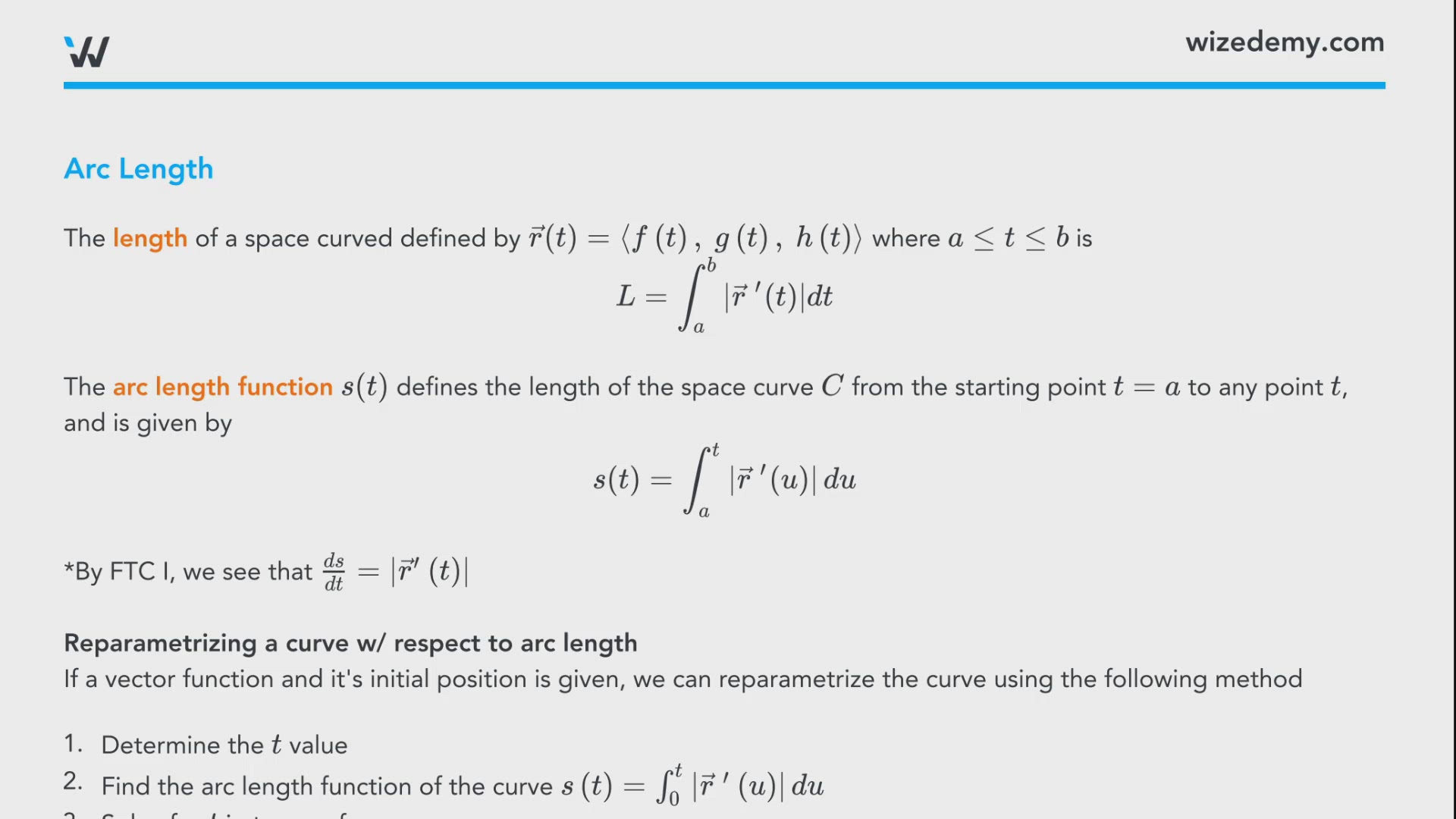
Arc Length

The length of a space curved defined by r(t)=f(t), g(t), h(t)\displaystyle \vec{r}(t)=\left\langle f\left(t\right),\ g\left(t\right),\ h\left(t\right)\right\rangle where atba\le t\le b is
L=abr (t)dt\displaystyle L=\int_a^b|\vec{r}\ '(t)|dt

The arc length function s(t)s(t) defines the length of the space curve CC from the starting point t=at=a to any point tt, and is given by
s(t)=atr (u)du\displaystyle s(t)=\int_a^t\left|\vec r\ '(u)\right|du

*By FTC I, we see that dsdt=r(t)\frac{ds}{dt}=\left|\vec{r}'\left(t\right)\right|

Reparametrizing a curve w/ respect to arc length

If a vector function and it's initial position is given, we can reparametrize the curve using the following method
  1. Determine the tt value
  2. Find the arc length function of the curve s(t)=0tr (u)dus\left(t\right)=\int_0^t\left|\vec{r}\ '\left(u\right)\right|du
  3. Solve for tt in terms of ss
  4. Replace tt in the vector function with this new ss expression, and change the initial bounds on tt to bounds on ss
Example
Reparamaterize the curve r(t)=etcosti+etsintj+k\vec{r}\left(t\right)=e^t\cos t\vec{i}+e^t\sin t\vec{j}+k with respect to the arc length starting from the point (1, 0, 1)\left(1,\ 0,\ 1\right)
1. The point (1, 0 ,1)\left(1,\ 0\ ,1\right) tells us that
  • etcost=1e^t\cos t=1
  • etsint=0e^t\sin t=0
  • 1=11=1
Meaning that our curve starts at t=0t=0.

2. We need the arc length function:
s(t)=0tr (u)dus\left(t\right)=\int_0^t\left|\vec{r}\ '\left(u\right)\right|du
s(t)=0teucosueusinu, eusinu+eucosu, 0 dus\left(t\right)=\int_0^t\left|\left\langle e^u\cos u-e^u\sin u,\ e^u\sin u+e^u\cos u,\ 0\right\rangle\right|\ du
s(t)=0t(eucosueusinu)2+(eusinu+eucosu)2+(0)2dus(t)=\int_0^t\sqrt{\left(e^u\cos u-e^u\sin u\right)^2+\left(e^u\sin u+e^u\cos u\right)^2+\left(0\right)^2}du
s(t)=0te2u(12cosusinu)+e2u(1+2sinucosu)dus\left(t\right)=\int_0^t\sqrt{e^{2u}\left(1-2\cos u\sin u\right)+e^{2u}\left(1+2\sin u\cos u\right)}du
s(t)=0t2e2udus\left(t\right)=\int_0^t\sqrt{2e^{2u}}du
s(t)=0t2eu dus(t)=\int_0^t\sqrt 2e^u\ du
s(t)=2et2s(t)=\sqrt 2e^t-\sqrt 2

3. Solving for tt:
s+22=et\frac{s+\sqrt{2}}{\sqrt{2}}=e^t
lns+22=t\ln\left|\frac{s+\sqrt{2}}{\sqrt{2}}\right|=t

4. Therefore,
r(t(s))=elns+22cos(lns+22)i+elns+22sin(lns+22)j+k\vec{r}\left(t\left(s\right)\right)=e^{\ln\left|\frac{s+\sqrt{2}}{\sqrt{2}}\right|}\cos\left(\ln\left|\frac{s+\sqrt{2}}{\sqrt{2}}\right|\right)\vec{i}+e^{\ln\left|\frac{s+\sqrt{2}}{\sqrt{2}}\right|}\sin\left(\ln\left|\frac{s+\sqrt{2}}{\sqrt{2}}\right|\right)\vec{j}+\vec{k}
r(t(s))=s+22cos(lns+22)i+s+22sin(lns+22)j+k\vec{r}\left(t\left(s\right)\right)=\frac{s+\sqrt{2}}{\sqrt{2}}\cos\left(\ln\left|\frac{s+\sqrt{2}}{\sqrt{2}}\right|\right)\vec{i}+\frac{s+\sqrt{2}}{\sqrt{2}}\sin\left(\ln\left|\frac{s+\sqrt{2}}{\sqrt{2}}\right|\right)\vec{j}+\vec{k}
where ss starts at 00
0:00 / 0:00

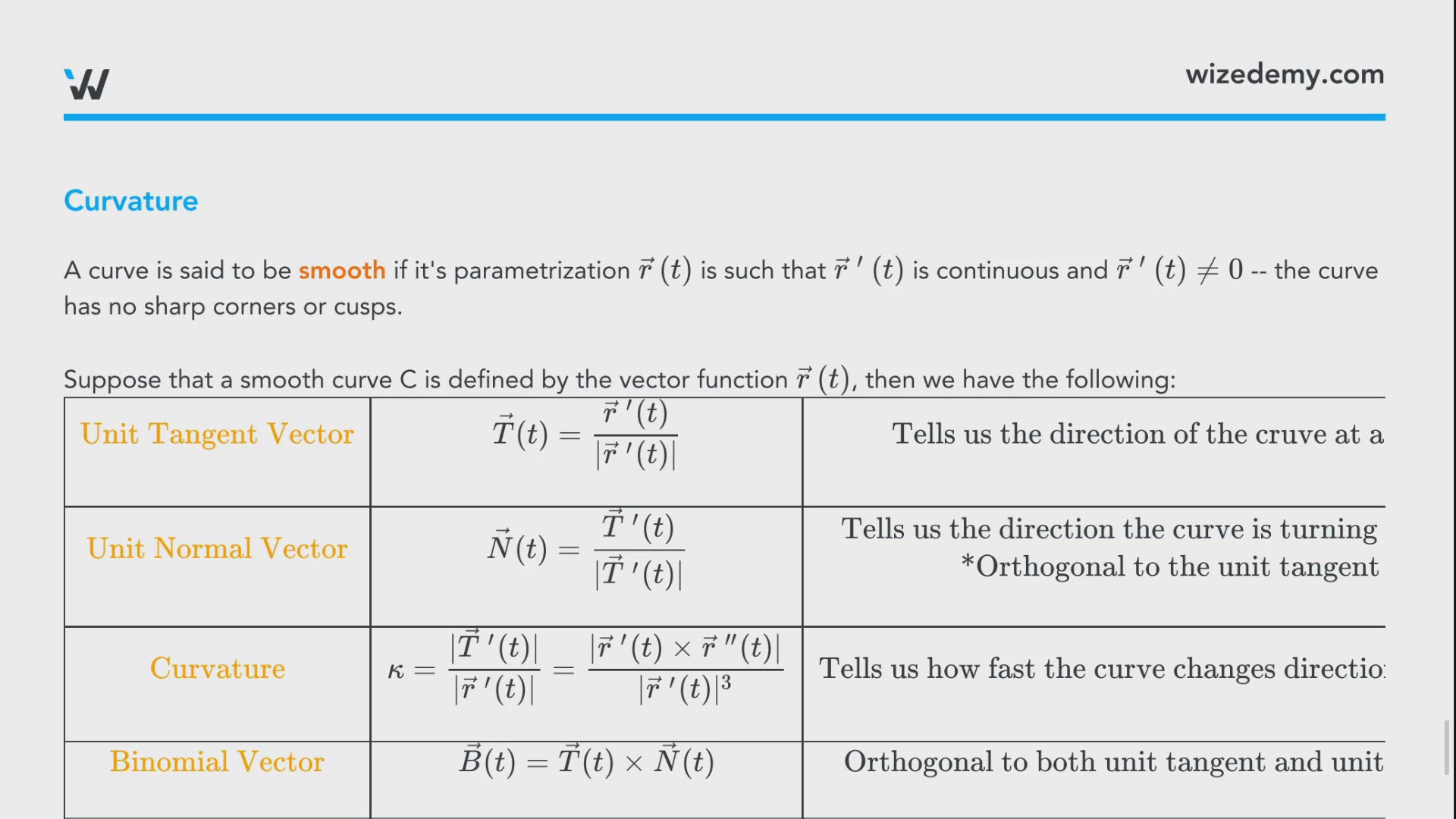
Curvature

A curve is said to be smooth if it's parametrization r(t)\vec{r}\left(t\right) is such that r (t)\vec{r}\ '\left(t\right) is continuous and r (t)0\vec{r}\ '\left(t\right)\ne0 -- the curve has no sharp corners or cusps.

Suppose that a smooth curve C is defined by the vector function r(t)\vec{r}\left(t\right), then we have the following:
Unit Tangent VectorT(t)=r (t)r (t)Tells us the direction of the cruve at a given pointUnit Normal VectorN(t)=T (t)T (t)Tells us the direction the curve is turning at a given point*Orthogonal to the unit tangent vectorCurvatureκ=T (t)r (t)=r (t)×r (t)r (t)3Tells us how fast the curve changes direction at a given pointBinomial VectorB(t)=T(t)×N(t)Orthogonal to both unit tangent and unit normal vectors\begin{array}{|c|c|c|} \hline \textcolor{orange}{\text{Unit Tangent Vector}}&\displaystyle\vec T(t)=\frac{\vec r\ '(t)}{|\vec r\ '(t)|}&\text{Tells us the direction of the cruve at a given point}\\\\ \hline \textcolor{orange}{\text{Unit Normal Vector}}&\displaystyle\vec N(t)=\frac{\vec T\ '(t)}{|\vec T\ '(t)|}&\begin{array}{c}\text{Tells us the direction the curve is turning at a given point}\\\text{*Orthogonal to the unit tangent vector}\end{array}\\\\ \hline \textcolor{orange}{\text{Curvature}}&\displaystyle \kappa =\frac{|\vec T\ '(t)|}{|\vec r\ '(t)|}=\frac{|\vec r\ '(t)\times\vec r\ ''(t)|}{|\vec r\ '(t)|^3}&\text{Tells us how fast the curve changes direction at a given point}\\\\ \hline \textcolor{orange}{\text{Binomial Vector}}&\displaystyle \vec B(t)=\vec T(t)\times\vec N(t)&\text{Orthogonal to both unit tangent and unit normal vectors}\\\\\hline \end{array}
  • Normal plane at a given point: the plane determined by N(t)\vec{N}\left(t\right) and B(t)\vec{B}\left(t\right)
  • Osculating plane at a given point: the plane determined by T(t)\vec{T}\left(t\right) and N(t)\vec{N}\left(t\right)
  • Osculating circle (or the circle of curvature) at a given point: best describes how the curve behaves near that point, and shares the same tangent, normal, and curvature at the point

Example
Find the unit tangent vector, curvature, and unit normal vector of the curve r(t)=3sint,3cost,4t\vec r(t)=\left\langle3\sin t,3\cos t,4t\right\rangle at the point (0,3,0)\left(0,3,0\right)

Unit Tangent Vector
At the point (0,3,0)(0,3,0), we can solve for t and get t=0t=0
  • r(t)=3cost,3sint,4\vec{r}'\left(t\right)=\left\langle3\cos t,-3\sin t,4\right\rangle
  • r(t)=9cos2t+9sin2t+16=25=5\left|\vec{r}'\left(t\right)\right|=\sqrt{9\cos^2t+9\sin^2t+16}=\sqrt{25}=5
So, the unit tangent vector is T(t)=3cost,3sint,45  T(0)= 35,0,45\vec{T}\left(t\right)=\frac{\left\langle3\cos t,-3\sin t,4\right\rangle}{5}\ \to\ \vec{T}\left(0\right)=\ \left\langle\frac{3}{5},0,\frac{4}{5}\right\rangle

Curvature
  • T(t)=35sint, 35cost, 0=925sin2t+925cos2t=35\left|\vec{T}'\left(t\right)\right|=\left|\left\langle-\frac{3}{5}\sin t,\ -\frac{3}{5}\cos t,\ 0\right\rangle\right|=\sqrt{\frac{9}{25}\sin^2t+\frac{9}{25}\cos^2t}=\frac{3}{5}
  • r(t)=5\left|\vec{r}'\left(t\right)\right|=5
So, the curvature is κ=355=325\kappa=\frac{\frac{3}{5}}{5}=\frac{3}{25}

Unit Normal Vector
  • T(t)=35sint,35cost,0\vec{T}'\left(t\right)=\left\langle-\frac{3}{5}\sin t,-\frac{3}{5}\cos t,0\right\rangle
  • T(t)=35\left|\vec{T}'\left(t\right)\right|=\frac{3}{5}
So, the unit normal vector is N(t)=35sint,35cost,035  N(0)=0,1,0\vec{N}\left(t\right)=\frac{\left\langle-\frac{3}{5}\sin t,-\frac{3}{5}\cos t,0\right\rangle}{\frac{3}{5}}\ \to\ \vec{N}\left(0\right)=\left\langle0,-1,0\right\rangle
Extra Practice