Popular Courses
Calculus 2
University Study Guides
Calculus 2
General Course
Calculus 2
University Study Guides
MATH 101A
University of British Columbia
SC/MATH 1014 3.00
York University
MATH 105
University of British Columbia
MATH 117
University of Waterloo
MATH 103
University of British Columbia
MATH 101B
University of British Columbia
MTH 240
Toronto Metropolitan University
MATH 101C
University of British Columbia
MATH 156
University of Alberta
MATH-1730
University of Windsor
MATH 146
University of Alberta
MATH 1700
University of Manitoba
MATH 119
University of Waterloo
MATH 1226
Virginia Tech
MATH 1LT3
McMaster University
MATH 10B
University of California - San Diego
MATH 1005
Carleton University
0:00 / 0:00
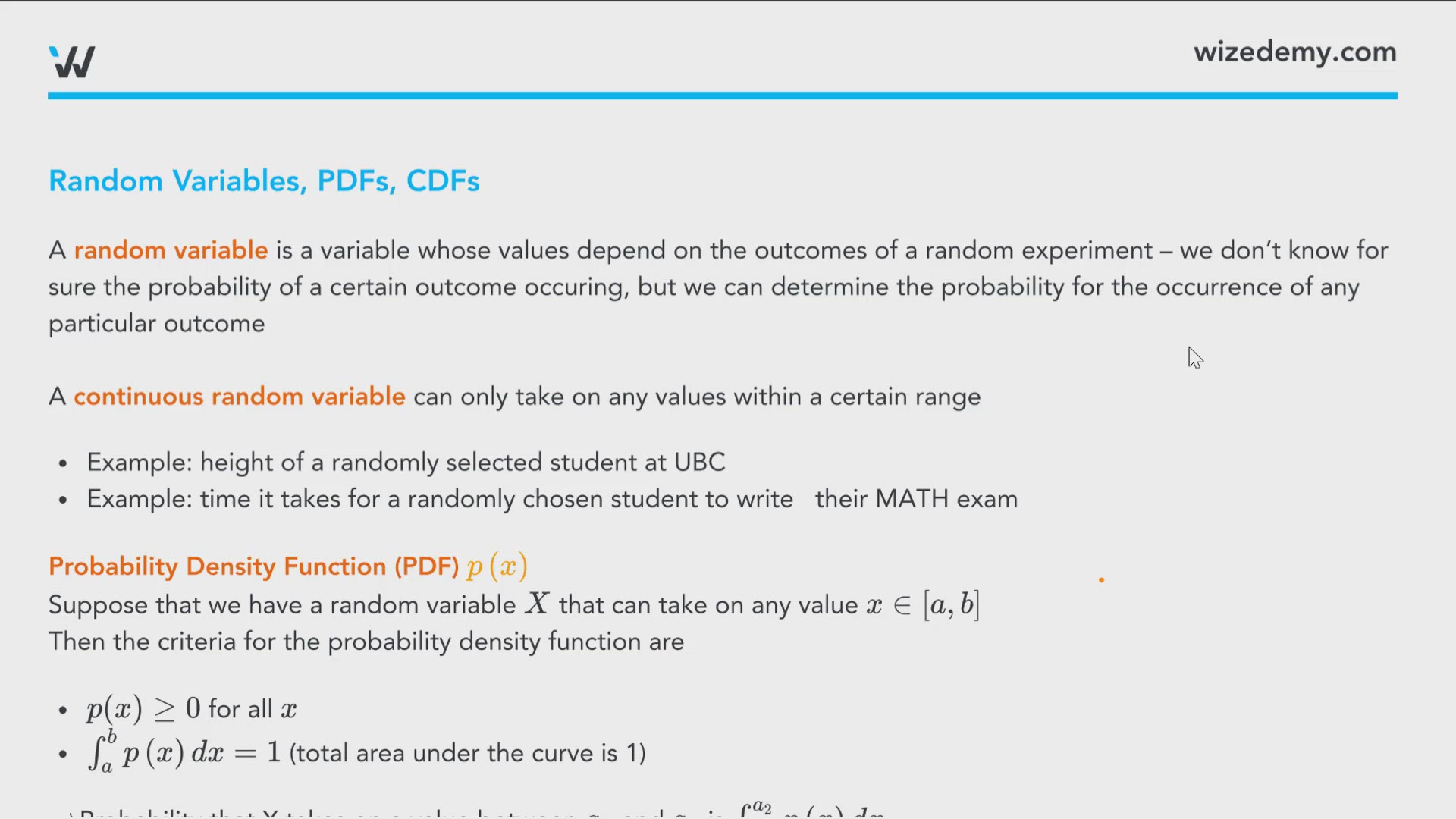
Random Variables, PDFs, CDFs
A random variable is a variable whose values depend on the outcomes of a random experiment – we don’t know for sure the probability of a certain outcome occuring, but we can determine the probability for the occurrence of any particular outcome
A continuous random variable can only take on any values within a certain range
- Example: height of a randomly selected student at UBC
- Example: time it takes for a randomly chosen student to write their MATH exam
Probability Density Function (PDF)
Suppose that we have a random variable that can take on any value
Then the criteria for the probability density function are
- for all
- (total area under the curve is 1)
Probability that X takes on a value between and is
Wize Tip
If the PDF is defined on the interval then
Cumulative Distribution Function (CDF)
The cumulative function represents the probability that the random variable takes on a value in the range
- is an increasing, continuous function
- By the Fundamental Theorem of Calculus I,
- By the Fundamental Theorem of Calculus II,
- Important properties: and
Wize Tip
If the PDF is defined on the interval , then and
Practice: PDF
Given the probability density function for ,
a. determine the value of such that is a proper probability density function.
b. what is the probability that ?
c. find the cumulative distribution function .
Practice: CDF
Find a, b, and k such that this is a valid cumulative distribution function
0:00 / 0:00
Mean, Median, and Variance
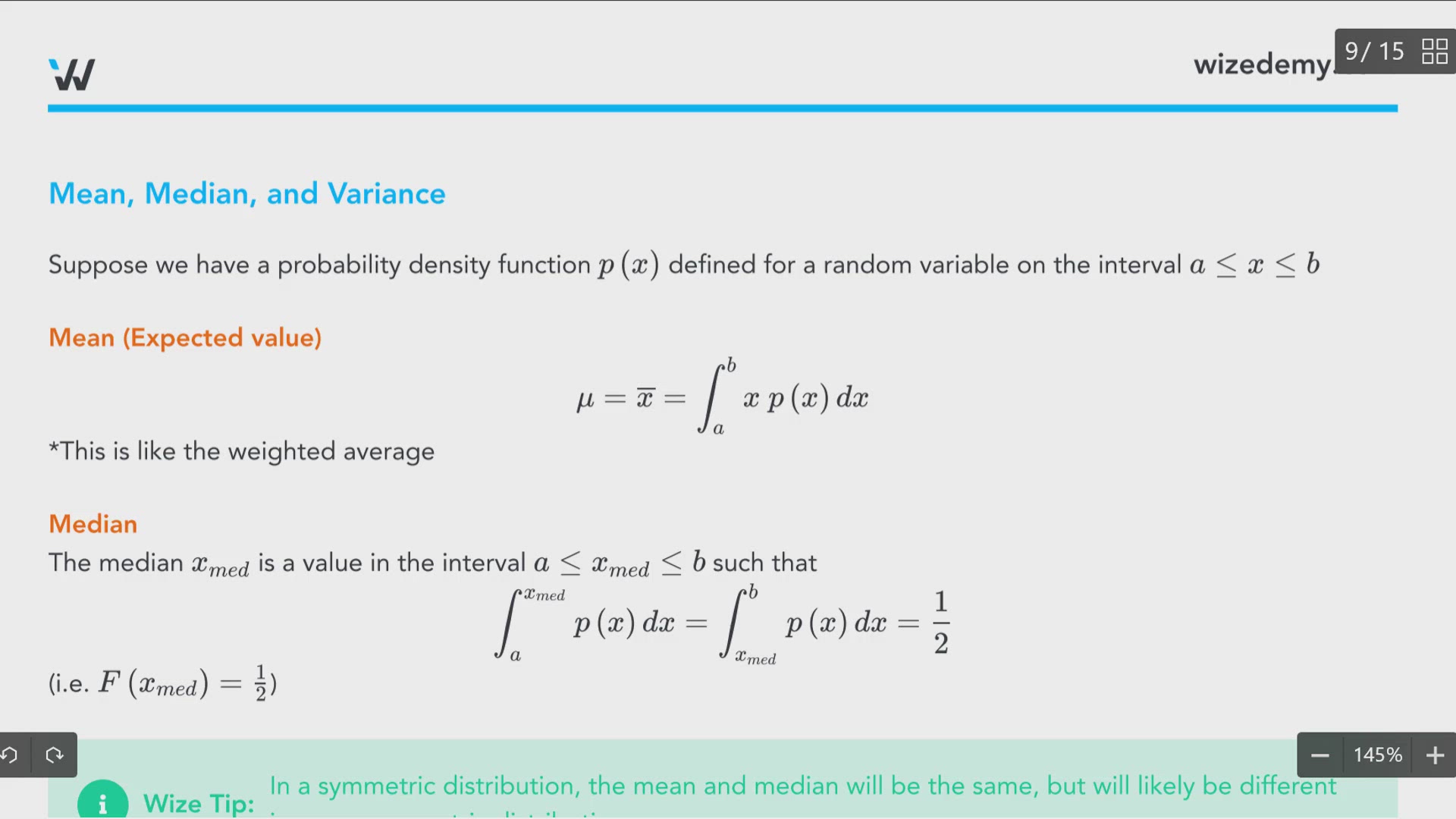
Suppose we have a probability density function defined for a random variable on the interval
Mean (Expected value)
*This is like the weighted average
Median
The median is a value in the interval such that
(i.e. )
Wize Tip
In a symmetric distribution, the mean and median will be the same, but will likely be different in a non-symmetric distribution.
Variance
The variance is the "average square distance between the mean and the whole distribution"
Standard deviation
The standard deviation is the "average distance between the mean and the whole distribution". It is just the square root of the variance
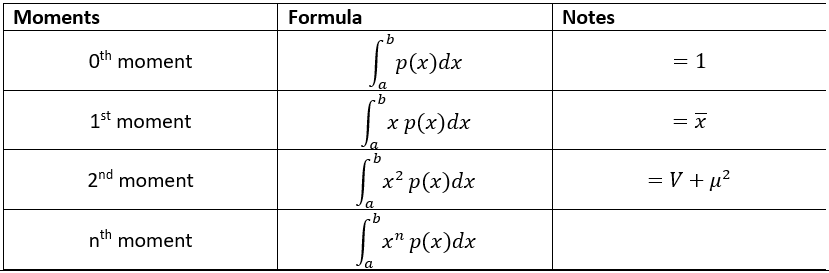
Moments
Practice
The flight altitude of a certain bird (measured from the ground) is given by the probability density function for .
a) What is the average altitute ?
b) What is the probability that a bird's flight altitude is higher than 3?
Practice: Median
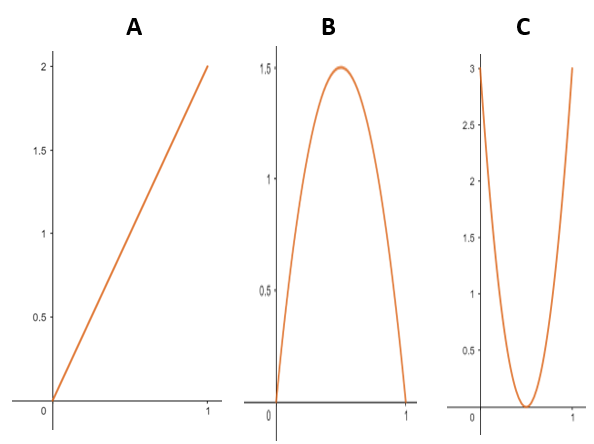
Which of the following PDFs has the largest median?