0:00 / 0:00

Dividing Polynomials - Long Division

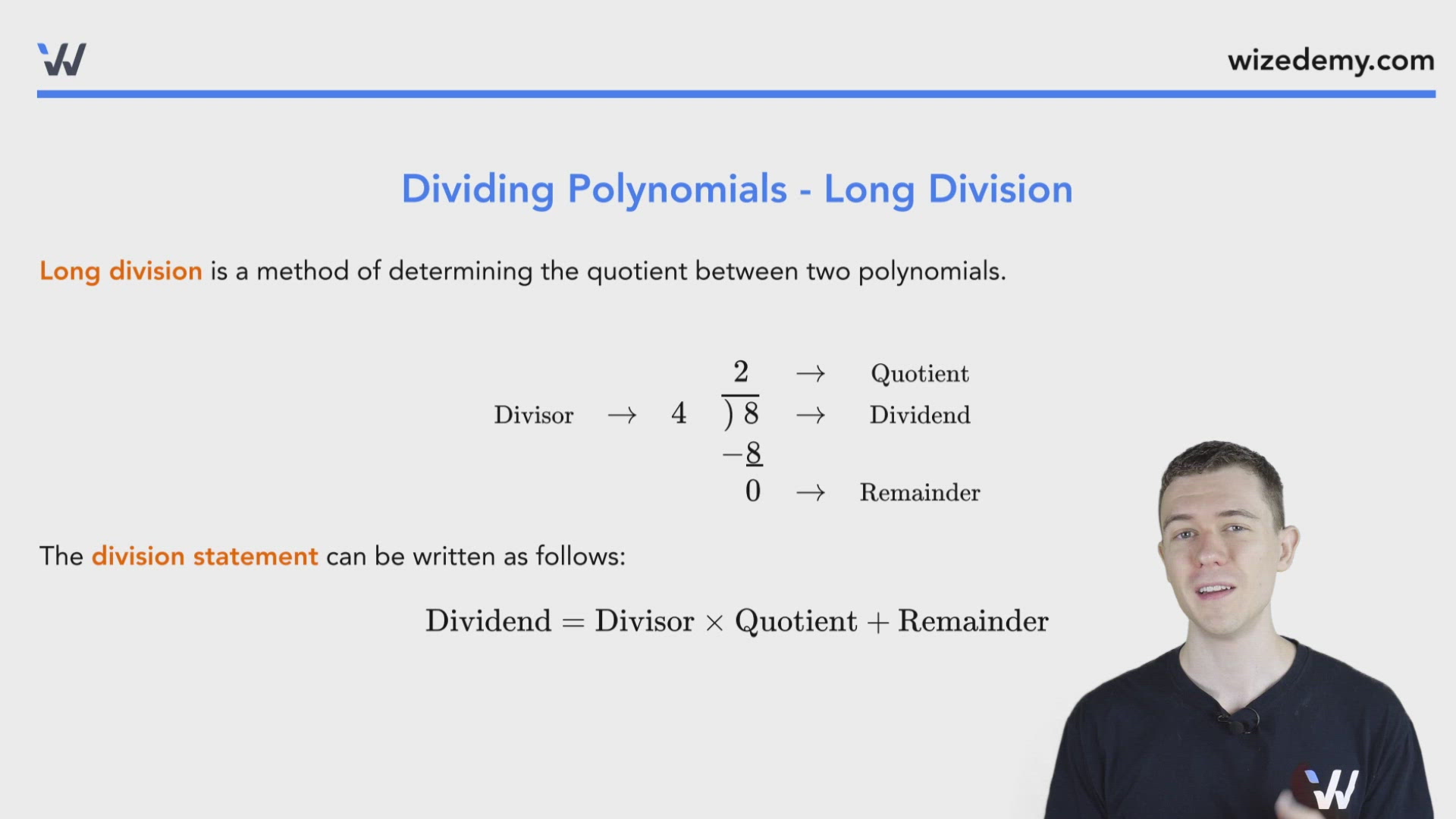
Long division is a method of determining the quotient between two polynomials.

2QuotientDivisor4) 8Dividend8   0Remainder\begin{array}{r c c c l} &&&2&\rightarrow&\footnotesize{}\text{Quotient}\\ \footnotesize{\text{Divisor}}&\rightarrow&4&\overline{)~8}&\rightarrow&\footnotesize{}\text{Dividend}\\ &&&-\underline{8}&&\\ &&&~~~0&\rightarrow&\footnotesize{}\text{Remainder} \end{array}
The division statement can be written as follows:
Dividend=Divisor×Quotient+Remainder\text{Dividend}=\text{Divisor}\times\text{Quotient}+\text{Remainder}

PAGE BREAK
Example
Let's divide x3+8x2+6x+10x^3+8x^2+6x+10 by x+1x+1.


x+1)x3+8x2+6x+10Divide the leading termsx3÷x=x2x2                  x+1)x3+8x2+6x+10Multiply the quotient & divisor(x3+x2)                  Subtract7x2       Divide 7x2÷x=7xx2+7xx+1)x3+8x2+6x+10Multiply 7x(x+1)(x3+x2)                   Carry Down 6x7x2+6xSubtract(7x2+7x)            xDivide -x÷x=1          x2+7x1x+1)x3+8x2+6x+10Multiply 1(x+1)(x3+x2)                   7x2+6x(7x2+7x)                     x+10Carry Down 10               (x1)Subtract                            11\begin{array}{ccc} {\color{magenta}x}+1&\overline{){\color{magenta}x^3}+8x^2+6x+10}&&&&\footnotesize\text{Divide the leading terms}\\&&&&&\footnotesize x^3\div{x}=x^2\\\\ &\color{magenta}x^2~~~~~~~~~~~~~~~~~~\\ \color{magenta}x+1&\overline{)x^3+8x^2+6x+10}&&&&\footnotesize{\text{Multiply the quotient \& divisor}}\\ &-(\underline{x^3+x^2})~~~~~~~~~~~~~~~~~~&&&&\footnotesize{\text{Subtract}}\\ &7x^2~~~~~~~&&&&\footnotesize{\text{Divide}}~7x^2\div{x}=7x\\\\\\ &x^2+{\color{magenta}7x}\\ {\color{magenta}x}+1&\overline{)x^3+8x^2+6x+10}&&&&\footnotesize{\text{Multiply}~7x\cdot{(x+1)}}\\ &-(\underline{x^3+x^2})~\color{red}\downarrow~~~~~~~~~~~~~~~~~~&&&&\footnotesize{\text{Carry Down 6x}}\\ &7x^2+6x&&&&\footnotesize{\text{Subtract}}\\ &-\underline{(7x^2+7x)}~~&&&&\\&~~~~~~~~~~-x&&&&\footnotesize{\text{Divide -x}\div{x}=1}\\\\\\ &~~~~~~~~~~x^2+7x-1\\ {\color{magenta}x}+1&\overline{)x^3+8x^2+6x+10}&&&&\footnotesize{\text{Multiply}~-1\cdot{(x+1)}}\\ &-(\underline{x^3+x^2})~\color{red}\downarrow~~~~~~~~~~~~~~~~~~&&&&\\ &7x^2+6x&&&&\\ &-\underline{(7x^2+7x)}~~&&&&\\&~~~~~~~~~~~~~~~~~~~-x+10&&&&\footnotesize{\text{Carry Down 10}}\\ &~~~~~~~~~~~~~~~-\underline{(-x-1)}&&&&\footnotesize{\text{Subtract}}\\ &~~~~~~~~~~~~~~~~~~~~~~~~~~~~11 \end{array}
The division statement is:
x3+8x2+6x+10=(x+1)(x2+7x1)+11x^3+8x^2+6x+10=(x+1)(x^2+7x-1)+11

0:00 / 0:00

Example: Dividing Polynomials - Long Division

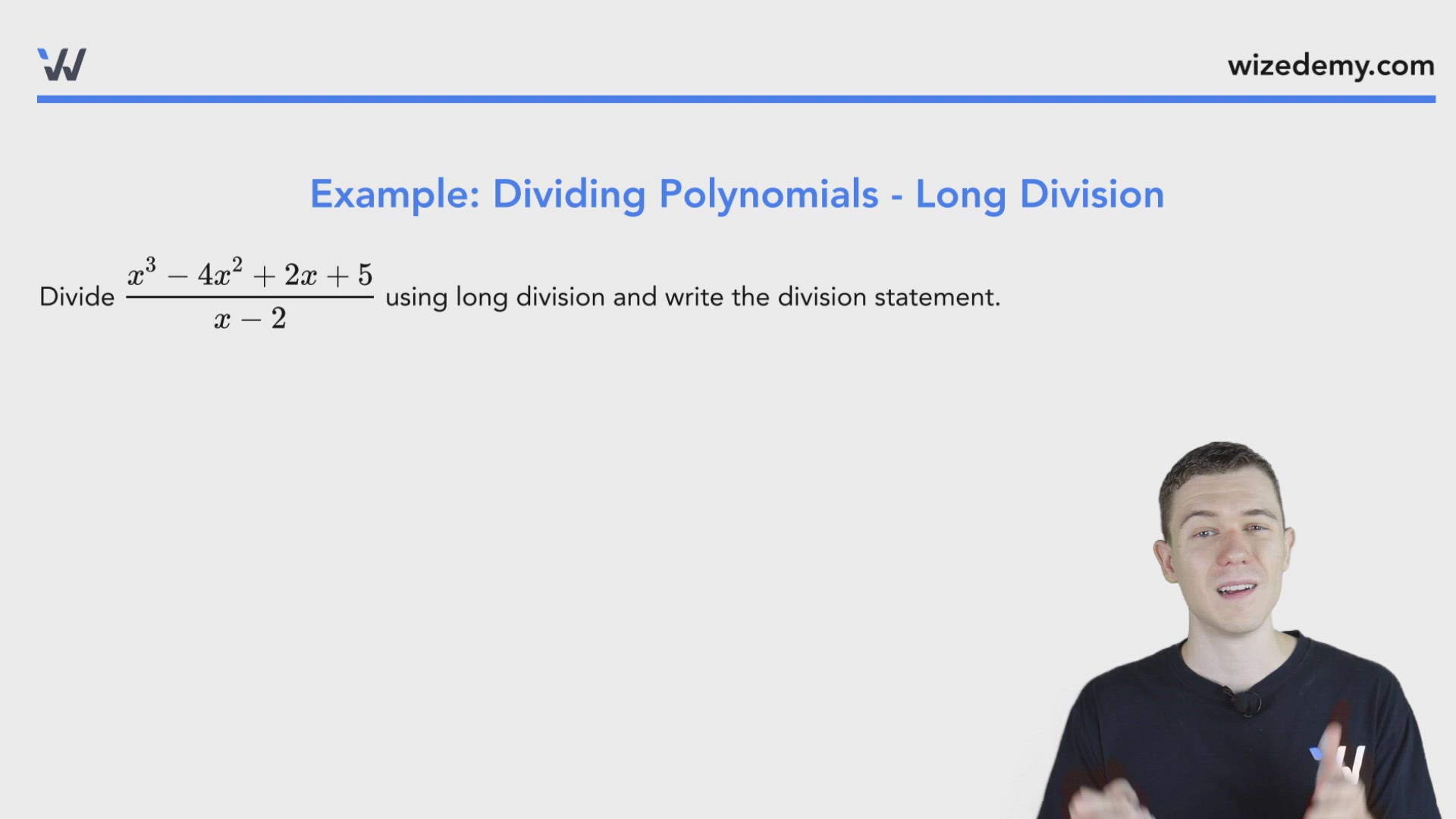
Divide x34x2+2x+5x2\displaystyle\frac{x^3-4x^2+2x+5}{x-2} using long division and write the division statement.

                x22x2(x2)    )x34x2+2x+5(x32x2)           2x2+2x        (2x2+4x)                        2x+5                    (2x+4)  1\begin{array}{cl} &~~~~~~~~~~~~~~~~x^2-2x-2&\\ (x-2)&~~~~\overline{)x^3-4x^2+2x+5}\\ &-\underline{(x^3-2x^2)}\\&~~~~~~~~~~~-2x^2+2x\\ &~~~~~~~~-\underline{(-2x^2+4x)}\\ &~~~~~~~~~~~~~~~~~~~~~~~~-2x+5\\ &~~~~~~~~~~~~~~~~~~~~-\underline{(-2x+4)}\\ &\quad\quad\quad\quad\quad\quad\quad\quad\quad~~1 \end{array}
DIvision Statement:
x34x2+2x+5=(x2)(x22x2)+1x^3-4x^2+2x+5=(x-2)(x^2-2x-2)+1

0:00 / 0:00

Dividing Polynomials - Synthetic Division

Synthetic division is a shortcut from long division.

Synthetic Division used with Monic, Linear Factors (xa)\blue{(x-a)}.

Example 1
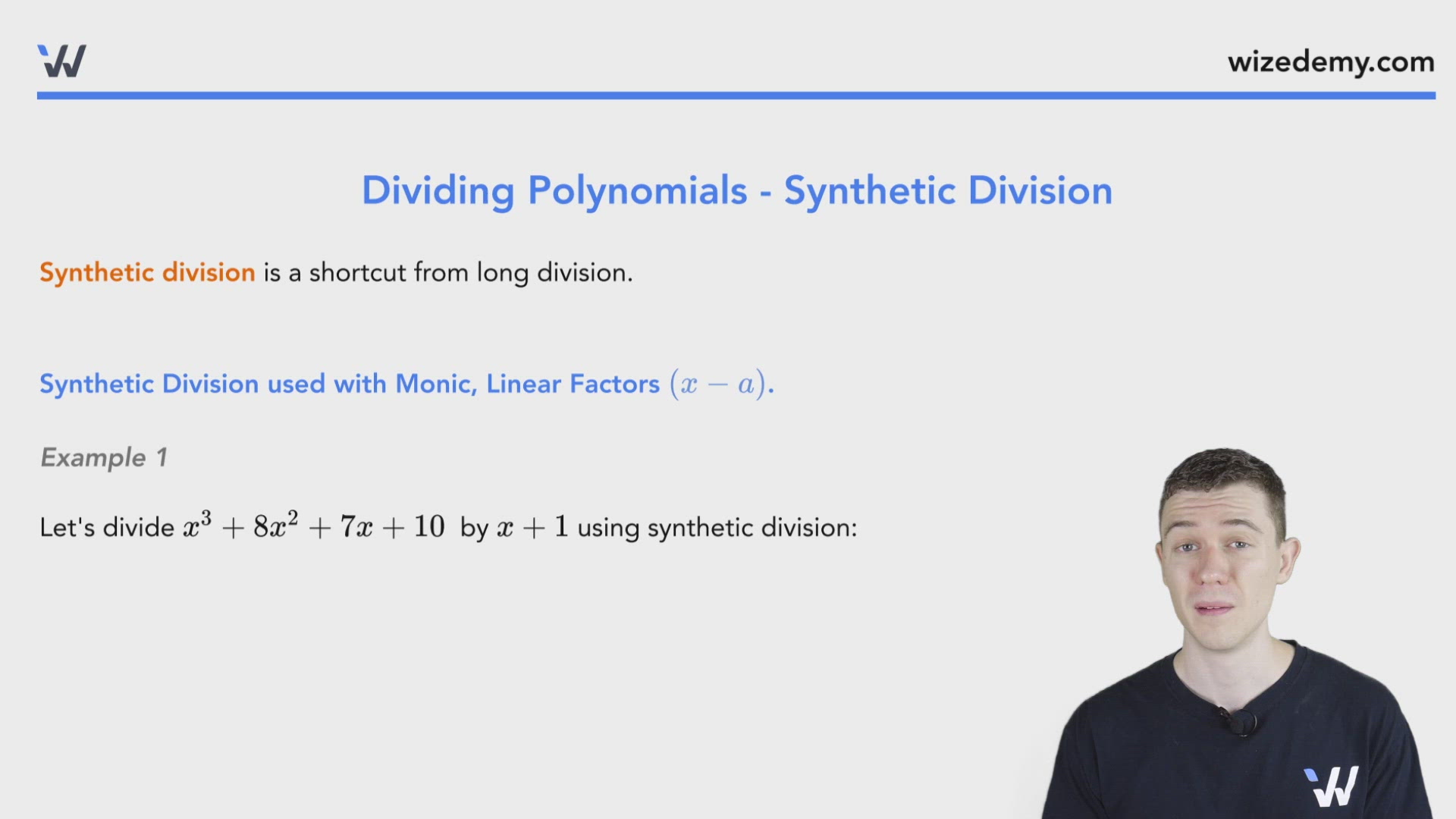
Let's divide x3+8x2+7x+10x^3+8x^2+7x+10 by x+1x+1 using synthetic division:
18710111Multiply -1 & 1 = -1187101117Add 8 & -1 = 71871011717Multiply 7 & -1 = -718710117170Add 7 & -7 = 0187101170170Multiply -1 & 0 = 018710117017010Add 10 & 0 = 10\begin{array}{l l} \begin{array}{l|cccc} {}&1&8&7&10\\ -1&\downarrow&\color{red}-1&&\\\\ \hline&1 \end{array}&\footnotesize\text{Multiply -1 \& 1~=~-1}\\\\\\ \begin{array}{l|cccc} {}&1&8&7&10\\ -1&\downarrow&-1&&\\\\ \hline&1&\color{red}7 \end{array}&\footnotesize\text{Add 8 \& -1~=~7}\\\\\\ \begin{array}{l|cccc} {}&1&8&7&10\\ -1&\downarrow&-1&\color{red}-7&\\\\ \hline&1&7 \end{array}&\footnotesize\text{Multiply 7 \& -1~=~-7}\\\\\\ \begin{array}{l|cccc} {}&1&8&7&10\\ -1&\downarrow&-1&-7&\\\\ \hline&1&7&\color{red}0& \end{array}&\footnotesize\text{Add 7 \& -7~=~0}\\\\\\ \begin{array}{l|cccc} {}&1&8&7&10\\ -1&\downarrow&-1&-7&\color{red}0\\\\ \hline&1&7&0& \end{array}&\footnotesize\text{Multiply -1 \& 0~=~0}\\\\\\ \begin{array}{l|cccc} {}&1&8&7&10\\ -1&\downarrow&-1&-7&0\\\\ \hline&1&7&0&\color{red}10 \end{array}&\footnotesize\text{Add 10 \& 0~=~10} \end{array}

The division statement is:
x3+8x2+7x+10=(x+1)(x2+7x)+10x^3+8x^2+7x+10=(x+1)(x^2+7x)+10

PAGE BREAK

Synthetic Division used with Non-Monic Linear Factors (axb), a0\blue{(ax-b),~a\neq{0}}

When a polynomial is divided by a non-monic linear factor using synthetic division, the quotient must be divided by 'aa'.

Example 2
Let's divide 3x44x2+x32x1\displaystyle\frac{3x^4-4x^2+x-3}{2x-1} using synthetic division and write the division statement.

3041312323413856332134585316\begin{array}{r|ccccc} &3&0&-4&1&-3\\ \footnotesize\frac{1}{2}&\downarrow&\footnotesize\frac{3}{2}&\footnotesize\frac{3}{4}&\footnotesize-\frac{13}{8}&\footnotesize-\frac{5}{6}\\\\\hline &\footnotesize3&\footnotesize\frac{3}{2}&\footnotesize-\frac{13}{4}&\footnotesize-\frac{5}{8}&\footnotesize-\frac{53}{16} \end{array}
The quotient will be divided by a = 2:
32x3+34x2138x516\frac{3}{2}x^3+\frac{3}{4}x^2-\frac{13}{8}x-\frac{5}{16}
The division statement becomes:

3x44x2+x3=(2x1)(32x3+34x2138x516)53163x^4-4x^2+x-3=(2x-1)\Bigg(\frac{3}{2}x^3+\frac{3}{4}x^2-\frac{13}{8}x-\frac{5}{16}\Bigg)-\frac{53}{16}

0:00 / 0:00

Example: Dividing Polynomials - Synthetic Division

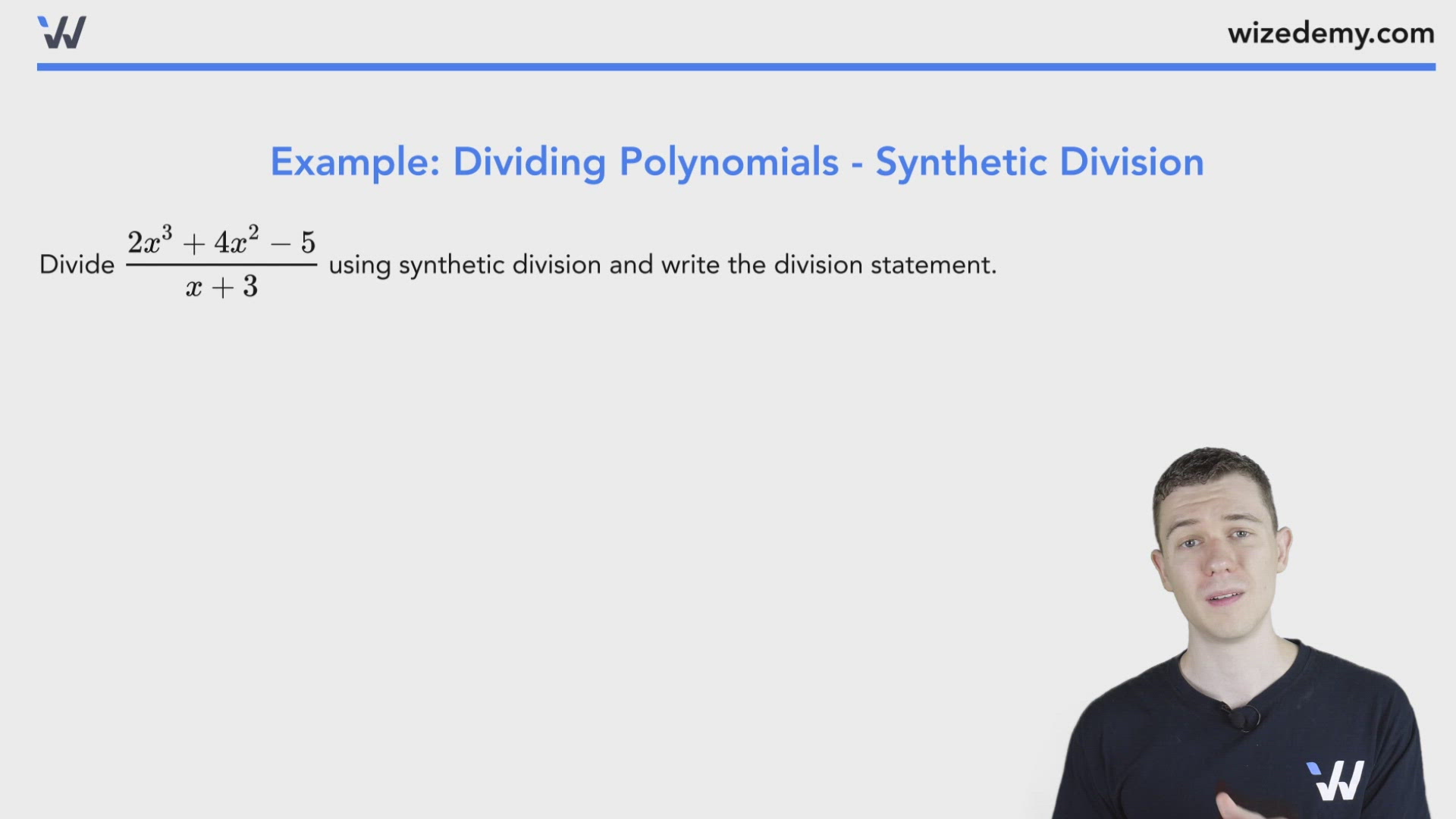
Divide 2x3+4x25x+3\displaystyle\frac{2x^3+4x^2-5}{x+3} using synthetic division and write the division statement.

24053661822623\begin{array}{c|cccc} &2&4&0&-5\\ -3&\downarrow&-6&6&-18\\ \hline &2&-2&6&-23 \end{array}
The quotient becomes:
2x22x+62x^2-2x+6

Division Statement:
2x3+4x25=(x+3)(2x22x+6)232x^3+4x^2-5=(x+3)(2x^2-2x+6)-23

Find the remainder using synthetic division when (x4+5x310x+2) ÷ (x2)(x^4+5x^3-10x+2)~\div~(x-2)
Divide 3x3+14x+11x23x+2\displaystyle\frac{3x^3+14x+11}{x^2-3x+2} and choose the correct quotient.
Extra Practice