Wize University Calculus 1 Textbook > Pre-Calculus (Review)
Rational Functions
Popular Courses
CALCULUS 1000A/B
Western University
Calculus 1
University Study Guides
AP Calculus (AB) Exam Prep Course
AP Exam Prep
MATH 100A
University of British Columbia
MATH 100C
University of British Columbia
MATH 249
University of Calgary
MATH 265
University of Calgary
Calculus 1
General Course
MATH 275
University of Calgary
MATH 140
McGill University
MATH*1080
University of Guelph
MATH 134
University of Alberta
Calculus 1
University Study Guides
MAT 1320
University of Ottawa
MATH 100
University of Alberta
MATH 100B
University of British Columbia
MATH 203
Concordia University
MAT 1330
University of Ottawa
MTH 140
Toronto Metropolitan University
SC/MATH 1013 3.00
York University

0:00 / 0:00
Rational Functions
A rational function can be expressed as:
where is the largest exponent in the numerator and is the largest exponent in the denomiator.
Properties of Rational Functions
- X-Intercepts can be found by setting and solving for
- Vertical asymptotes can be found by setting the denominator to 0 and solving for
- Horizontal asymptotes:
- If : There is a horizontal asymptote at
- If : There is a horizontal asymptote at
- If : There is no horizontal asymptote. There may be an oblique/diagonal asymptote.
- If factoring the numerator & denominator of , any terms that cancel out indicates where a missing point/hole in
- The domain is the set of all real numbers except where there are vertical asymptotes & missing points/holes
- The range is the set of all real numbers except where there are horizontal asymptotes in most cases
Watch Out!
Rational functions may only attain values strictly above or below horizontal asymptotes. This will affect the range.
Example 1
Let's look at .
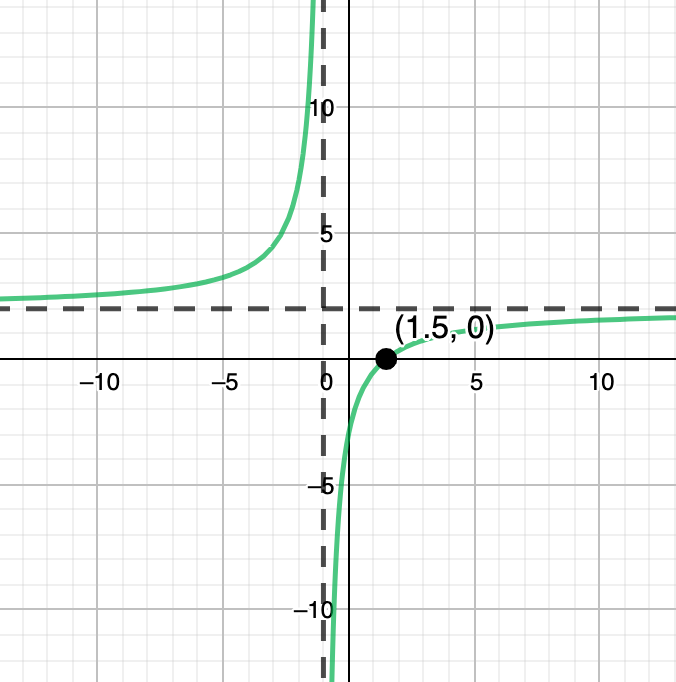
- -Intercept:
- Vertical Asymptote:
- Horizontal Asymptote:
- Missing Points/Holes: None
- Intervals of Increasing:
- Intervals of Decreasing: NA
- Domain:
- Range:
0:00 / 0:00
Solving Rational Equations
Rational equations are a type of equation containing at least one rational term, , where are continuous polynomials.
Rational equations can contain non-permissible values (NPV) that identify the restrictions of the domain. They identify the value of the variable that gives a in the denominator.
Wize Tip
The NPV's are equivalent to the vertical asymptote and missing points/holes.
Example
Solve , stating any NPV's.
Step 1.
Identify any non-permissible values.
The NPV's are the vertical asymptotes.
Therefore, otherwise there is a total of in the denominator.
Step 2.
Find the lowest common denominator and multiply each term by it.
The lowest common denominator is .
Step 3.
Solve for
Step 4.
Verify.

0:00 / 0:00
Example: Solving Rational Equations
Solve , stating any NPV's.
Step 1.
Identify any non-permissible values.
The NPV's are the vertical asymptotes.
Therefore, otherwise there is a total of in the denominator.
Step 2.
Find the lowest common denominator and multiply each term by it.
The lowest common denominator is .
Step 3.
Solve for
According to the NPV's, .
Therefore, is an extraneous solution.
Step 4.
Verify.
Therefore, is the only solution.

0:00 / 0:00
Example: Rational Functions
A graph of the function is sketched below:
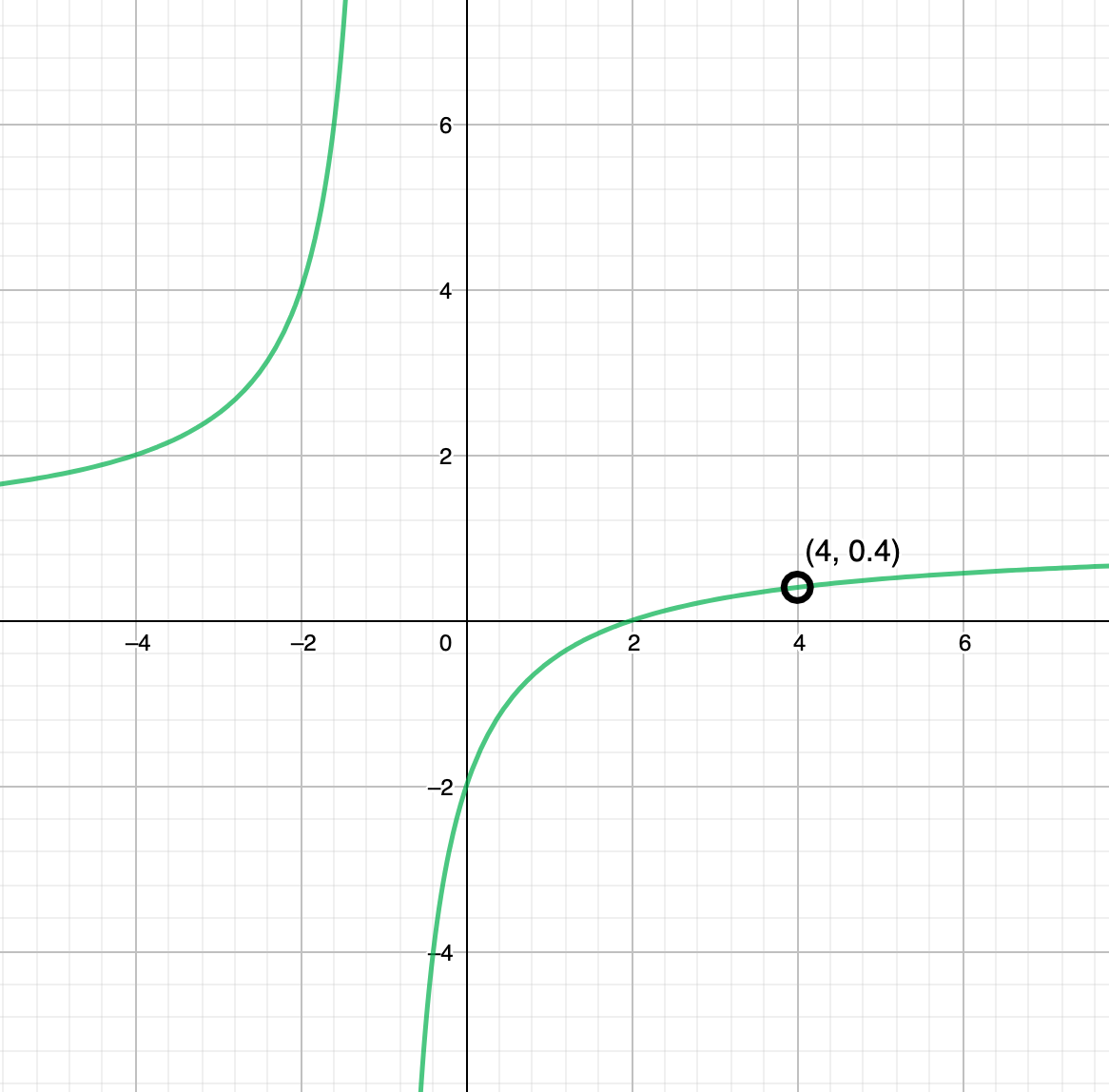
Identify the equations for any vertical & horizontal asymptotes, and missing points/holes.
Factor :
Vertical Asymptotes:
Let .
The vertical asymptote is at
Horizontal Asymptote:
The degree of the numerator is equivalent to the degree in the denominator.
Therefore, .
Missing Points/Holes
Missing points/holes exist whenever terms in the numerator and denominator cancel.
Since the term was eliminated, there is a missing point/hole at
Given the equation , answer the following questions.
Solve for .
Identify the vertical asymptotes, the horizontal asymptotes, the x-intercepts, and any missing points of: