Wize University Calculus 1 Textbook > Pre-Calculus (Review)
Radical Functions
Popular Courses
CALCULUS 1000A/B
Western University
Calculus 1
University Study Guides
Grade 12 Pre-Calculus/Functions
Canada High School
AP Calculus (AB) Exam Prep Course
AP Exam Prep
Math 30-1
Alberta High School
Pre-Calculus 12
British Columbia High School
MATH 1LS3
McMaster University
MATH 249
University of Calgary
MATH 265
University of Calgary
Calculus 1
General Course
MATH 275
University of Calgary
MATH 140
McGill University
MATH*1080
University of Guelph
MATH 134
University of Alberta
MATH 154
University of Alberta
Calculus 1
University Study Guides
MAT 1320
University of Ottawa
MATH 100
University of Alberta
MATH 203
Concordia University
MAT 1330
University of Ottawa

0:00 / 0:00
Radical Functions
A radical function is defined as:
where is a function and .
Square-Root Functions
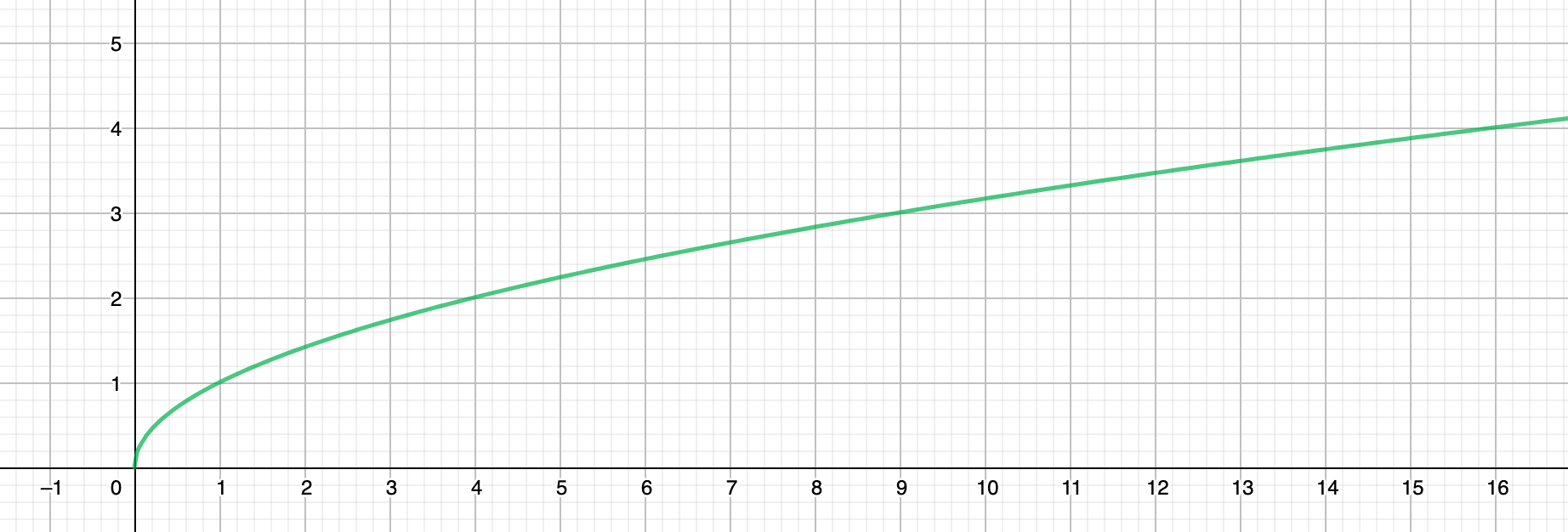
-Intercept:
-Intercept:
Domain:
Range:

0:00 / 0:00
Solving Radical Equations
A radical equation is
where are continuous polynomial functions.
Solutions to Radical Equations
Solve . State the restrictions for 'x'.
Let and let .
Restrictions:
Graph and :
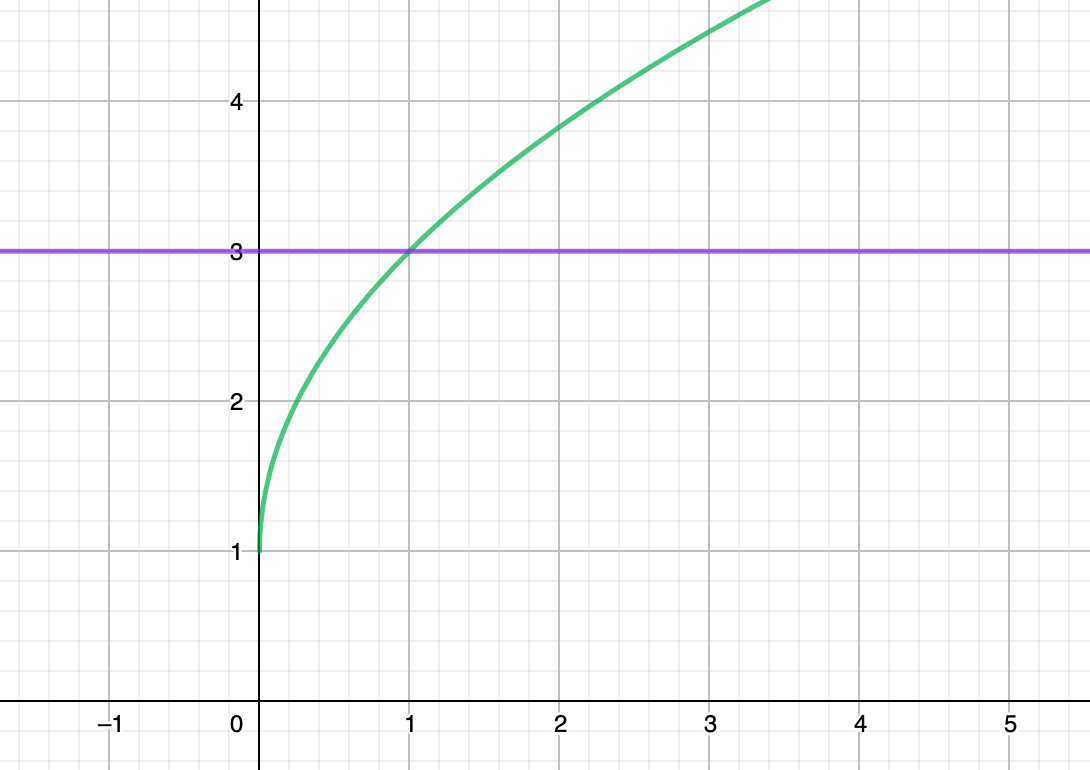
intersect at (1, 3).
Let's verify the answer:
Therefore, (1, 3) is the solution.
Algebraic Solutions to Radical Equations
Solve . State the domain and range
Isolate for 'x'
Restriction: Since the argument of a square root must be 0 or larger, which means that our domain can be given by , or in interval notation. The range can be found be recognizing that the square root has an output of 0 or higher, and so subtracting 2 from this will give us a possible range of .
Verify:
0:00 / 0:00
Example: Solving Radical Equations
Solve graphically & algebraically, stating the restrictions on :
Graphically:
Let and . Then,

The solution is (4, 4)
Restrictions on 'x':
Algebraically:
Verify:
Therefore, only x = 4 is a solution.
Solve algebraically, stating any restrictions: