
Piecewise Functions
A piecewise function is a function composed of 2 or more functions with restricted domains.
The notation used for a piecewise function is displayed below:
where each piece of f(x) represents a function and its domain.
A continuous piecewise function means:
- The function is continuous over the entire domain
- You do not have to lift your pencil from the paper in order to sketch its graph
- The output values on the boundary points are equivalent
A discontinuous piecewise function means:
- The function has discontinuities (holes, gaps, breaks, asymptotes) over the domain
- You have to lift your pencil from the paper in order to sketch its graph
- The output values on the boundary points are not equivalent
Example
The following piecewise function, f(x), is graphed below:

There are 2 discontinuities:
The domain of the function is:
The function f(x) can be expressed as 3 separate functions with restricted domains.
Blue Function:
Green Function:
Purple Function:
Therefore, the blue, green, and purple function can be expressed as a piecewise function, f(x):
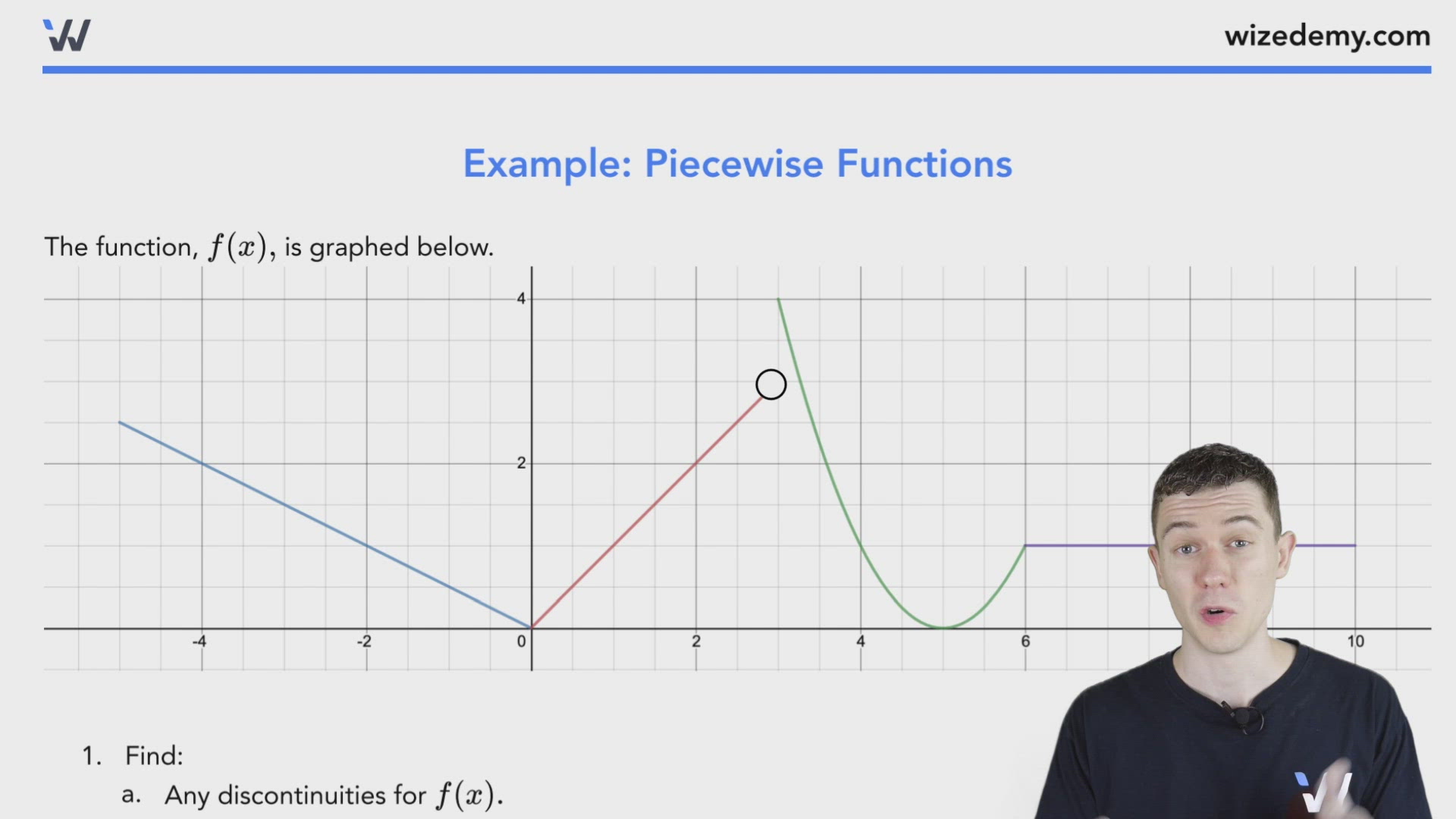
Example: Piecewise Functions
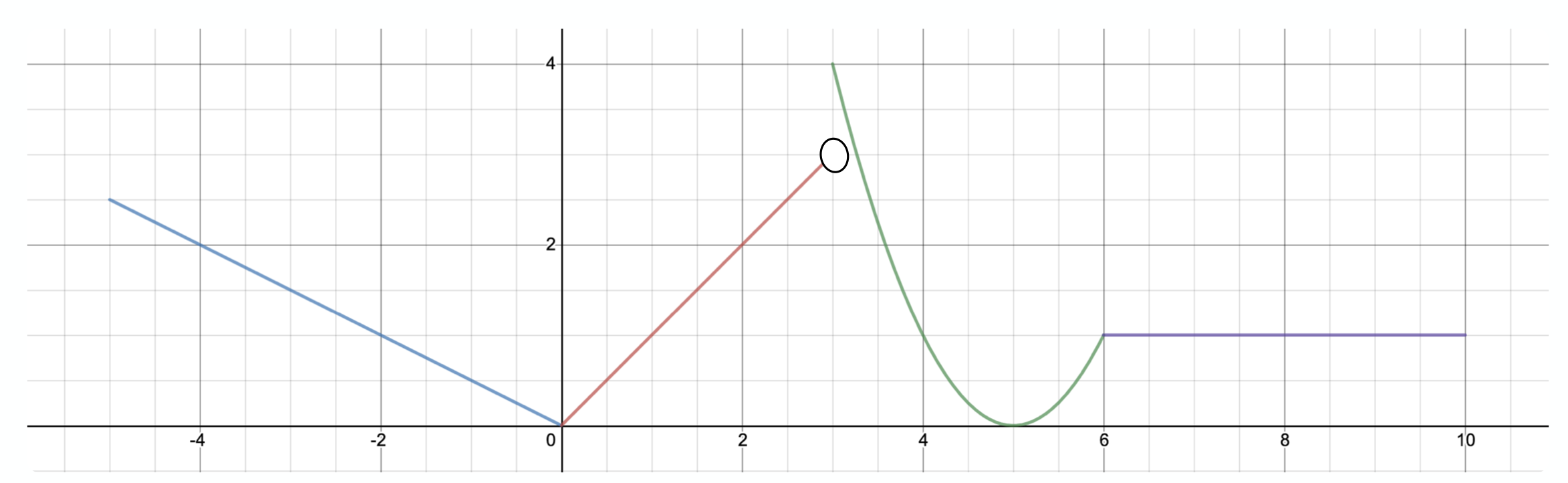
The function, is graphed below.
- Find:
- Any discontinuities for
- The domain and range for
- Find a piecewise function that describes
Part 1.
a. There is only one discontinuity at
b. Domain:
Range:
Part 2.
Blue Function:
Red Function:
Green Function:
Purple Function:
Therefore,
Note that there are a few different ways we could have chosen to include the endpoints on some of these domains while still being correct, as the points at and will remain the same whichever function is used.