Popular Courses
Calculus 1
University Study Guides
Calculus 1
General Course
Calculus 1
University Study Guides
MAT 1322
University of Ottawa
MTH 131
Toronto Metropolitan University
MATH 1225A/B
Western University
MATH 1500
University of Manitoba
MATH 121B
Queen's University
MATH 146
University of Alberta
MATH 146
University of Alberta
MATH 110
University of British Columbia
MATH 140
Pennsylvania State University
MATH 126
Queen's University
MATH 1510
University of Manitoba
MAT 1300
University of Ottawa
MATA29H3
University of Toronto
MATH 1MM3
McMaster University
MAC 2311
University of Florida
MAT 1308
University of Ottawa
MATH 104
University of Waterloo

0:00 / 0:00
Pressure and Force
When objects are submerged in fluid, Pressure (hydrostatic pressure) is exerted on the object. This pressure is determined by the density of the fluid and how far the object is submerged.
For an object submerged in a fluid with density at depth , the pressure on the the object is given by
where is the force of gravity.
Note: is often called weight-density , ,and reduces our formula
Fluid Force
The force (hydrostatic force) from a constant pressure applied to plate of area submerged horizontally is
Fluid Force Integrals
For variable depth, the force applied to an object from depth to is given by
where is the depth of the object and is the cross sectional length of the object over .
Wize Tip
Using symmetry or similar triangles often helps in determining .
0:00 / 0:00
Example: Pressure and Force
A right circular cylindrical tank lying on its side and in diameter contains a fluid with weight constant density . How much force does the fluid exert on the sides of the tank when the tank is half full?
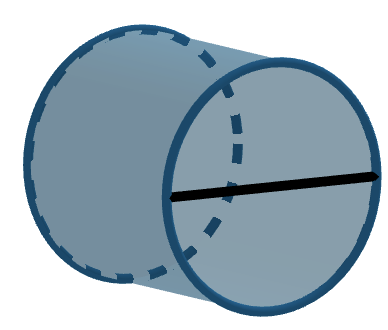
Viewing our tank as a cross section the fluid fills the tank from . (here the x-axis represents 0 depth since the tank is half full.)
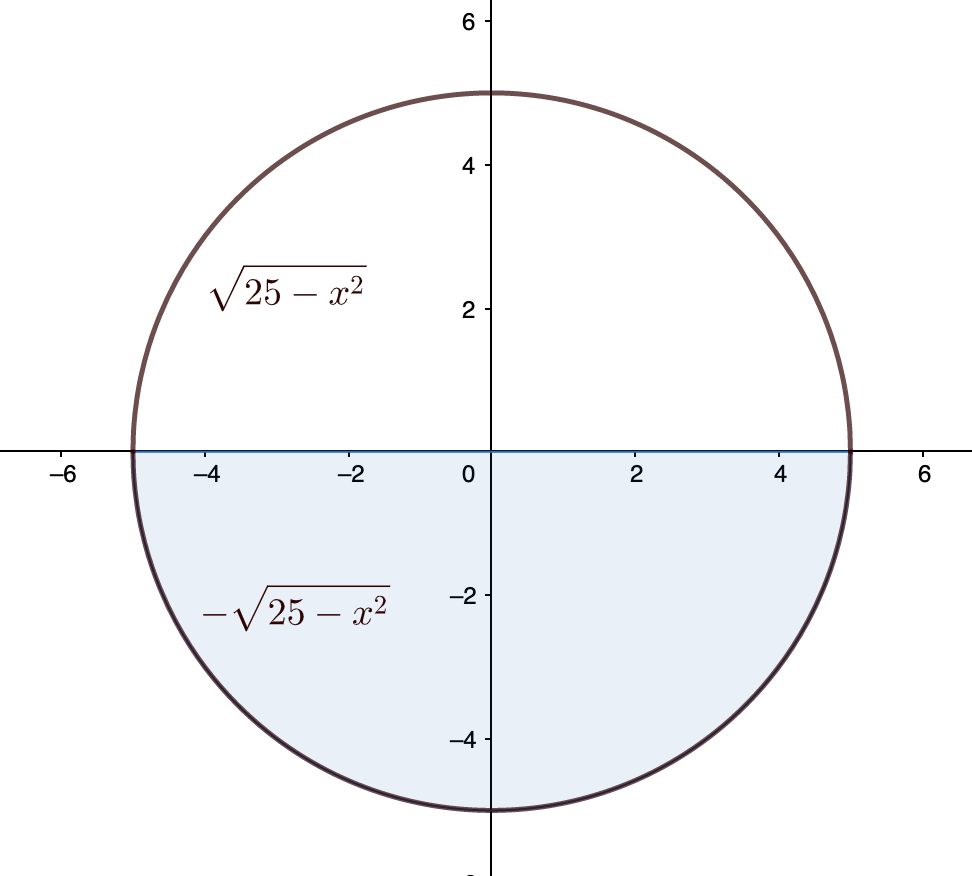
The depth varies linearly below the x-axis:
We can use symmetry to determine .
The cross sectional length varies from to but is the same length on each side of the y-axis.
Thus
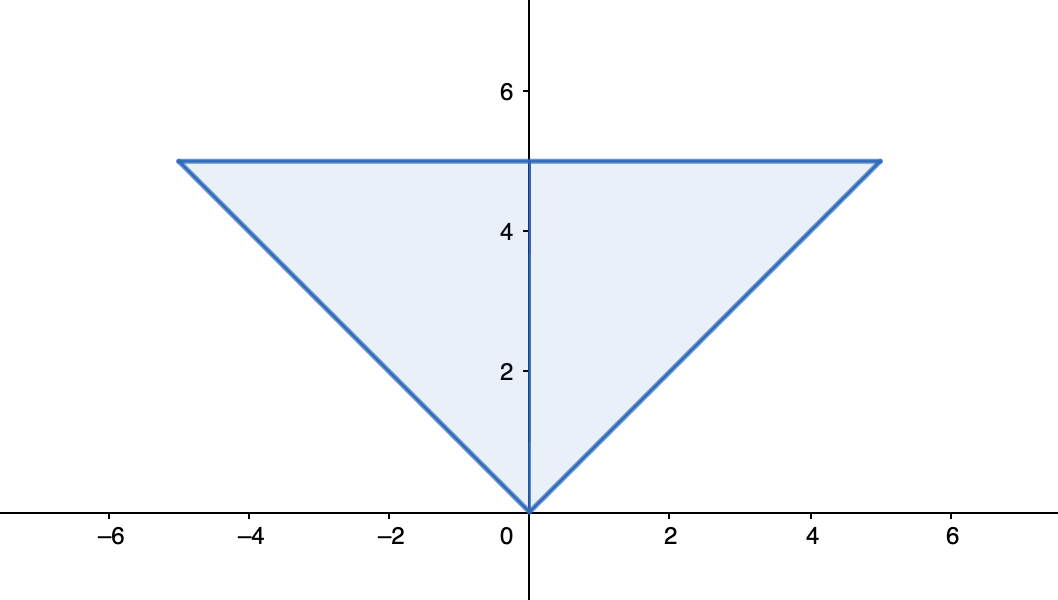
A triangular trough contains a certain oil with weight density . The cross section of the tank is shown below. How much force does the fluid exert on the tank when the tank is full?