Create a free account to get started

Unlock full course notes by signing up

  • Video lessons taught by top educators
  • Practice questions with guided solutions
  • Written review notes for reference
  • Expert answers anytime from course tutors

Center of Mass

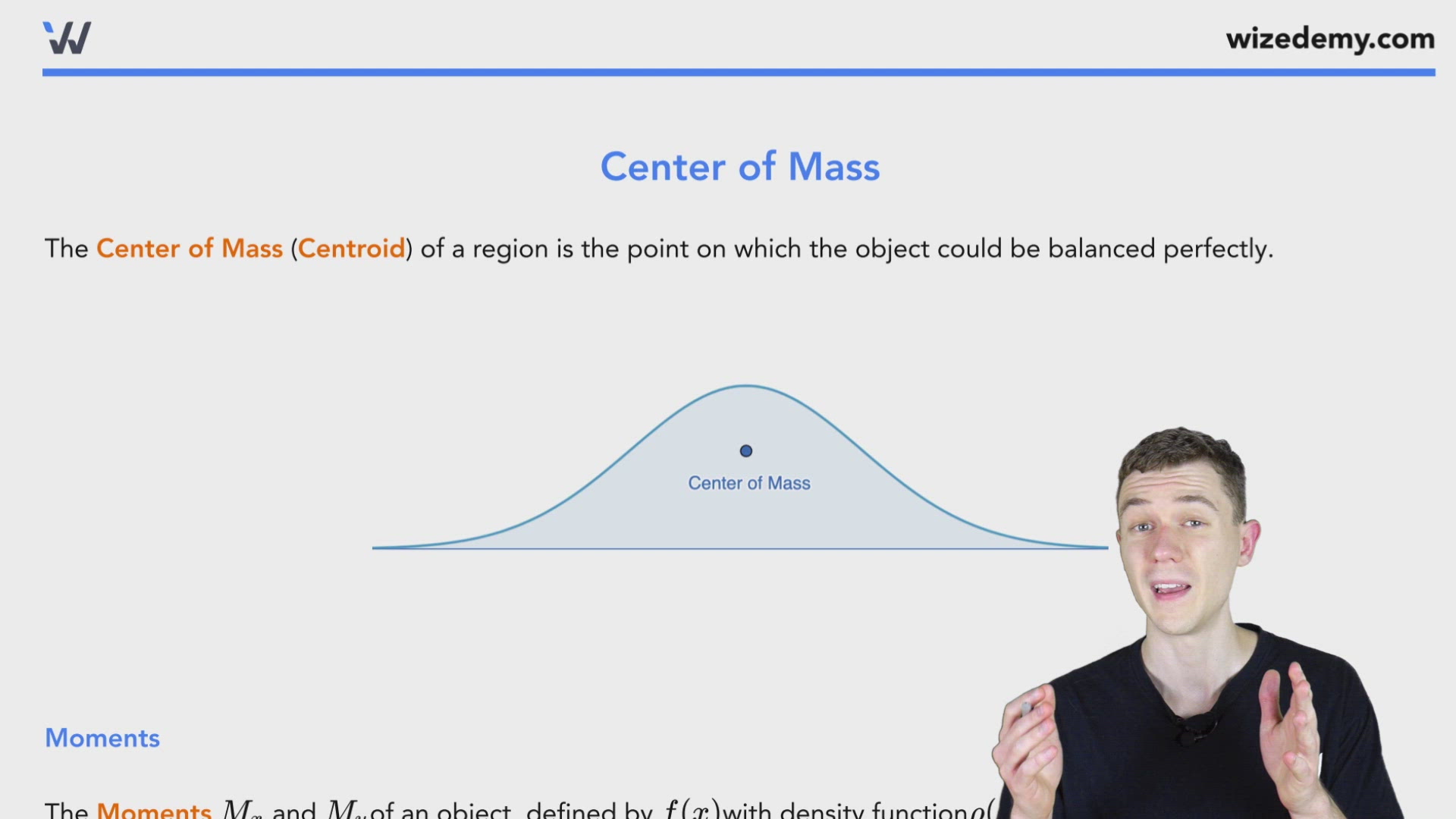
The Center of Mass (Centroid) of a region is the point on which the object could be balanced perfectly.
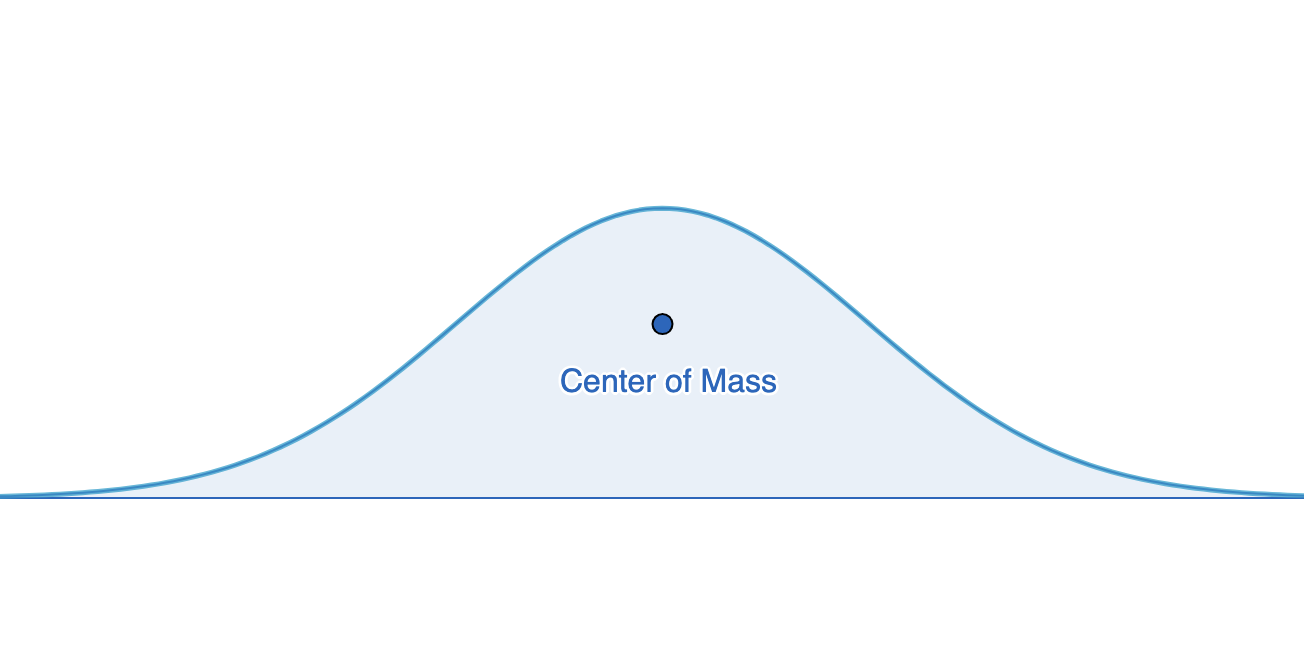
Image illustrating Center of Mass


Moments

The Moments MxM_x and MyM_yof an object, defined by f(x)f(x)with density functionρ(x)\rho(x),are the tendency for of the region to revolve around the x and y axes respectively on [a,b][a,b]. Moments can be calculated using

Mx=∫ab12ρ(x)[f(x)]2dx\boxed{M_x=\displaystyle \int_a^b\frac{1}{2}\rho\left(x\right)[f(x)]^2dx}


My=∫abxρ(x)f(x)dx\boxed{M_y=\displaystyle \int_a^bx\rho \left(x\right)f(x)dx}


Center of Mass (Centroid)

The center of mass or centroid ,(x‾,y‾)(\overline{x}, \overline{y}) , of an object defined by f(x)f(x) with density function ρ(x)\rho \left(x\right) and mass MMdefined on the interval [a, b]\left[a,\ b\right] can be found using

 x‾=MyM=∫abxρ(x)f(x)dx∫abρ(x)f(x)dx \boxed{\displaystyle \ \overline{x}=\frac{M_y}{M}=\frac{\displaystyle \int_a^bx\rho\left(x\right)f(x)dx}{\displaystyle \int_a^b\rho\left(x\right)f(x)dx} \ }


 y‾=MxM=∫ab12ρ(x)[f(x)]2dx∫abρ(x)f(x)dx \boxed{\displaystyle \ \overline{y}=\frac{M_x}{M}=\frac{\displaystyle \int_a^b\frac{1}{2}\rho\left(x\right)[f(x)]^2dx}{\displaystyle \int_a^b\rho\left(x\right)f(x)dx} \ }


Create a free account to get started

Unlock full course notes by signing up

  • Video lessons taught by top educators
  • Practice questions with guided solutions
  • Written review notes for reference
  • Expert answers anytime from course tutors

Example: Center of Mass

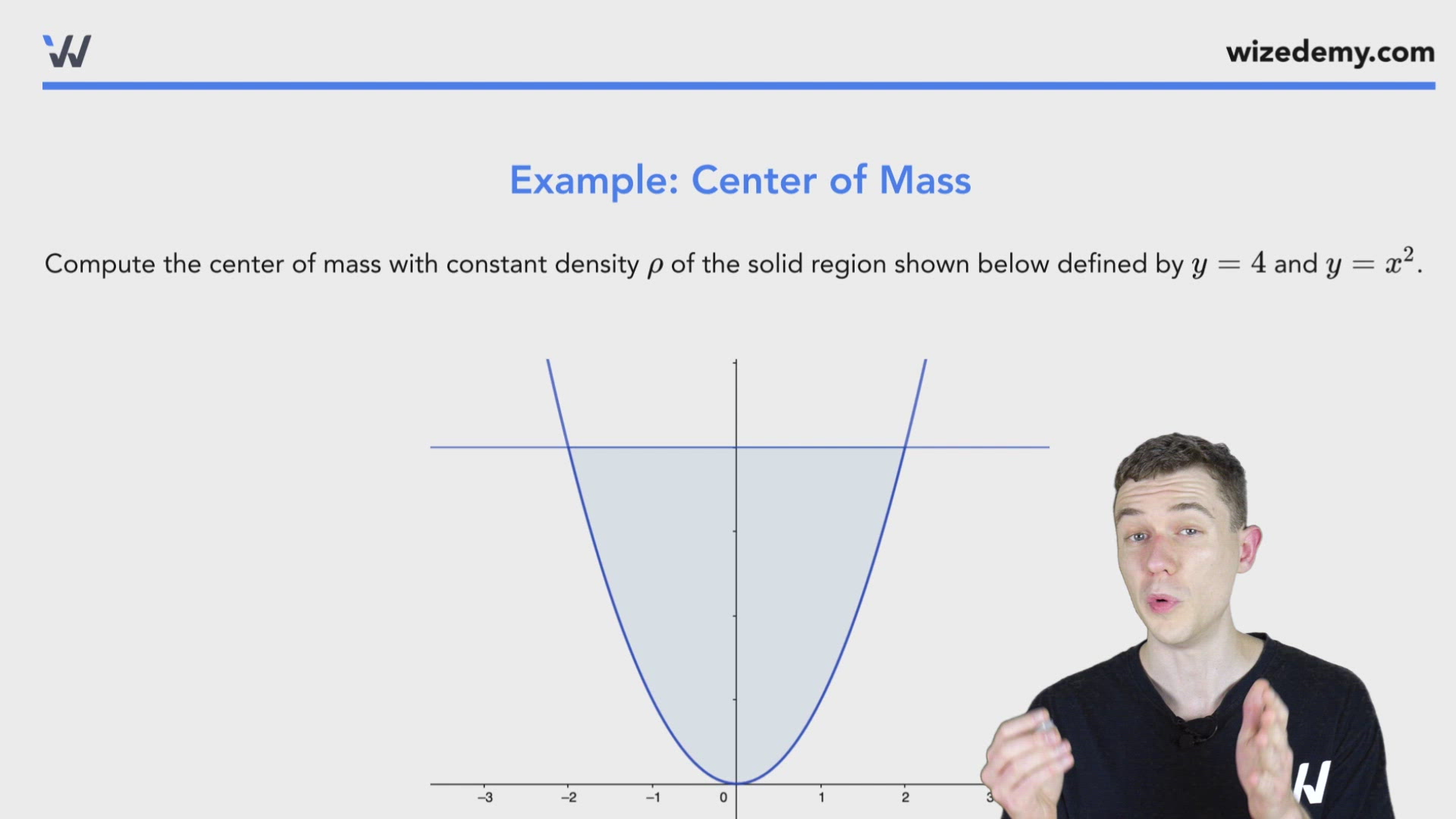
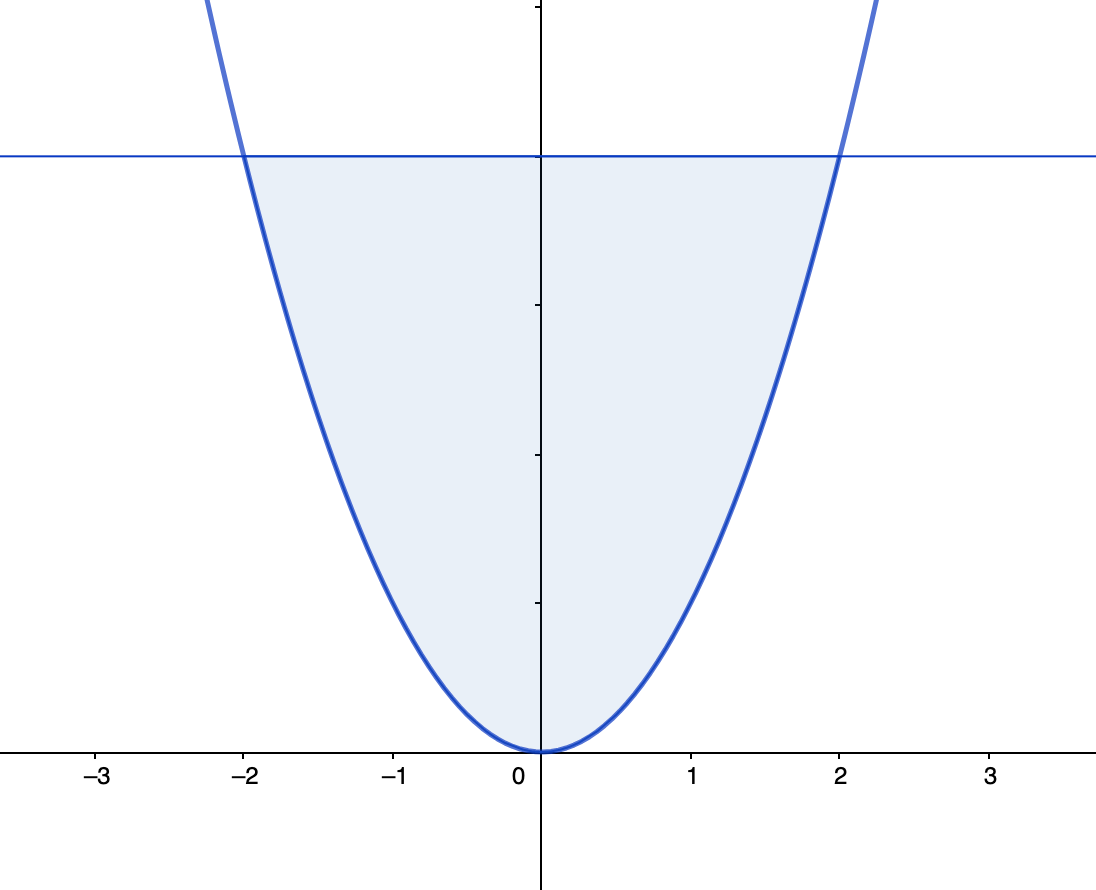
Compute the center of mass with constant density ρ\rho of the solid region shown below defined by y=4y=4 and y=x2y=x^2.


Image illustrating Example


Note: Since we have area between curves f(x)−g(x)=top−bottomf(x)-g(x)=\text{top}-\text{bottom}

Since the region has constant density and is symmetrical about the y-axis. We can conclude x‾=0\overline{x}=0 by inspection.


The region has no other symmetry so


 y‾=∫ab12ρ(x)[f(x)2−g(x)2]dx∫abρ(x)[f(x)−g(x)]dx {\displaystyle \ \overline{y}=\frac{\displaystyle \int_a^b\frac{1}{2}\rho\left(x\right)[f(x)^2-g(x)^2]dx}{\displaystyle \int_a^b\rho\left(x\right)[f(x)-g(x)]dx} \ }


=12ρ∫−22[42−(x2)2]dxρ∫−22[4−x2]dx {\displaystyle =\frac{\displaystyle \frac{1}{2}\rho\int_{-2}^2[4^2-(x^2)^2]dx}{\displaystyle \rho\int_{-2}^2[4-x^2]dx} \ }


=12∫−22[16−x4]dx∫−22[4−x2]dx {\displaystyle =\frac{\displaystyle \frac{1}{2}\int_{-2}^2[16-x^4]dx}{\displaystyle \int_{-2}^2[4-x^2]dx} \ }


=12[16x−x55]∣−22[4x−x33]∣−22{\displaystyle =\frac{\displaystyle \frac{1}{2}[16x-\frac{x^5}{5}]\bigg|_{-2}^2}{\displaystyle [4x-\frac{x^3}{3}]\bigg|_{-2}^2} }


=12[16(2)−(2)55−16(−2)+−255]4(2)−(2)33−4(−2)+(−2)33{\displaystyle =\frac{\displaystyle \frac{1}{2}[16(2)-\frac{(2)^5}{5}-16(-2)+\frac{-2^5}{5}]}{\displaystyle 4(2)-\frac{(2)^3}{3}-4(-2)+\frac{(-2)^3}{3}} }


=125\displaystyle =\frac{12}{5}


Thus (x‾,y‾)=(0,125)\displaystyle (\overline{x},\overline{y})=(0,\frac{12}{5})

Find the center of mass of the following region with constant density .


Illustration for practice question: Applications of Integration: Moments and Center of Mass


Your answers

Create a free account to get started

Unlock full course notes by signing up

  • Video lessons taught by top educators
  • Practice questions with guided solutions
  • Written review notes for reference
  • Expert answers anytime from course tutors