Create a free account to get started

Unlock full course notes by signing up

  • Video lessons taught by top educators
  • Practice questions with guided solutions
  • Written review notes for reference
  • Expert answers anytime from course tutors

Trigonometric (Trig) Functions

SOH CAH TOA

Using a right triangle, Trig Functions can be defined by using the hypotenuse, opposite side, and adjacent sides.

Image illustrating Trigonometric Functions

sin⁡θ=opphypcsc⁡θ=hypoppcos⁡θ=adjhypsec⁡θ=hypadjtan⁡θ=oppadjcot⁡θ=adjopp\begin{array}{ccc} \sin\theta=\frac{opp}{hyp} & &\csc\theta=\frac{hyp}{opp}\\ \\ \cos\theta=\frac{adj}{hyp} & & \sec\theta=\frac{hyp}{adj}\\ \\ \tan\theta=\frac{opp}{adj} & &\cot\theta=\frac{adj}{opp} \end{array}


CAST Rule (All Students Take Calculus)

We can determine the sign (positive or negative) for our trig functions based on which quadrant the angle measure falls in.
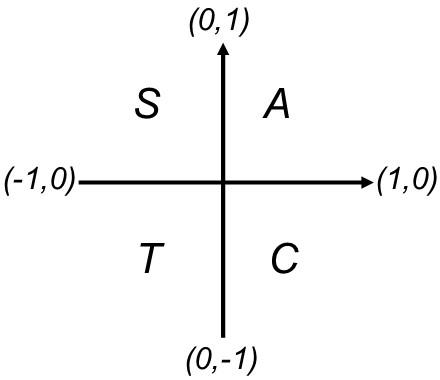

Image illustrating Trigonometric Functions


• Quadrant 1: All trig ratios are positive• Quadrant 2: Only sin ratio is positive• Quadrant 3: Only tan ratio is positive• Quadrant 4: Only cos ratio is positive\begin{array}{l} •\ \text{Quadrant 1: All trig ratios are positive}\\ •\ \text{Quadrant 2: Only sin ratio is positive}\\ •\ \text{Quadrant 3: Only tan ratio is positive}\\ •\ \text{Quadrant 4: Only cos ratio is positive} \end{array}


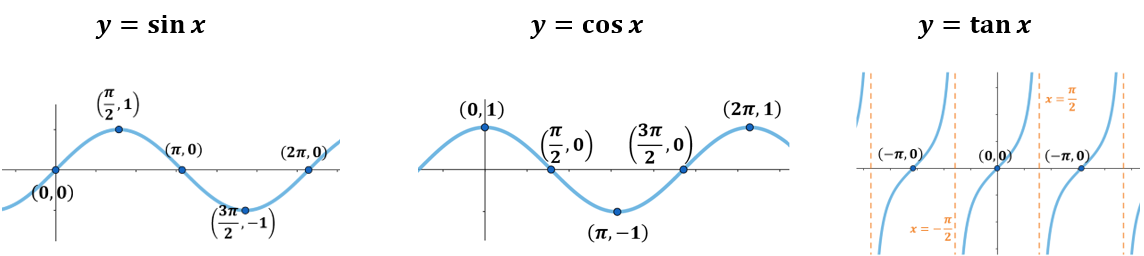
Trig Graphs

Image illustrating Trigonometric Functions


Special Triangles

So called 30-60-90 Triangles and 45-45-90 Triangles help us find exact values of trig functions.


Image illustrating Trigonometric Functions


  1. Draw out the angle given
  2. Identify the relative acute angle (RAA)--angle made with the x-axis
  3. Find the trig ratio of the RAA using special triangles
  4. Make the trig ratio positive or negative based on the CAST rule

Example: tan⁡(π3)=\tan\left(\frac{\pi}{3}\right)=


Create a free account to get started

Unlock full course notes by signing up

  • Video lessons taught by top educators
  • Practice questions with guided solutions
  • Written review notes for reference
  • Expert answers anytime from course tutors

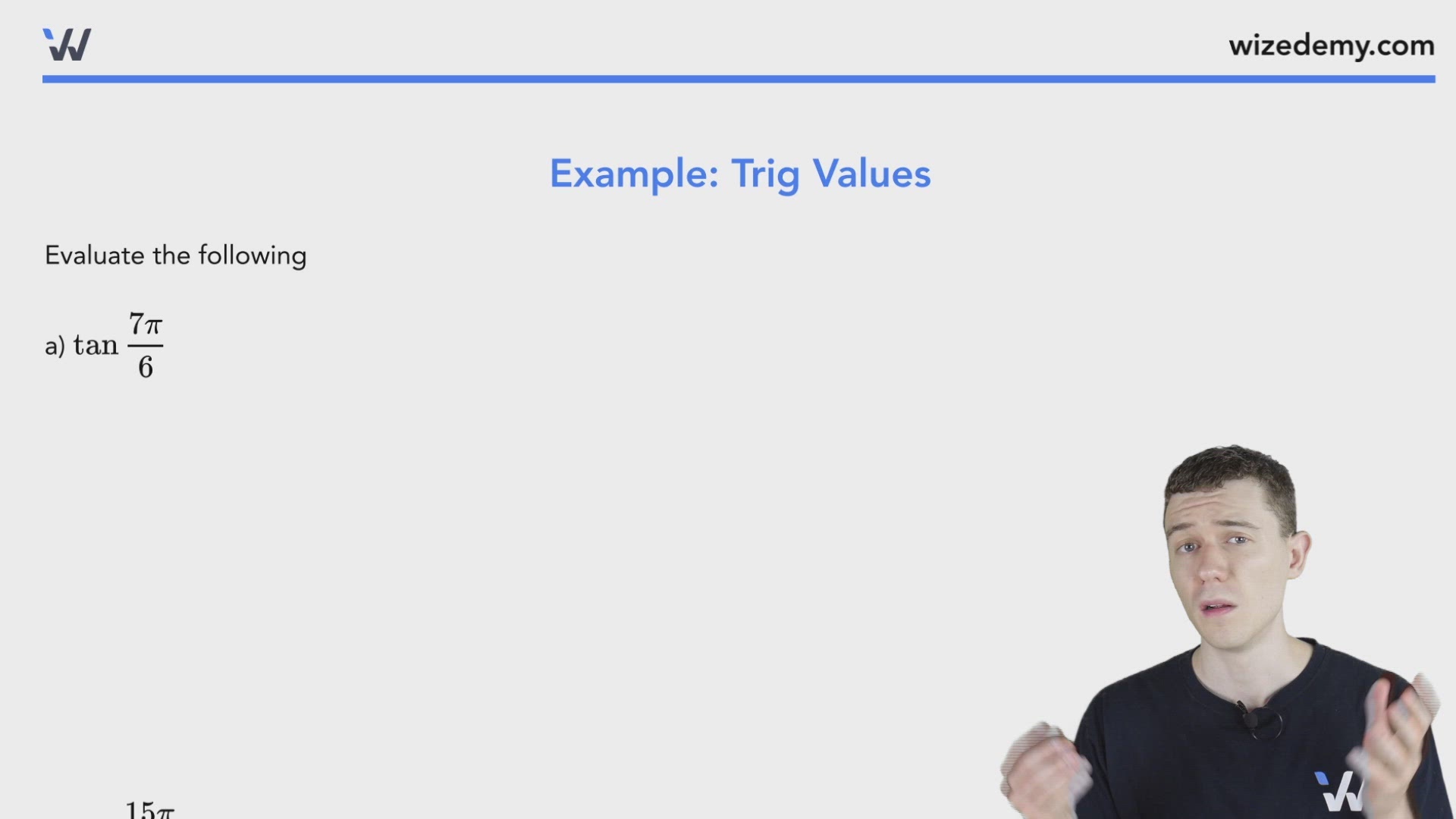
Example: Trig Values

Evaluate the following


a) tan⁡7π6\displaystyle \tan\frac{7\pi}{6}

  1. The angle 7π6\frac{7\pi}{6} can be written as π+π6\pi+\frac{\pi}{6}. So, when we draw out the angle, it’s in quadrant 3.
  2. The relative acute angle (RRA) is the angle it makes with the 𝑥-axis, which will beπ6\frac{\pi}{6} .
  3. Finding the trig. ratio of the relative acute angle, we get tan⁡(π6)=13\tan\left(\frac{\pi}{6}\right)=\frac{1}{\sqrt{3}}
  4. Since tan⁡\tan is positive in the 3rd quadrant (use CAST rule), our answer is tan⁡(7π6)=13\tan\left(\frac{7\pi}{6}\right)=\frac{1}{\sqrt{3}}


b) sin⁡15π4\displaystyle \sin\frac{15\pi}{4}

  1. The angle 15π4\frac{15\pi}{4} can be written as 3π+3π43\pi+\frac{3\pi}{4}. So, when we draw out the angle, it's in quadrant 4.
  2. The relative acute angle (RRA) is the angle it makes with the 𝑥-axis, which will beπ4\frac{\pi}{4} .
  3. Finding the trig. ratio of the relative acute angle, we get sin⁡(π4)=12\sin\left(\frac{\pi}{4}\right)=\frac{1}{\sqrt{2}}
  4. Since sin⁡\sin is negative in the 4th quadrant (use CAST rule), out answer is sin⁡(15π4)=−12\sin\left(\frac{15\pi}{4}\right)=-\frac{1}{\sqrt{2}}
Create a free account to get started

Unlock full course notes by signing up

  • Video lessons taught by top educators
  • Practice questions with guided solutions
  • Written review notes for reference
  • Expert answers anytime from course tutors

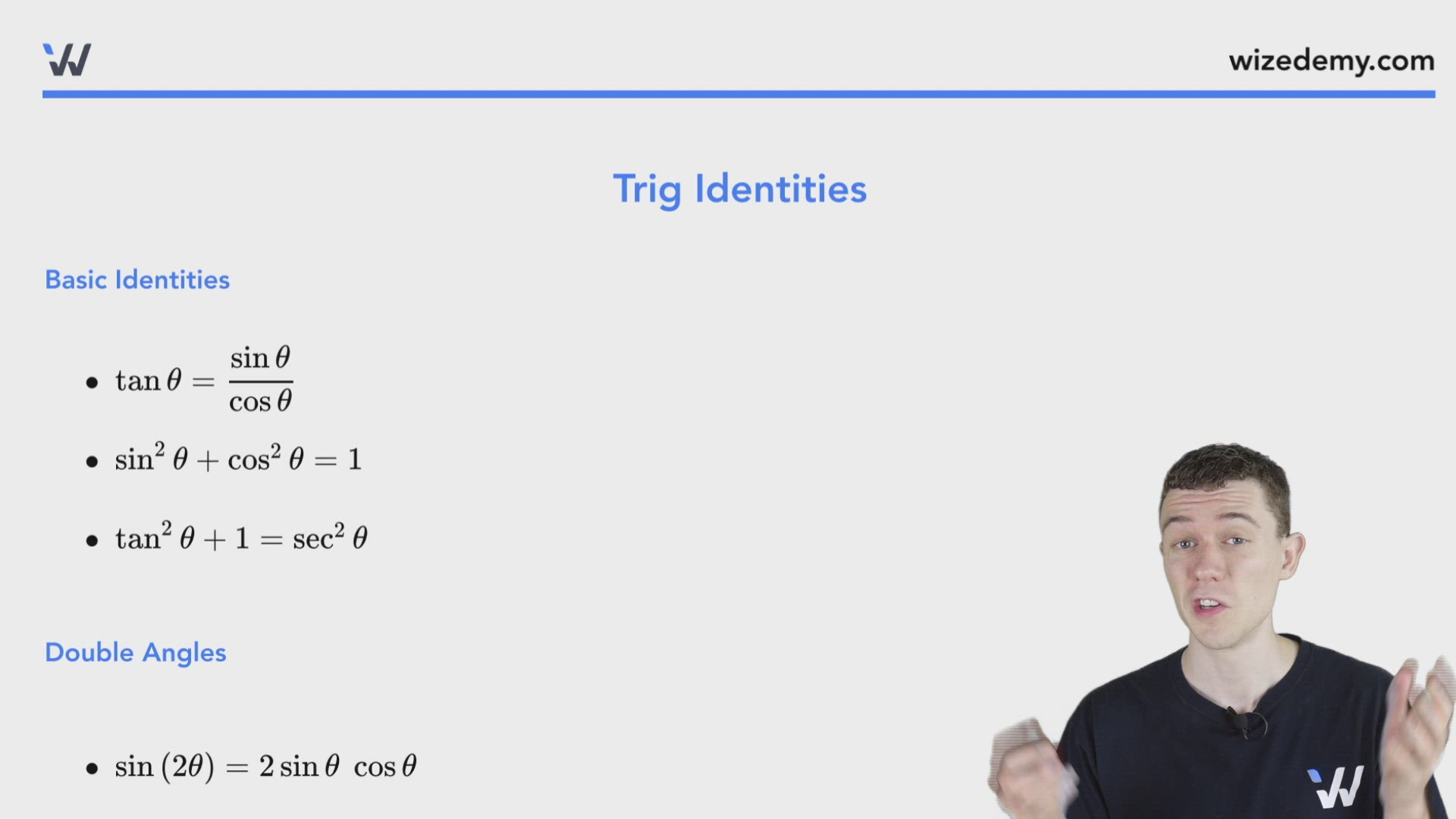
Trig Identities

Basic Identities

  • tan⁡θ=sin⁡θcos⁡θ\displaystyle \tan\theta=\frac{\sin\theta}{\cos\theta}
  • sin⁡2θ+cos⁡2θ=1\sin^2\theta+\cos^2\theta=1
  • tan⁡2θ+1=sec⁡2θ\tan^2\theta+1=\sec^2\theta

Double Angles

  • sin⁡(2θ)=2sin⁡θ cos⁡θ\sin\left(2\theta\right)=2\sin\theta\ \cos\theta
  • cos⁡(2θ)=cos⁡2θ−sin⁡2θ  or  2cos⁡2θ−1  or  1−2sin⁡2θ\cos\left(2\theta\right)=\cos^2\theta-\sin^2\theta\ \ \text{or}\ \ 2\cos^2\theta-1\ \ \text{or}\ \ 1-2\sin^2\theta

Angle Sum & Difference

  • sin⁡(x±y)=sin⁡xcos⁡y±cos⁡xsin⁡y\sin\left(x\pm y\right)=\sin x\cos y\pm\cos x\sin y
  • cos⁡(x±y)=cos⁡xcos⁡y∓sin⁡xsin⁡y\cos\left(x\pm y\right)=\cos x\cos y\mp\sin x\sin y

Even and Odd Properties

  • Odd function: sin⁡(−θ)=−sin⁡θ\sin\left(-\theta\right)=-\sin\theta
  • Even function: cos⁡(−θ)=cos⁡θ\cos\left(-\theta\right)=\cos\theta

Given cos⁡ θ=1213\cos\ \theta=\frac{12}{13} and 3π2<θ<2π\frac{3\pi}{2}<\theta<2\pi , find the exact values of 13sin⁡2θ13\sin2\theta.


Create a free account to get started

Unlock full course notes by signing up

  • Video lessons taught by top educators
  • Practice questions with guided solutions
  • Written review notes for reference
  • Expert answers anytime from course tutors

Solve the equation 2sin⁡2x=3sin⁡x−12\sin^2x=3\sin x-1 on the interval [0,2π]\left[0,2\pi\right].


Choose an answer

Create a free account to get started

Unlock full course notes by signing up

  • Video lessons taught by top educators
  • Practice questions with guided solutions
  • Written review notes for reference
  • Expert answers anytime from course tutors

Extra Practice