Popular Courses
Calculus 1
University Study Guides
MATH 209
Concordia University
MATH 100A
University of British Columbia
MATH 100C
University of British Columbia
MATH 249
University of Calgary
MATH 265
University of Calgary
Calculus 1
General Course
MATH 140
McGill University
MATH 121
Queen's University
MATH*1080
University of Guelph
MATH 134
University of Alberta
Calculus 1
University Study Guides
MAT 1320
University of Ottawa
MATH 100
University of Alberta
MATH 100B
University of British Columbia
MATH 203
Concordia University
MAT 1330
University of Ottawa
MTH 140
Toronto Metropolitan University
SC/MATH 1013 3.00
York University
MATH 109
University of Victoria
0:00 / 0:00
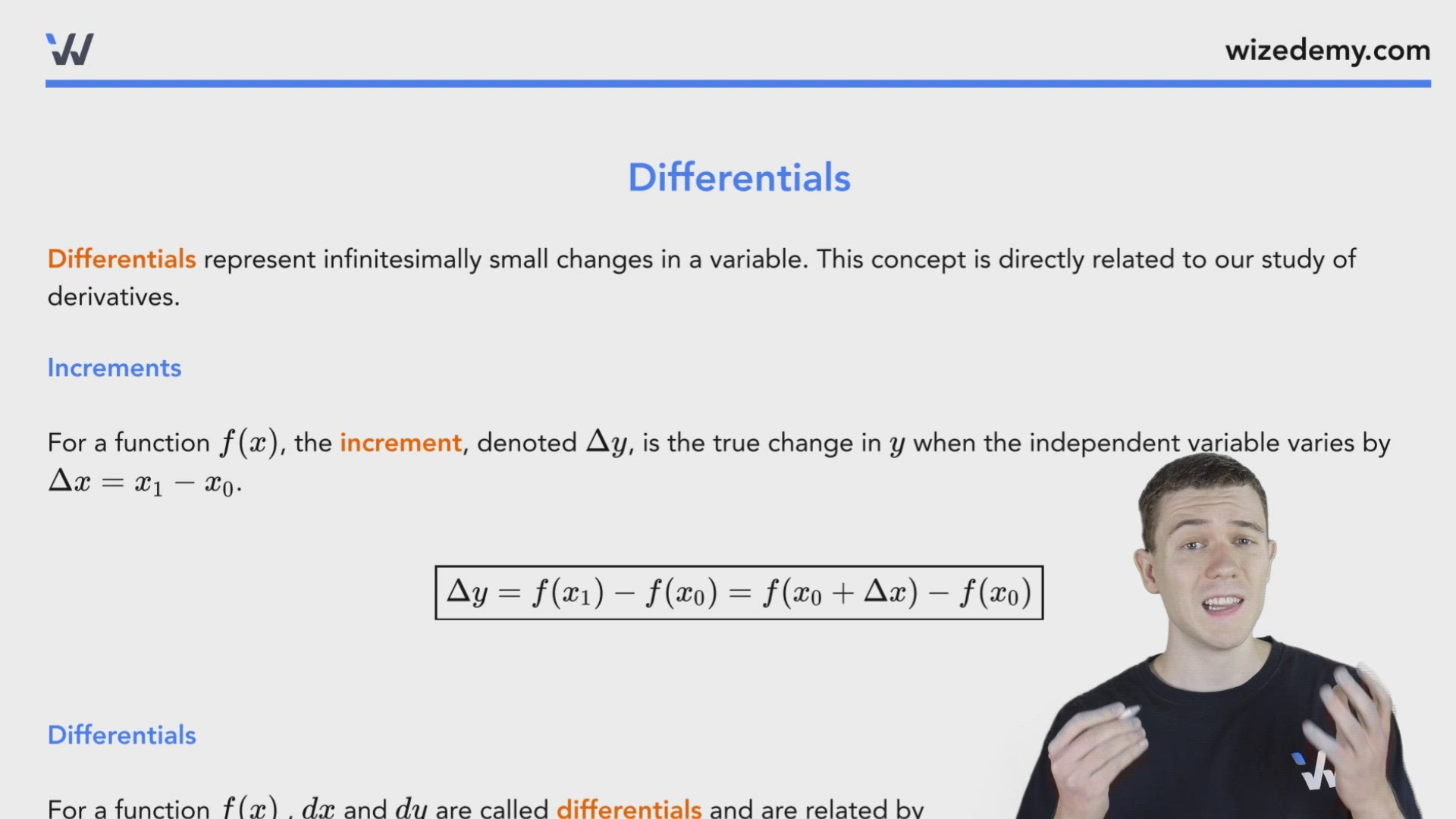
Differentials
Differentials represent infinitesimally small changes in a variable. This concept is directly related to our study of derivatives.
Increments
For a function , the increment, denoted , is the true change in when the independent variable varies by .
Differentials
For a function , and are called differentials and are related by
Approximations with Differentials
When , the change in , is small, increments can be approximated by differentials.
0:00 / 0:00
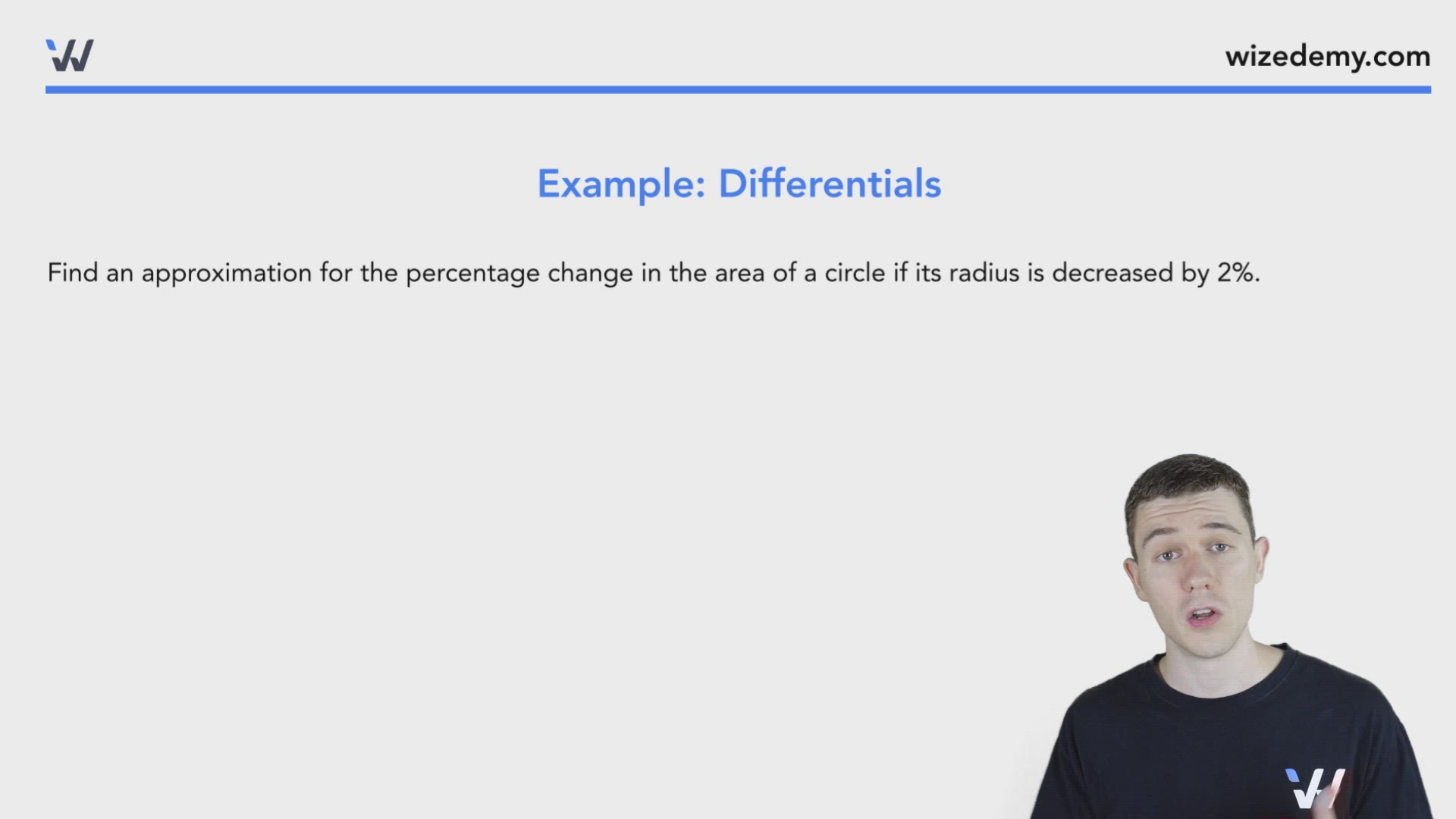
Example: Differentials
Find an approximation for the percentage change in the area of a circle if its radius is decreased by 2%.
Remember and
for constants and . By approximately what percentage will change if increases by ?