Popular Courses
CALCULUS 1000A/B
Western University
Calculus 1
University Study Guides
AP Calculus (AB) Exam Prep Course
AP Exam Prep
MATH 209
Concordia University
MATH 100A
University of British Columbia
MATH 100C
University of British Columbia
MATH 249
University of Calgary
MATH 265
University of Calgary
Calculus 1
General Course
MATH 275
University of Calgary
MATH 140
McGill University
MATH 121
Queen's University
MAT135H1
University of Toronto
MATH*1080
University of Guelph
MATH 134
University of Alberta
Calculus 1
University Study Guides
MAT 1320
University of Ottawa
MATH 100
University of Alberta
MATH 100B
University of British Columbia
MATH 203
Concordia University
0:00 / 0:00
Related Rates
A related rates problem involves quantities which vary with time and equations linking these quantities. Typically, the value of these quantities are given at a certain time as well as their rates of change. Often, one rate is missing and has to be found.
Procedure for Solving Related Rates
- Draw a picture.
- Identify the meaningful variables and constants with their respective units (put them on the picture if applicable).
- Identify the known and unknown rates of change.
- Find an equation linking the variables found in 2.
- Use implicit differentiation to differentiate both sides of the equation found in 4.
- Substitute the known quantities and rates of change in the equation found in 5.
- Solve 6 for the desired rate of change and answer the question.
0:00 / 0:00
Example: Related Rates
A ladder is resting against a wall with the base of the ladder initially from the wall. If the bottom gets pushed towards the wall at a constant rate of , how fast is the top of the ladder moving up the wall after 8 seconds?
1) Draw a Picture
2) Identify the meaningful variables and constants with their respective units (put them on the picture if applicable).
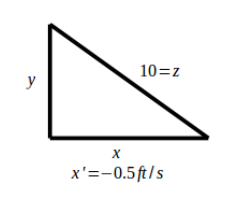
3) Identify the known and unknown rates of change
4) Find an equation linking the variables found in 2)
5) Use implicit differentiation to differentiate both sides of the equation found in 4)
6) Substitute the known quantities and rates of change into the equation in 5)
0:00 / 0:00
Example: Related Rates
If a tree trunk adds of an feet to its diameter and foot to its height each year, how rapidly is its volume changing when its diameter is feet and its height is feet (assume that the tree trunk is a circular cylinder).
1) Draw a Picture (see video)
2) Identify the meaningful variables and constants with their respective units (put them on the picture if applicable).
Let
3) Identity the known and unknown rates of change
Given
and
4) Find an equation linking the variables found in 2)
The volume of the trunk is
5) Use implicit differentiation to differentiate both sides of the equation found in 4)
6) Substitute the known quantities and rates of change into the equation in 5)
The radius of a pizza plate increases at a rate of cm/min placed in an oven. At what rate is the area of the plate increasing when cm?
A rocket is rising straight up from a level field by an observer feet from the point of launch. At the moment the observer's angle of elevation is , the angle is increasings at a rate of rads/minute. How fast is the rocket rising at that moment?

Mark Yourself Question
- Grab a piece of paper and try this problem yourself.
- When you're done, check the "I have answered this question" box below.
- View the solution and report whether you got it right or wrong.
A man running straight at a rate of ft/sec along a level street passes under a vertically rising balloon when it is feet high. Assuming that the balloon is rising at a constant rate of ft/sec, how fast is the distance between the balloon and the man increasing seconds later?