Wize University Calculus 1 Textbook > Applications of Differentiation for Science
Newton’s Law of Cooling
Popular Courses
Calculus 1
University Study Guides
MATH 100A
University of British Columbia
Calculus 1
General Course
MATH 134
University of Alberta
MATH 134
University of Alberta
Calculus 1
University Study Guides
MATH 100B
University of British Columbia
MAT 1330
University of Ottawa
MTH 140
Toronto Metropolitan University
SC/MATH 1506 3.00
York University
MTH 131
Toronto Metropolitan University
MATH 1000
Dalhousie University
MATH 139
McGill University
MATH 1225A/B
Western University
MATH 1500
University of Manitoba
MATH-1760
University of Windsor
MA103
Wilfrid Laurier University
MATH 110
University of British Columbia
MATH 140
Pennsylvania State University
MATH 126
Queen's University
0:00 / 0:00
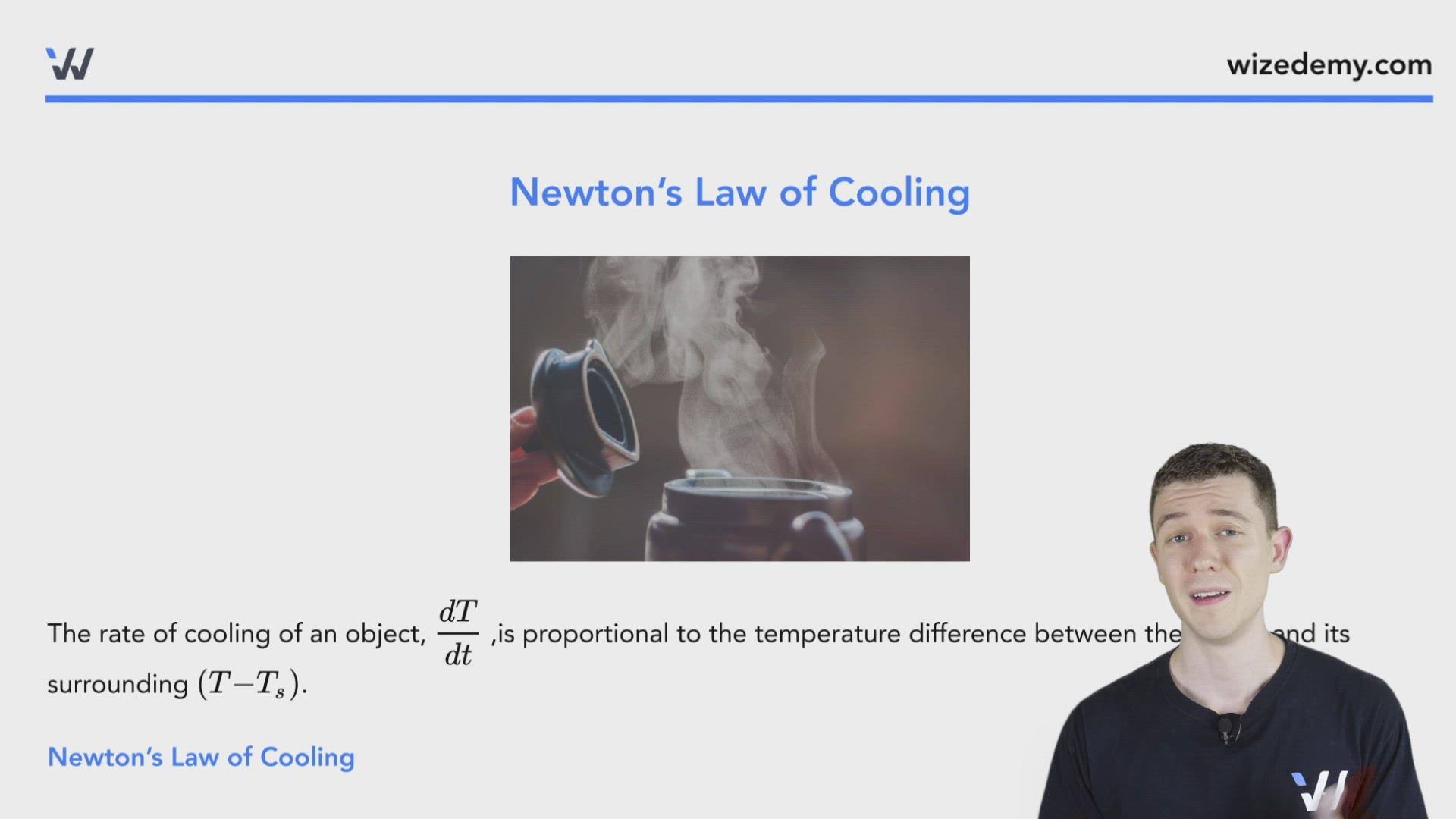
Newton’s Law of Cooling

The rate of cooling of an object, ,is proportional to the temperature difference between the object and its surrounding .
Newton’s Law of Cooling
where is the constant of proportionality, is the temperature of the object at time ,and is the temperature of the surroundings. The equation reduces to a growth/decay differential equation and the solution is
0:00 / 0:00
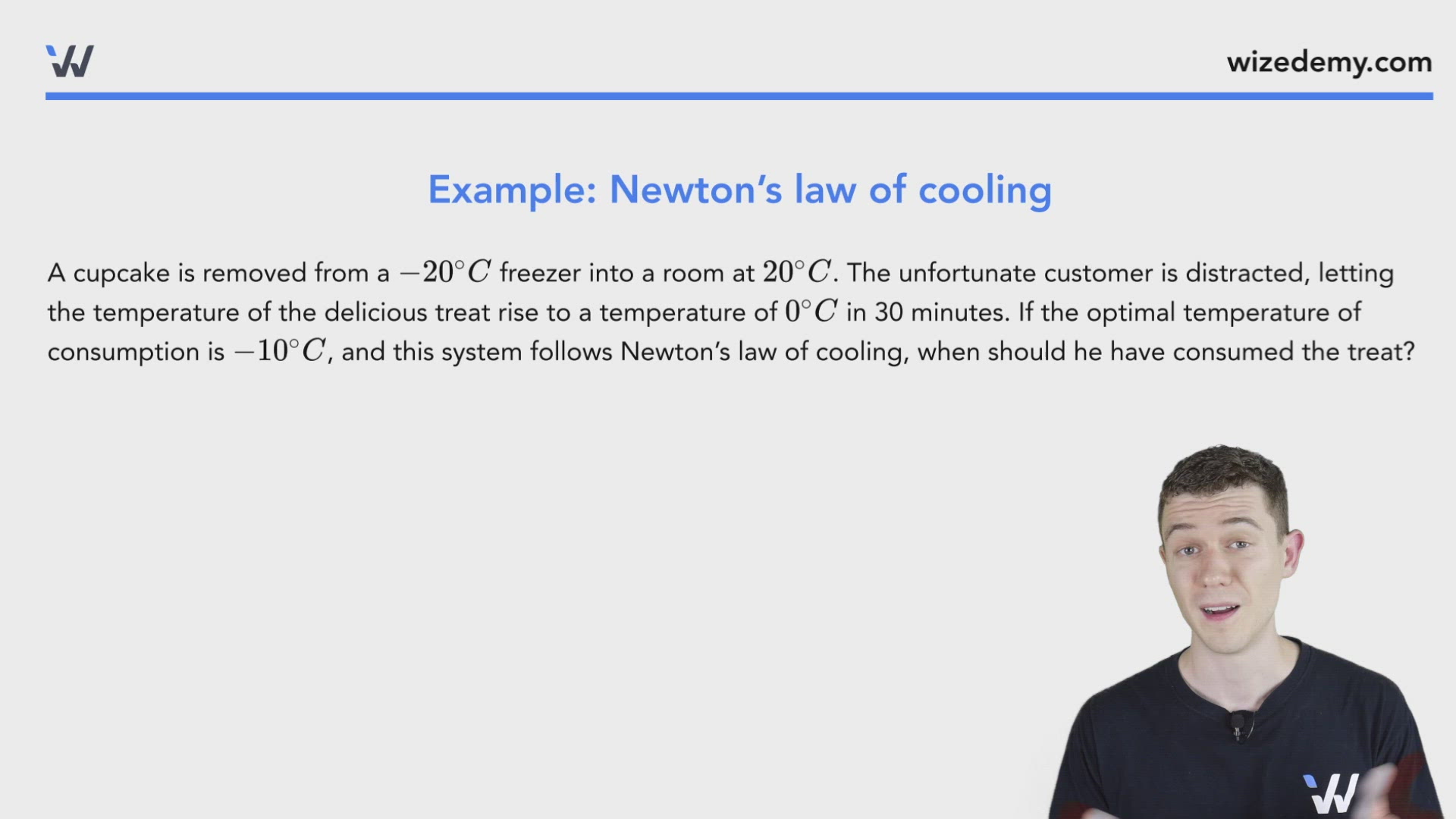
Example: Newton’s law of cooling
A cupcake is removed from a freezer into a room at . The unfortunate customer is distracted, letting the temperature of the delicious treat rise to a temperature of in 30 minutes. If the optimal temperature of consumption is , and this system follows Newton’s law of cooling, when should he have consumed the treat?
then
Consider Newton's law of cooling
Determine .