Wize University Calculus 1 Textbook > Applications of Differentiation for Science
Exponential Growth and Decay
Popular Courses
Calculus 1
University Study Guides
MATH 100A
University of British Columbia
Calculus 1
General Course
MATH 134
University of Alberta
MATH 134
University of Alberta
Calculus 1
University Study Guides
MATH 100B
University of British Columbia
MAT 1330
University of Ottawa
MTH 140
Toronto Metropolitan University
SC/MATH 1506 3.00
York University
MTH 131
Toronto Metropolitan University
MATH 1000
Dalhousie University
MATH 139
McGill University
MATH 1225A/B
Western University
MATH 1500
University of Manitoba
MATH-1760
University of Windsor
MA103
Wilfrid Laurier University
MATH 110
University of British Columbia
MATH 140
Pennsylvania State University
MATH 126
Queen's University
0:00 / 0:00
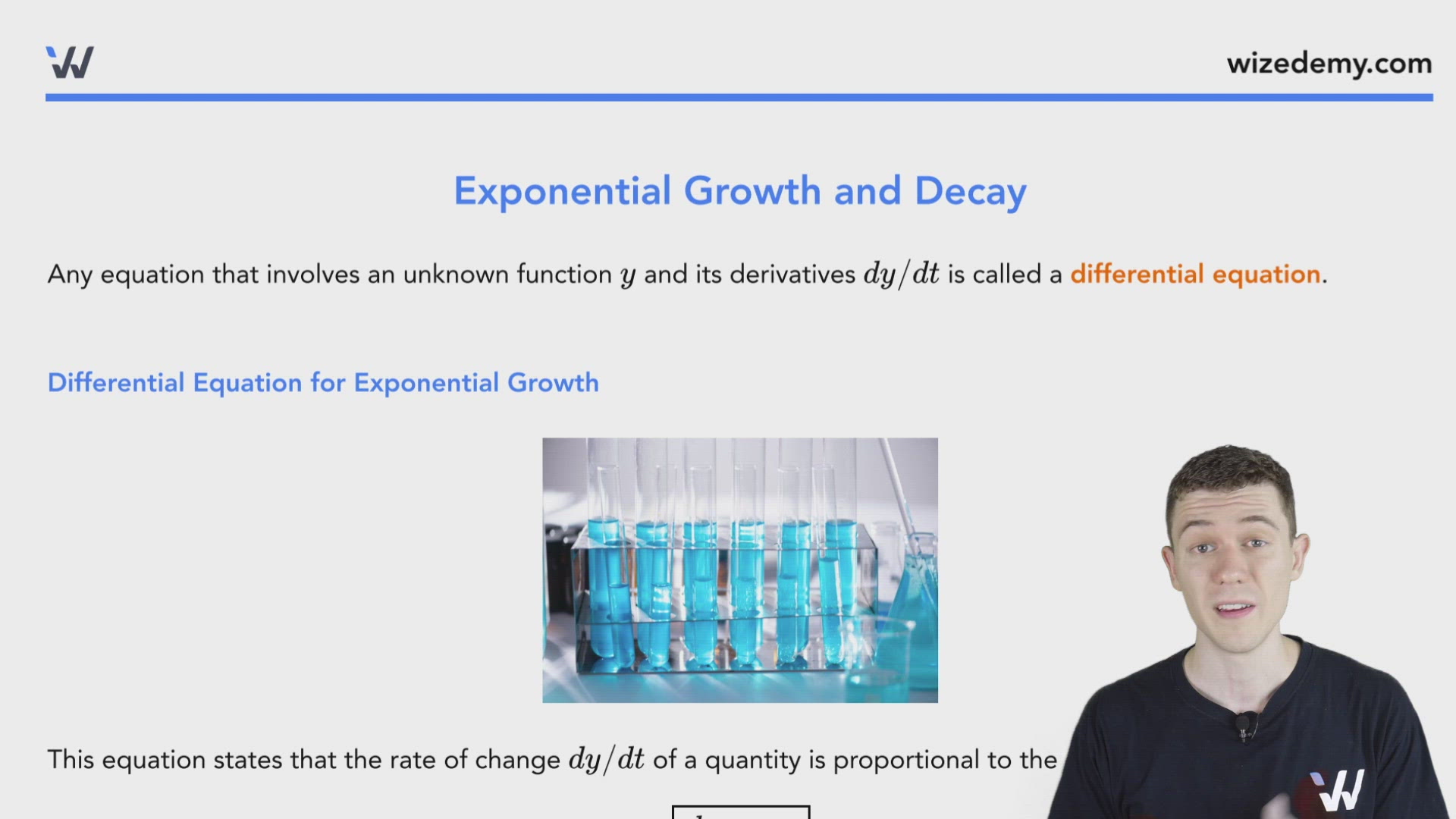
Exponential Growth and Decay
Any equation that involves an unknown function and its derivatives is called a differential equation.
Differential Equation for Exponential Growth

This equation states that the rate of change of a quantity is proportional to the current value of that quantity.
where is a constant called the proportionality constant If is the value of the function at time the solution becomes
Wize Tip
The half-life of a radioactive substance is defined as the time it takes the substance to decay to half of its original size.
Logistic Growth Model

A variant on the Exponential Growth Model is the Logistic Growth Model. This model's growth rate decreases as the population approaches the carrying capacity.
Where is the population at time , is the carrying capacity, and is the proportionality constant.
Where is determined by the initial condition .
Wize Tip
The population growth rate is fastest when the population is equal to .
0:00 / 0:00
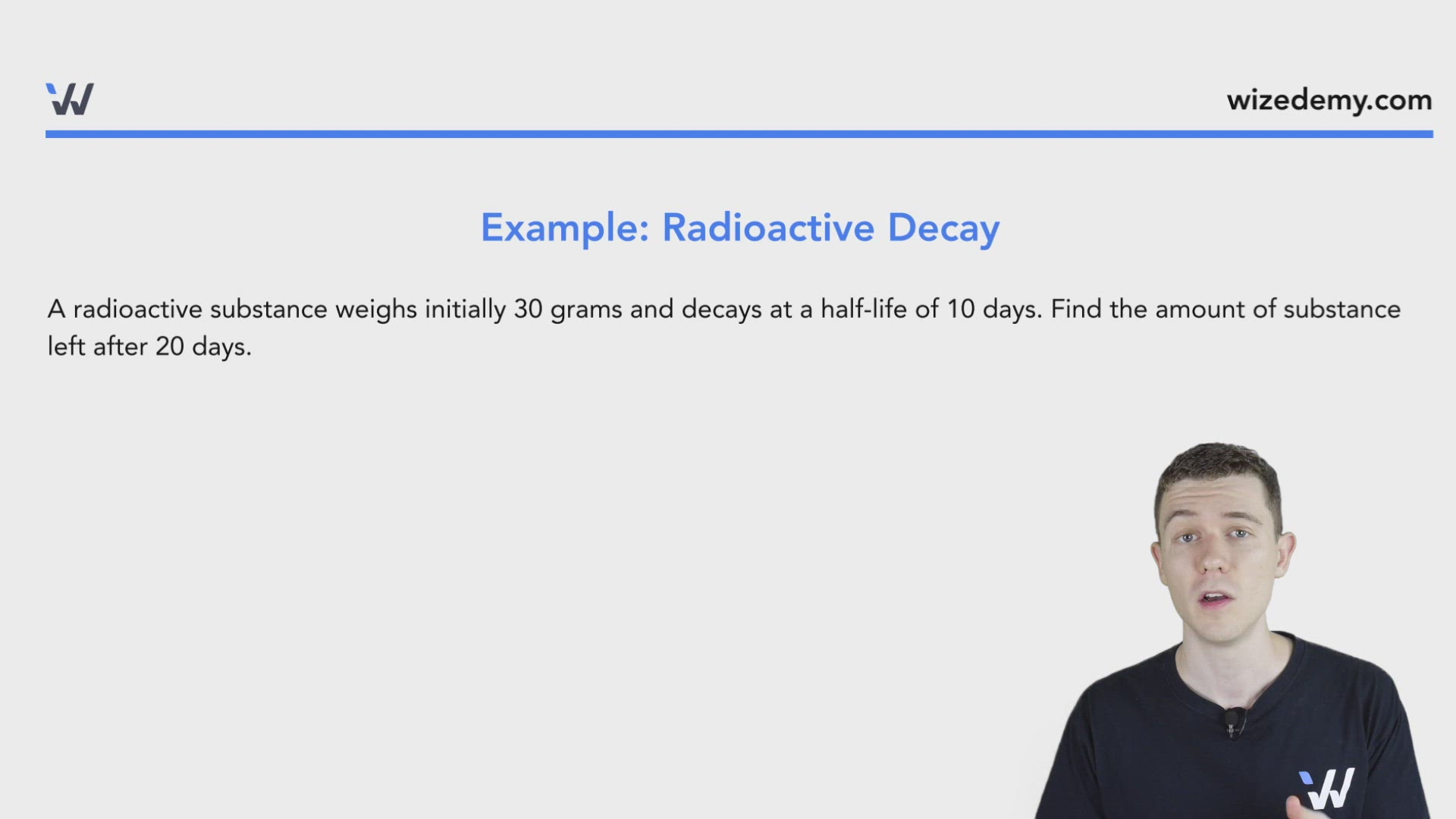
Example: Radioactive Decay
A radioactive substance weighs initially 30 grams and decays at a half-life of 10 days. Find the amount of substance left after 20 days.
With 2nd condition, we have:
0:00 / 0:00
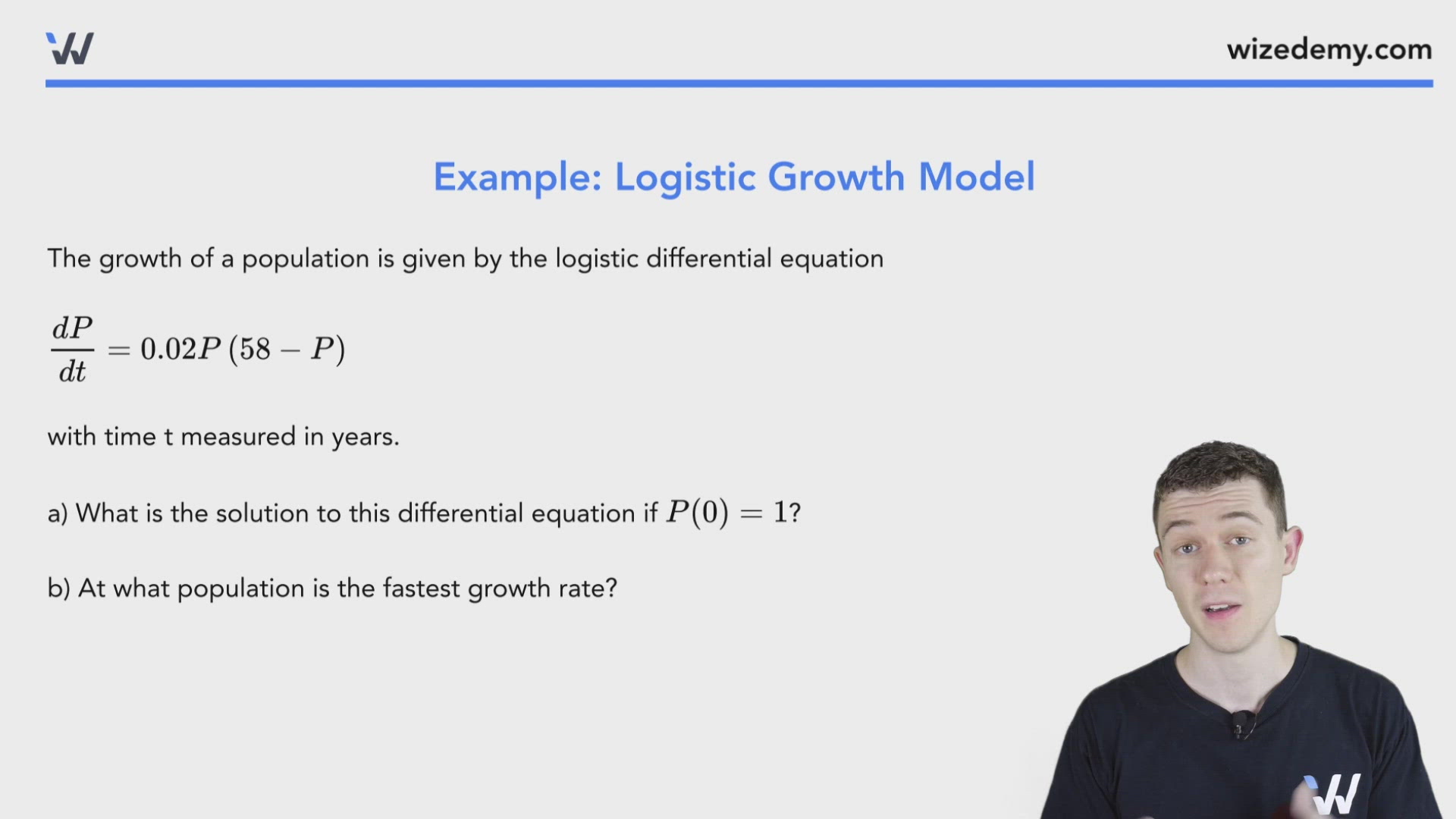
Example: Logistic Growth Model
The growth of a population is given by the logistic differential equation
with time t measured in years.
a) What is the solution to this differential equation if ?
b) At what population is the fastest growth rate?
a)
b) Find the critical points of the differential equation.
Alternatively, recall the fastest growth rate occurs at .
The number of a certain type of bacteria grows exponentially from 100 to 200 in 3 hours. In a fermentation process, 50 of these bacteria live. After 9 hours, 150 bacteria die due to feed rate shortage. Approximately how long will it take them to grow from that time to 1410 bacteria?