Popular Courses
Calculus 1
University Study Guides
MATH 209
Concordia University
Calculus 1
General Course
MATH 154
University of Alberta
MATH 154
University of Alberta
Calculus 1
University Study Guides
MTH 131
Toronto Metropolitan University
MA129
Wilfrid Laurier University
MATH 1500
University of Manitoba
MATH 121B
Queen's University
MATH 110
University of British Columbia
MATH 140
Pennsylvania State University
MATH 126
Queen's University
MATH 1510
University of Manitoba
MAT 1300
University of Ottawa
MTH 132
Michigan State University
MATH 1F03
McMaster University
MATA29H3
University of Toronto
MATH 1MM3
McMaster University
MAC 2311
University of Florida
0:00 / 0:00
Compound Interest
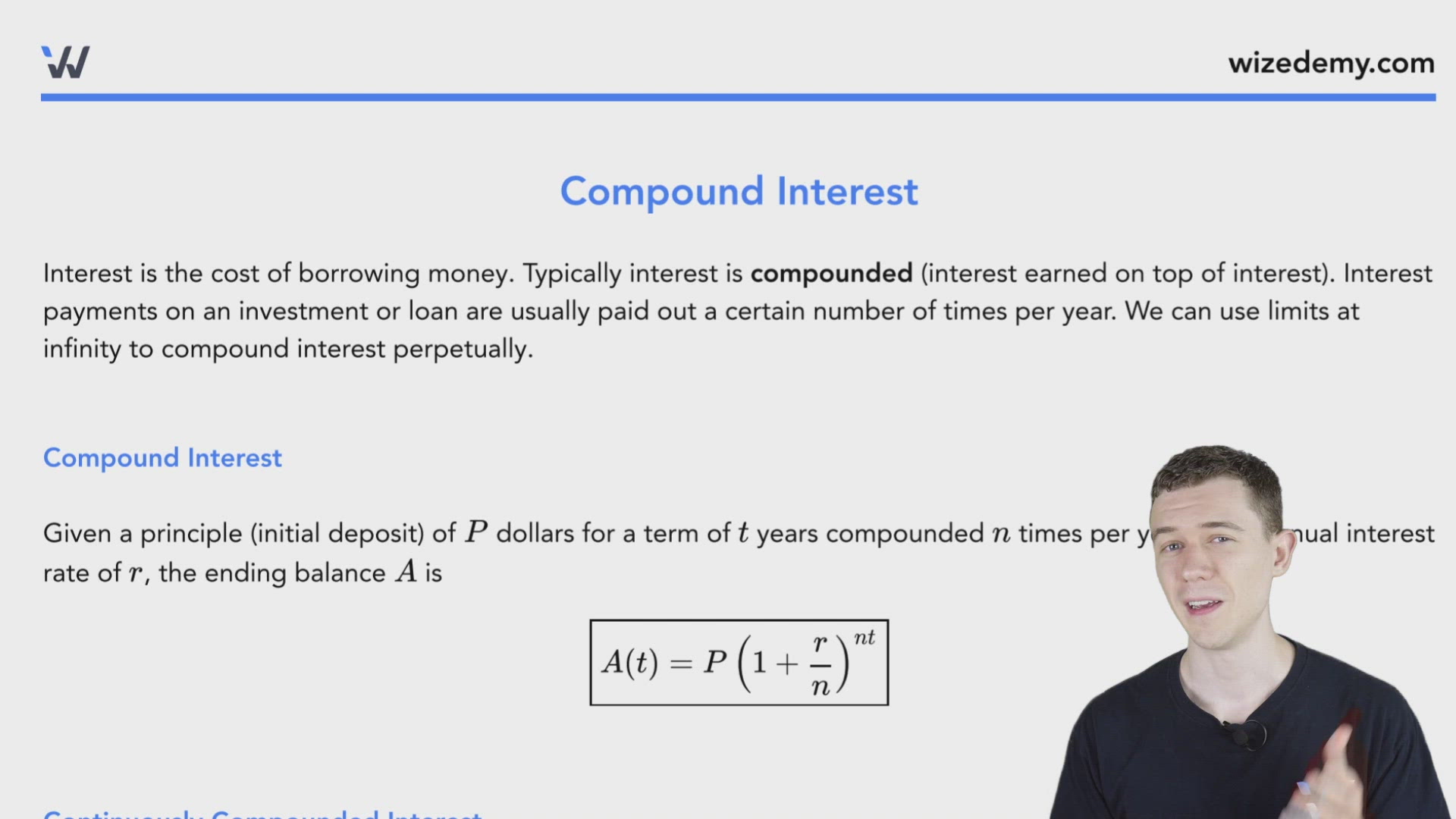
Interest is the cost of borrowing money. Typically interest is compounded (interest earned on top of interest). Interest payments on an investment or loan are usually paid out a certain number of times per year. We can use limits at infinity to compound interest perpetually.
Compound Interest
Given a principle (initial deposit) of dollars for a term of years compounded times per year at an annual interest rate of , the ending balance is
Continuously Compounded Interest
Instead of being compounded times a year, if interest is compounded continuously the ending balance is
Wize Concept
The above limit can be solved using L’Hˆopital’s Rule as an indeterminate form.
0:00 / 0:00
Example: Compound Interest
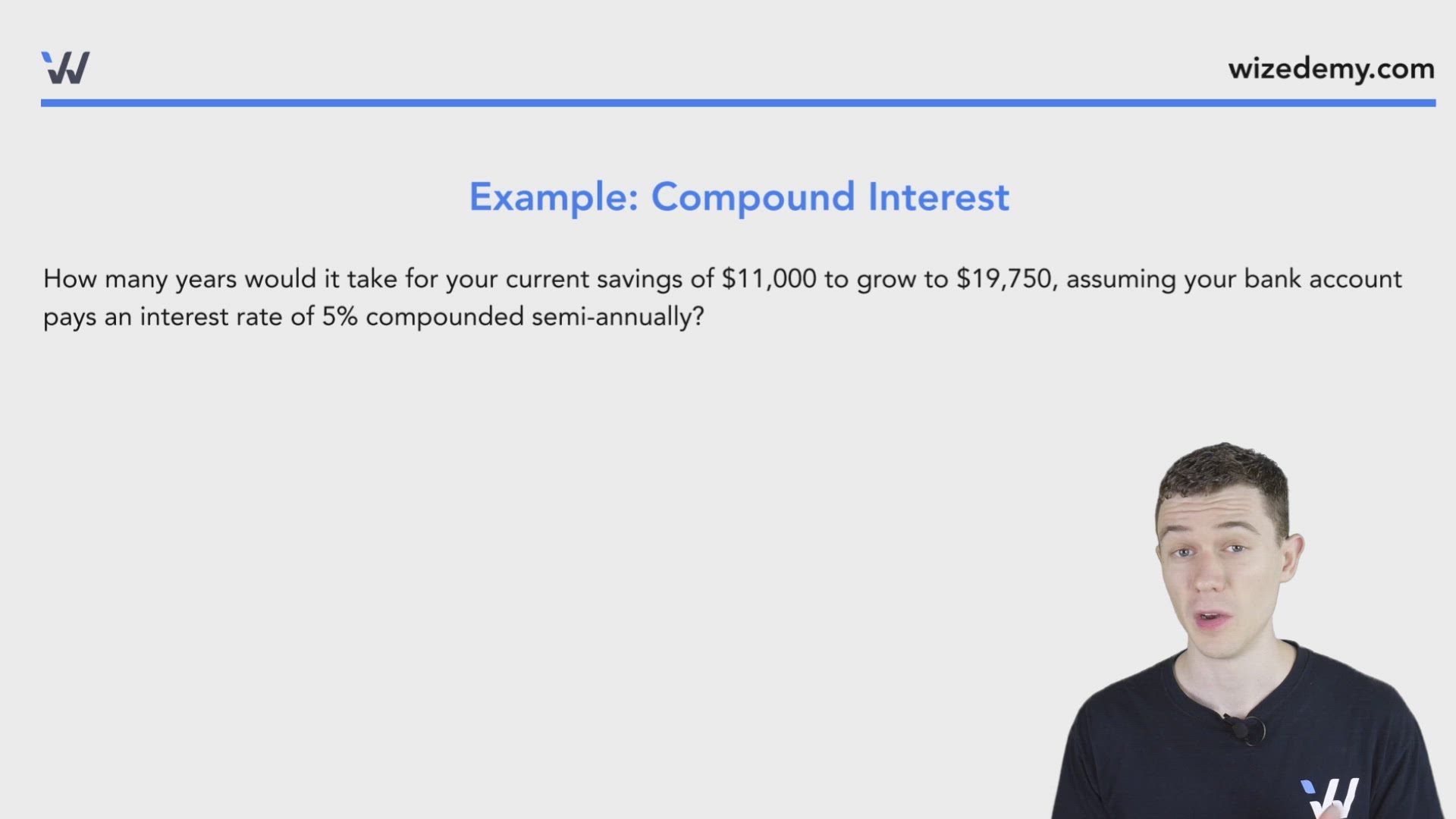
How many years would it take for your current savings of $11,000 to grow to $19,750, assuming your bank account pays an interest rate of 5% compounded semi-annually?
Interest compounded semi-annually:
Take the ln of both sides:
(years)
Given an initial investment of $7000 continuously compounded, what is the rate of annual interest required for this principle to double in 5 years?