Wize University Calculus 1 Textbook > Integrals
The Fundamental Theorem of Calculus - Part 2
Popular Courses
CALCULUS 1000A/B
Western University
Calculus 1
University Study Guides
AP Calculus (AB) Exam Prep Course
AP Exam Prep
MATH 209
Concordia University
MATH 1LS3
McMaster University
MATH 249
University of Calgary
MATH 265
University of Calgary
Calculus 1
General Course
MATH 275
University of Calgary
MATH 140
McGill University
MATH 121
Queen's University
MATH*1080
University of Guelph
MATH 134
University of Alberta
MATH 154
University of Alberta
Calculus 1
University Study Guides
MAT 1320
University of Ottawa
MATH 100
University of Alberta
MAT 1330
University of Ottawa
MTH 140
Toronto Metropolitan University
SC/MATH 1013 3.00
York University

0:00 / 0:00
Fundamental Theorem of Calculus (FTC) - Part 2
Computing definite integrals by definition is often difficult and time consuming. Fortunately, the second part of The Fundamental Theorem of Calculus provides us with a straightforward way of computing definite integrals.
Fundamental Theorem of Calculus: 2
Let be a continuous function on , so that on we have
Note: Sometimes we will use the notation
Wize Concept
To compute definite integrals using FTC, compute the antiderivative of the function, substitute the upper bound, and subtract substituting the lower bound.
0:00 / 0:00
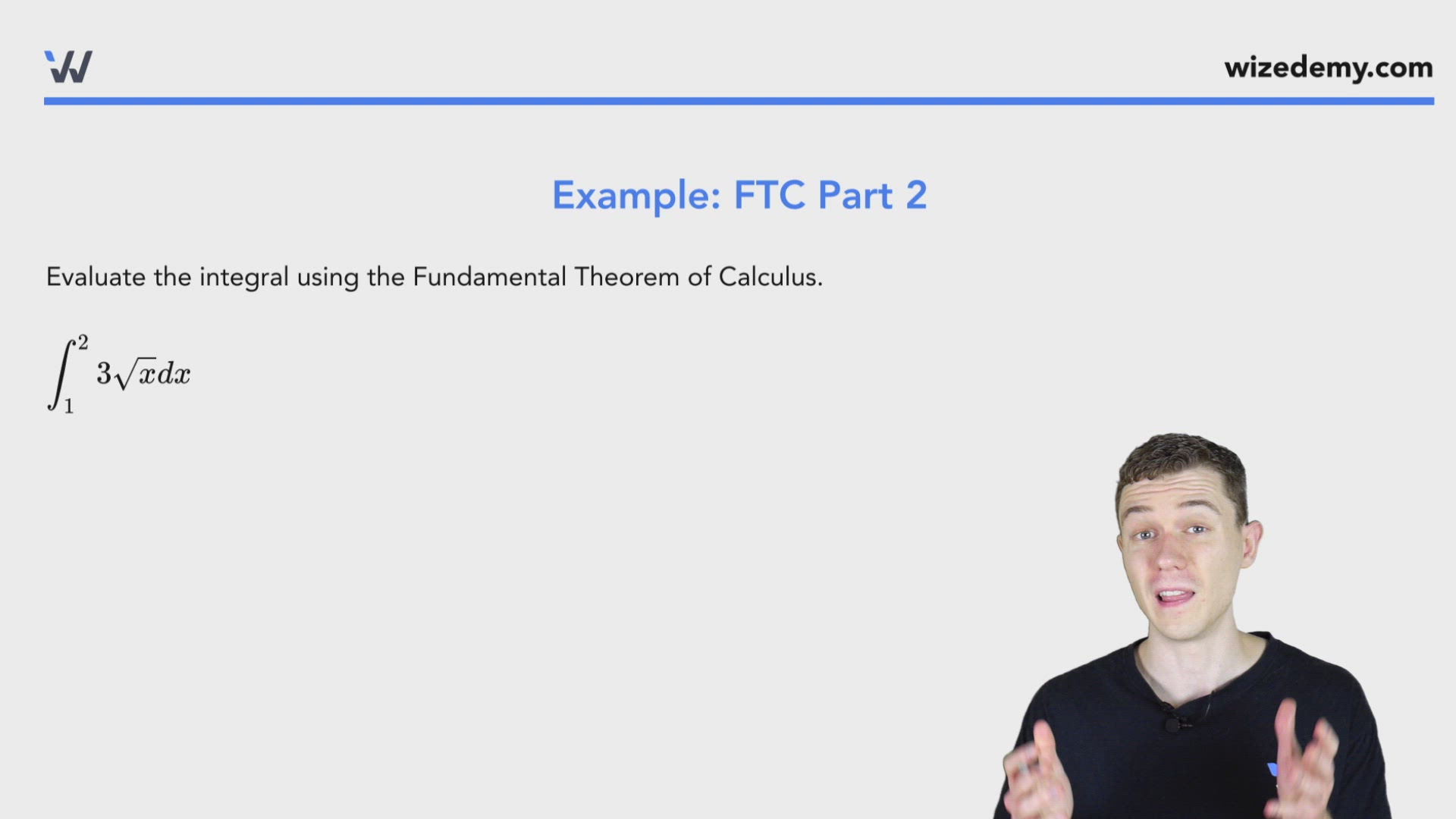
Example: FTC Part 2
Evaluate the integral using the Fundamental Theorem of Calculus.
(by defining the antiderivative)
(applying FTC2)

0:00 / 0:00
Example: FTC Part 2
Evaluate the integral using the Fundamental Theorem of Calculus.
Evaluate .
If , then what is a possible value of ?
Given that both and are continuous everywhere, if and , find .
Extra Practice
Fundamental Theorem of Calculus
Given that both and are continuous everywhere, and given and , find .
Practice: Property of Definite Integral
Given that both and are continuous everywhere, ifand , find .
Practice: Property of Definite Integral
Given that both and are continuous everywhere, ifand , find .