Create a free account to get started

Unlock full course notes by signing up

  • Video lessons taught by top educators
  • Practice questions with guided solutions
  • Written review notes for reference
  • Expert answers anytime from course tutors

Integrals to Compute Work

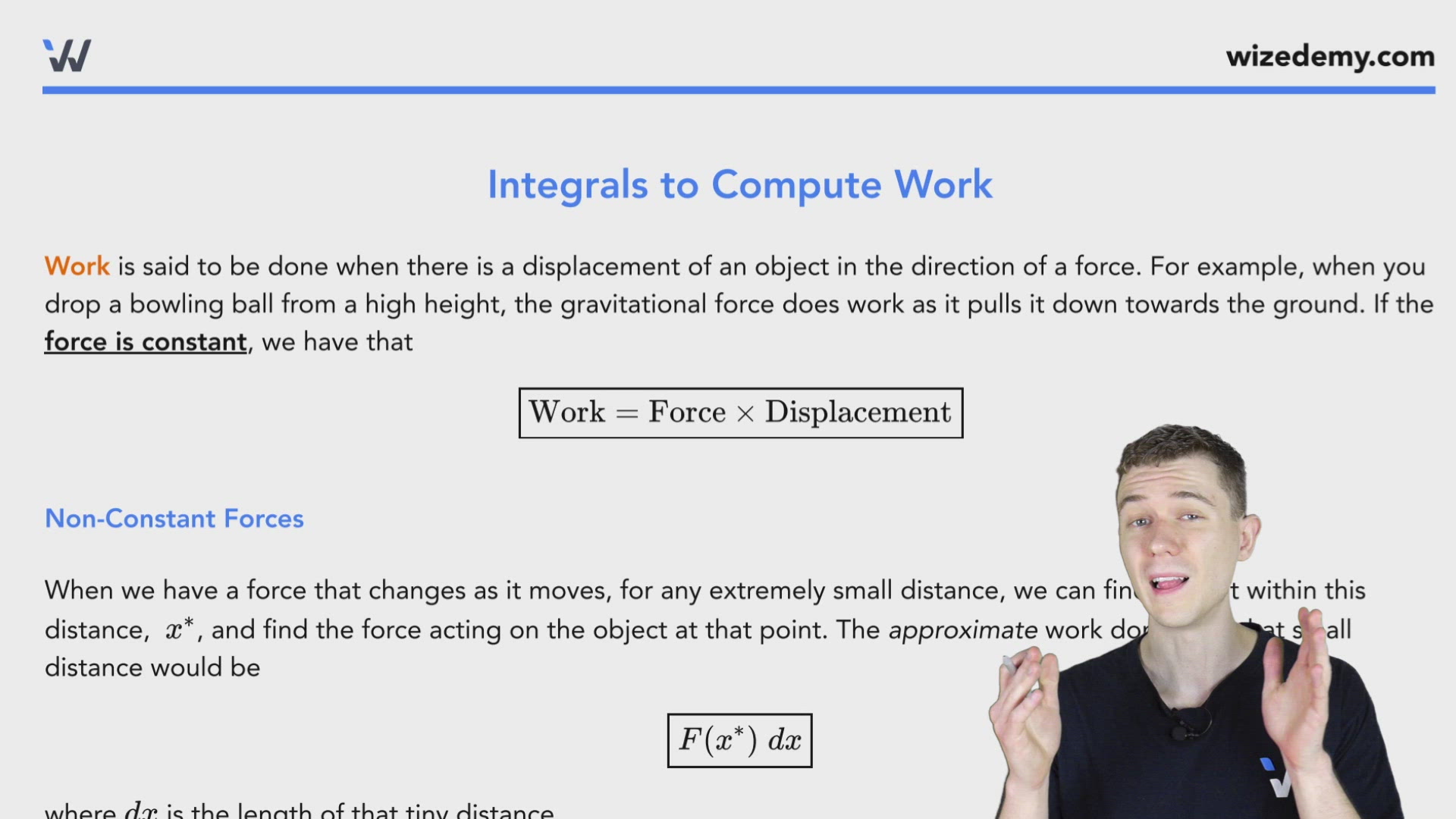
Work is said to be done when there is a displacement of an object in the direction of a force. For example, when you drop a bowling ball from a high height, the gravitational force does work as it pulls it down towards the ground. If the force is constant, we have that

Work=Force×Displacement\boxed{\text{Work} = \text{Force} \times \text{Displacement}}

Non-Constant Forces

When we have a force that changes as it moves, for any extremely small distance, we can find a point within this distance, x∗x^\ast, and find the force acting on the object at that point. The approximate work done over that small distance would be

F(x∗)  dx\boxed{F(x^\ast) \; dx}

where dxdx is the length of that tiny distance.


Work Integrals

This idea is exactly the basis upon which we developed the notion of an integral from Riemann sums, so we generalize this to the integral to obtain that

Work=∫abF(x)  dx\boxed{\text{Work} = \int_{a}^{b} F(x) \; dx}

where F(x)F(x) is the force acting on the object at position xx from points aa to bb .


Hooke's Law

If the question involves springs, we will need Hooke's Law: F(x)=kx\boxed{F(x)=kx}

  • FFis the force required to stretch or compress the spring
  • kk is the spring constant
  • xxis the distance stretched or compressed (in meters)
Create a free account to get started

Unlock full course notes by signing up

  • Video lessons taught by top educators
  • Practice questions with guided solutions
  • Written review notes for reference
  • Expert answers anytime from course tutors

Example: Work

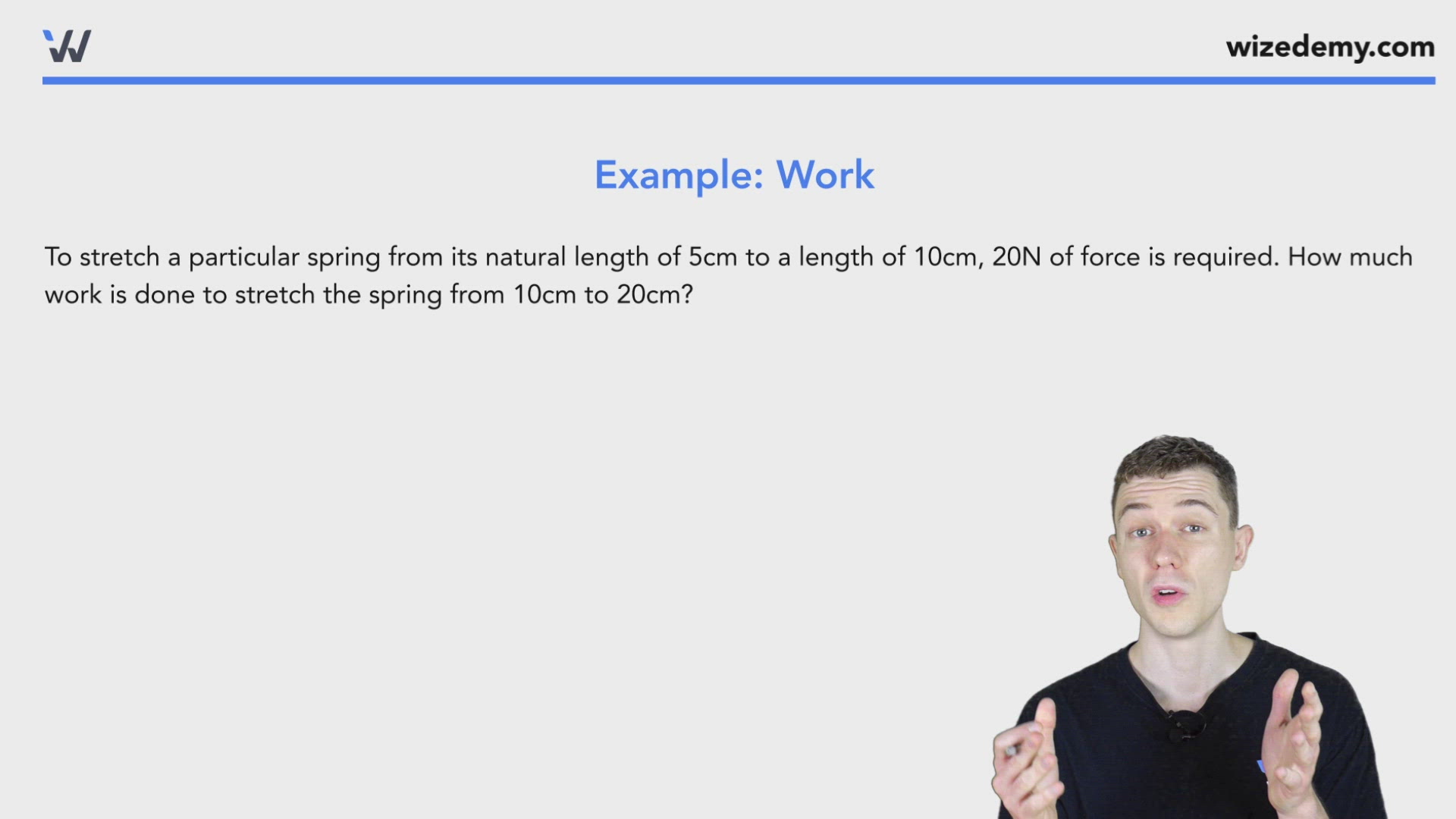
To stretch a particular spring from its natural length of 5cm to a length of 10cm, 20N of force is required. How much work is done to stretch the spring from 10cm to 20cm?


Stretching from 5cm to 10cm:


x=5 cm =0.05 mx=5 \ \text{cm}\ =0.05 \ \text{m}


F=20NF=20N


So, k=Fx=200.05=400\displaystyle k=\frac{F}{x}=\frac{20}{0.05}=400


So, the force exerted by the spring is F(x)=400xF\left(x\right)=400x.


Stretching from 10cm to 20cm:

Since the natural length of the spring is 5cm, our initial stretched length is actually 5 cm, and the final stretched length is 15cm.


The work done is


∫abF(x)dx\displaystyle \int_a^bF\left(x\right)dx


=∫0.050.15400x dx\displaystyle=\int_{0.05}^{0.15}400x\ dx


=[200x2]0.050.15\displaystyle =\left[200x^2\right]_{0.05}^{0.15}


=200[0.152−0.052]=200\left[0.15^2-0.05^2\right]

A chain with a total mass of 100 kg is hanging from the top of a 200 m building to the ground. Write down and solve a definite integral to determine the minimum work done in lifting the chain to the top of the building.


Your answers

Create a free account to get started

Unlock full course notes by signing up

  • Video lessons taught by top educators
  • Practice questions with guided solutions
  • Written review notes for reference
  • Expert answers anytime from course tutors

Extra Practice