Wize University Calculus 1 Textbook > Applications of Integration for Physical Science
Position, Velocity, and Acceleration
Popular Courses
CALCULUS 1000A/B
Western University
Calculus 1
University Study Guides
AP Calculus (AB) Exam Prep Course
AP Exam Prep
MATH 1LS3
McMaster University
Calculus 1
General Course
MATH 121
Queen's University
Calculus 1
University Study Guides
MTH 140
Toronto Metropolitan University
MTH 131
Toronto Metropolitan University
MATH 1225A/B
Western University
MATH 1500
University of Manitoba
MATH 121B
Queen's University
MATH 146
University of Alberta
MATH 110
University of British Columbia
MATH 140
Pennsylvania State University
MATH 126
Queen's University
MATH 1510
University of Manitoba
MAT 1300
University of Ottawa
MTH 132
Michigan State University
MATA29H3
University of Toronto
0:00 / 0:00
Position, Velocity, and Acceleration
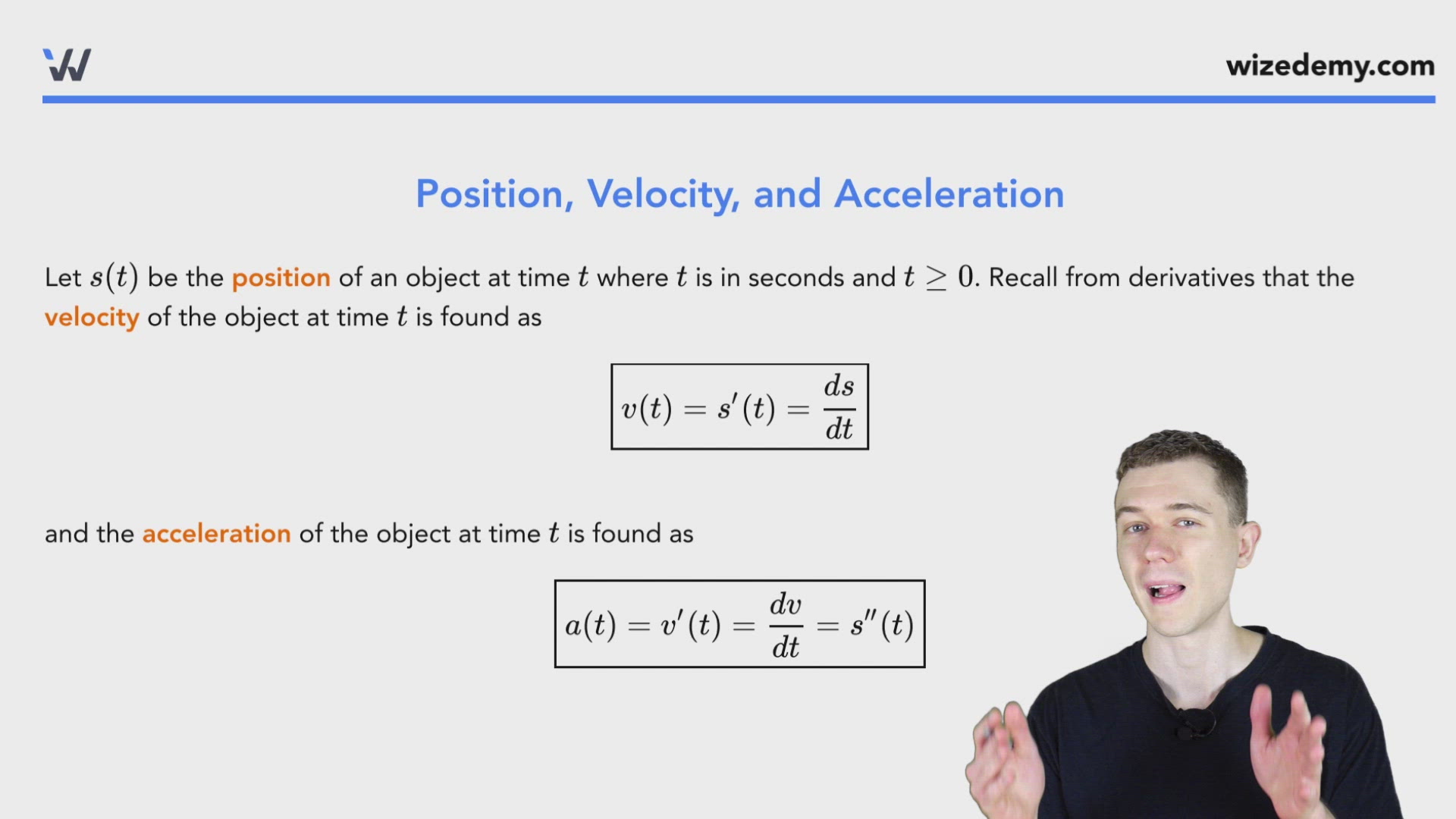
Let be the position of an object at time where is in seconds and . Recall from derivatives that the velocity of the object at time is found as
and the acceleration of the object at time is found as
Velocity and Position from Integrals
From what we now know of antiderivatives, this means that we can find velocity and position of the object given only its acceleration, its initial velocity , and its initial position :
Wize Concept
and are the constants of integration (the from indefinite integrals).
- Speed is the absolute value of velocity,
- If an object is dropped from rest, its only acceleration is due to gravity,
0:00 / 0:00
Example: Position and Velocity
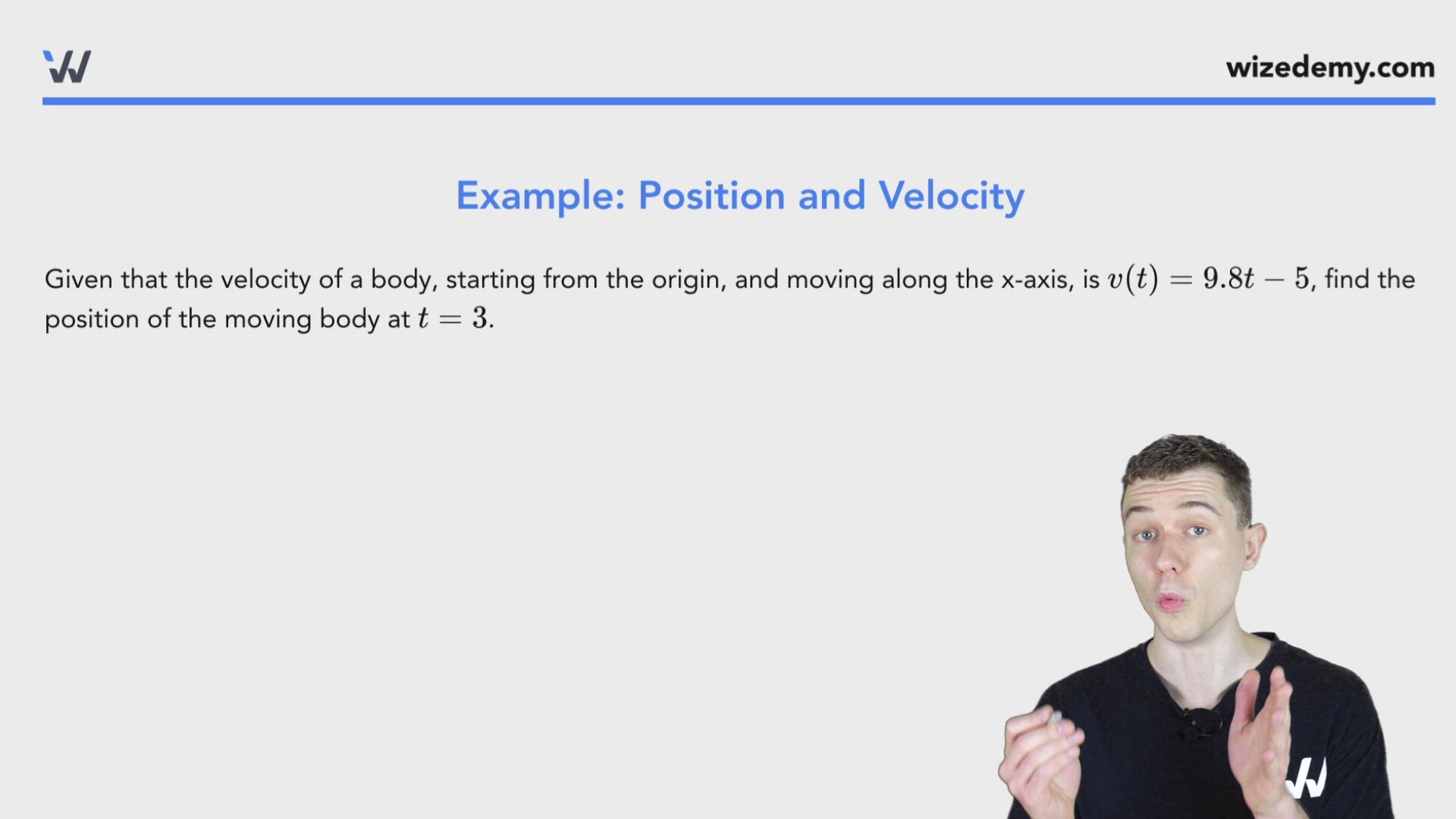
Given that the velocity of a body, starting from the origin, and moving along the x-axis, is , find the position of the moving body at .
Since the velocity is the derivative of position, position will be the integral of the velocity:
Integrate to find position:
Find the constant using the fact that the object starts at the origin, that is, position is zero when time is zero: . Put this in the equation to get:
Therefore the position function is:
At the position is:
0:00 / 0:00
Example: Position, Velocity, and Acceleration
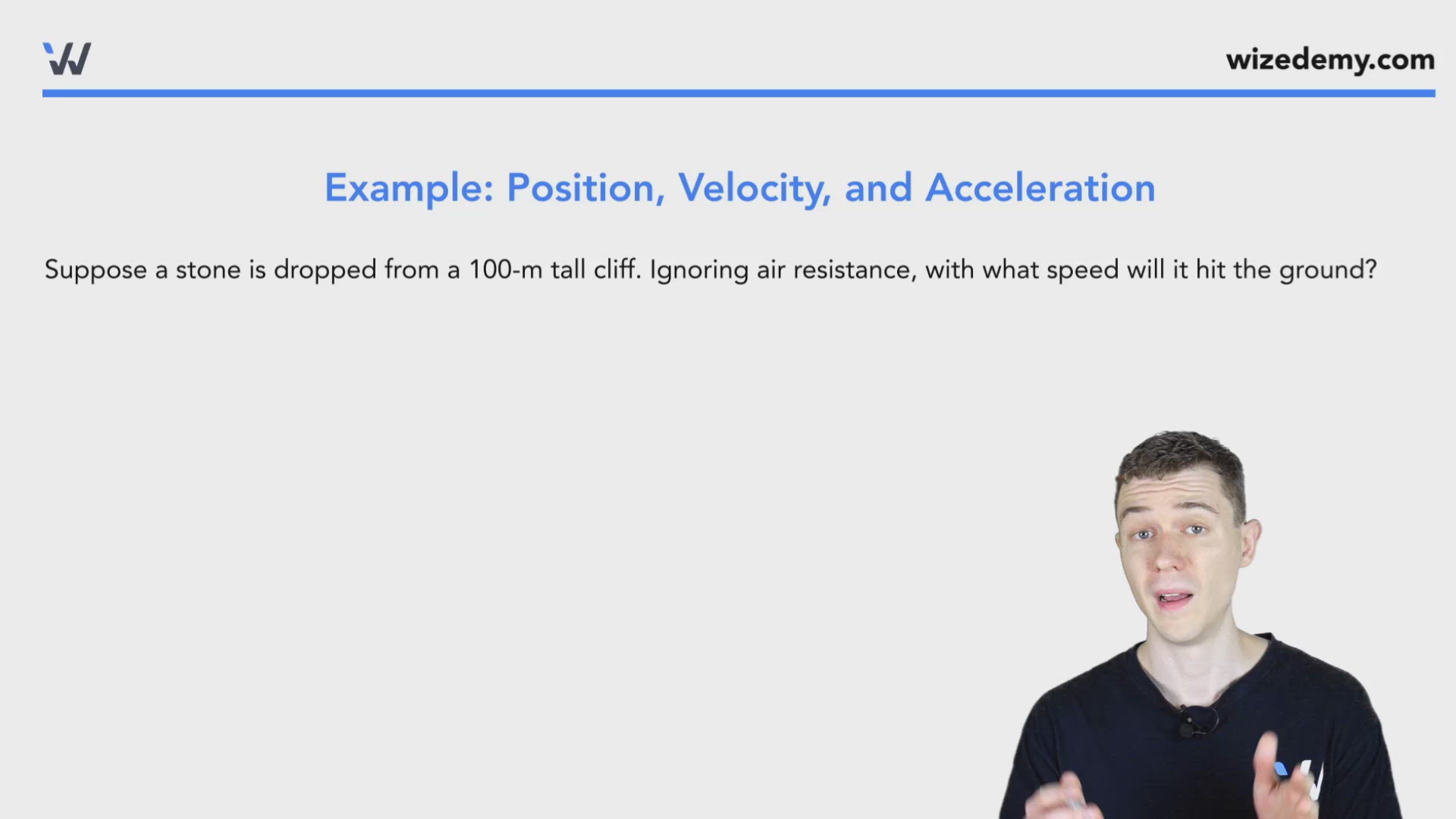
Suppose a stone is dropped from a 100-m tall cliff. Ignoring air resistance, with what speed will it hit the ground?
If we take up to be positive, then the ground is where , and . Since the stone is dropped from rest, we also have that . The only acceleration is due to gravity, and since the object is traveling downward, we take (in meters per second squared).
Given all this, we wish to find at the moment that .
We first find :
If we know the time at which the stone hits the ground, then we can find v at that time; but we don't. Our only information about hitting the ground is that it occurs when , so we'll find :
We want to know the time at which :
Since we're ignoring "negative time", we take , and find .
That is, the stone's speed at the instant it hit the ground was approximately 44.27 meters per second.
The position of an object is given by . If its acceleration is given by and if it starts from with a velocity , where will the object be at ?