Wize University Linear Algebra Textbook > Equations of Lines and Planes
Intersection of Two Lines
Popular Courses
MATH 211
University of Calgary
MATH 1229A/B
Western University
Linear Algebra
University Study Guides
MATH 152
University of British Columbia
MATH 1600A/B
Western University
Linear Algebra
General Course
MAT188H1
University of Toronto
Linear Algebra
University Study Guides
MATH 115
University of Waterloo
MATH-1270
University of Windsor
MATH 1210
University of Manitoba
MATH 111
Queen's University
MATH 1104
Carleton University
MATH 1300
University of Manitoba
MATH 1107
Carleton University
ENGM 1041
Dalhousie University
MATH 114
University of Waterloo
MATH-1260
University of Windsor
MA-UY 2034
New York University
MATH 266
University of Saskatchewan

0:00 / 0:00
Intersection of Two Lines
Possible Intersection Scenarios
- Lines are coincident (same line) They are parallel and intersect (share one point) infinitely many points of intersection
- Lines are parallel but do not intersect zero points of intersection
- Lines are skew They are not parallel but they do not intersect zero points of intersection
- Lines are not parallel and they intersect one point of intersection
Table Summary
Determining Collinearity
Two lines are parallel if they have:
- Collinear direction vectors
- Collinear normal vectors
- The direction vector of one line is orthogonal to the normal vector of the other
Determining Intersections
To determine whether two lines intersect:
- Make sure at least one line is in parametric form (convert if needed)
- Substitute the parametric equations into the equation of the other line
- Solve for the parameter
- Determine the number of intersections:
- If you don't get a consistent result when solving for the parameter (e.g. ) no intersection (or skewed in )
- If you get a single valid solution set (e.g. ) one point of intersection
- If you only get redundant equations (e.g. ) infinitely many points of intersection
0:00 / 0:00
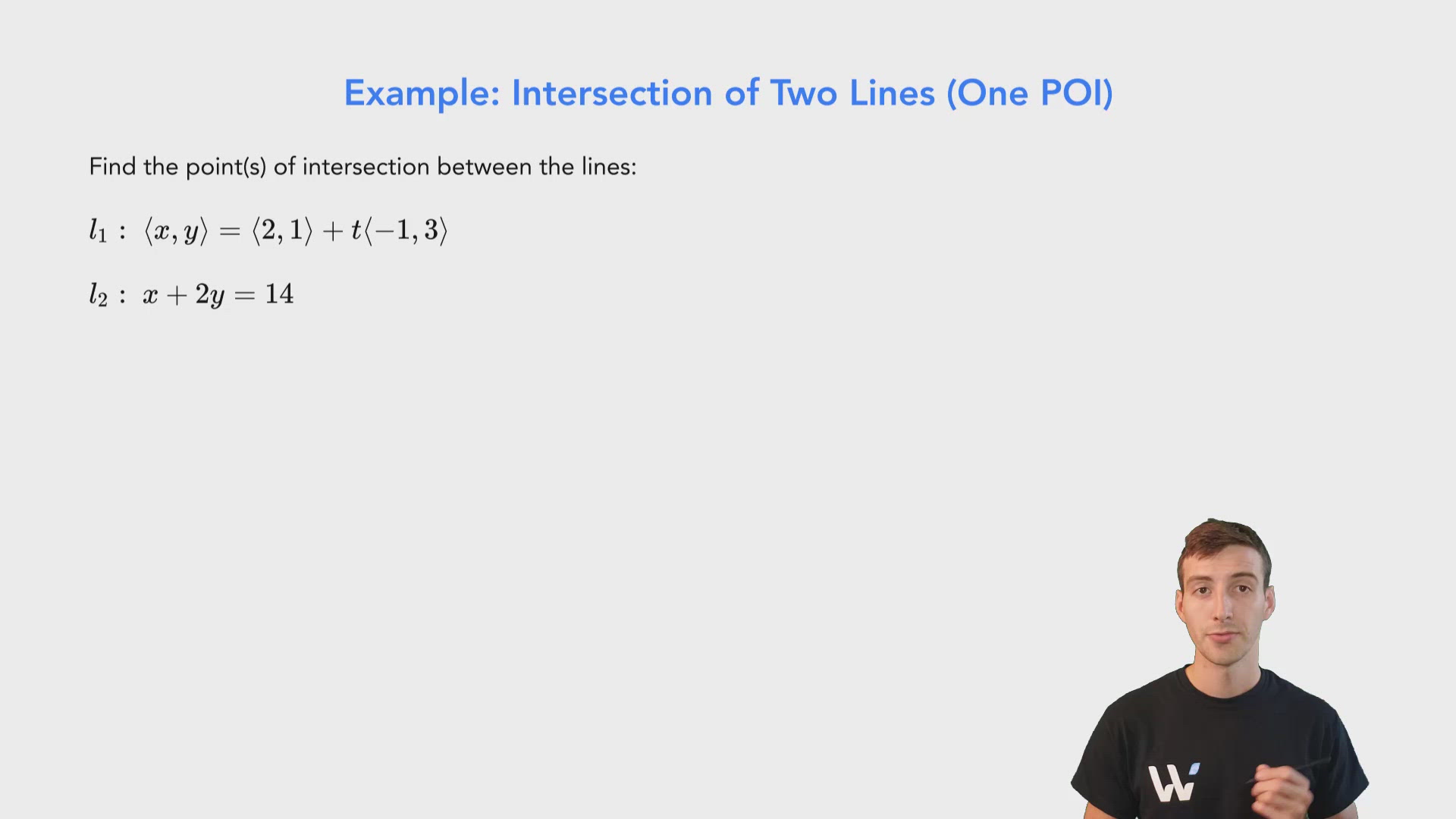
Example: Intersection of Two Lines (One POI)
Find the point(s) of intersection between the lines:
The direction vector of is .
The normal vector of is .
These are not orthogonal (dot product is not 0), meaning the lines are not parallel.
Since these lines are in , they must intersect at exactly one point (skew lines are only possible in ).
Writing in parametric form:
We can substitute these expressions into the standard form of the second equation:
Now we can substitute into the parametric equations of to find the point of intersection:
This position vector corresponds to the point of intersection .
0:00 / 0:00
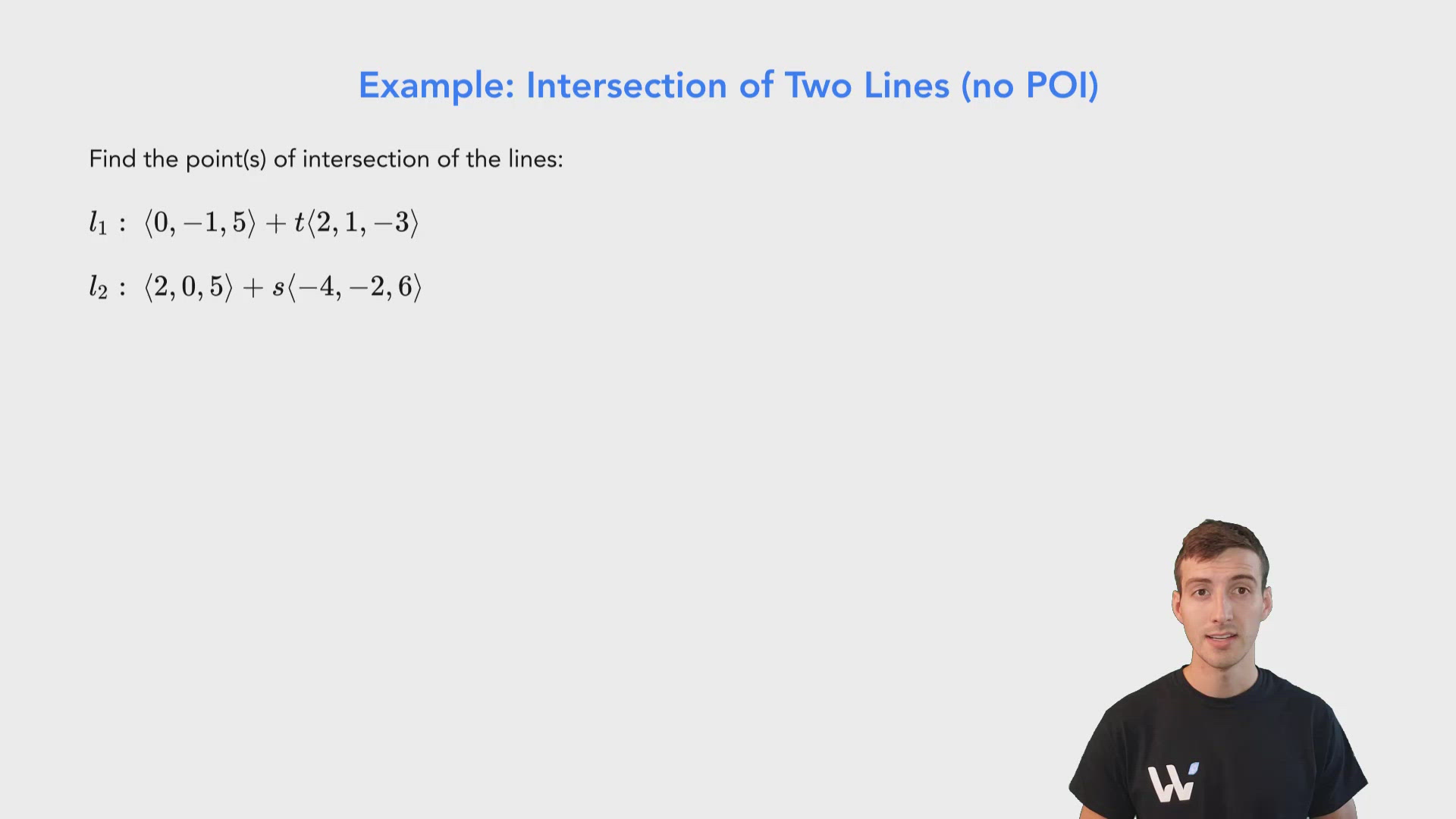
Example: Intersection of Two Lines (no POI)
Find the point(s) of intersection of the lines:
The direction vectors are and .
Since , the lines are parallel.
Now check if the lines are coincident by seeing if they share a point.
is a point on , so let's see if it's also on (which we convert to parametric form):
By solving this set of equations, we find that for the first two equations but not for the third. Inconsistent.
Thus, is a point on but not on , so they are not the same line.
Therefore, the lines are parallel and non-coincident, so there are no points of intersection.
Alternatively
We can jump straight into solving the set of parametric equations:
Setting them to be equal to each other:
Solving the first equation for yields:
Substituting into the second equation:
This is a redundant equation (always true), so it does not provide any information.
Substituting into the third equation:
We get an inconsistent result because there is no point where the two lines intersect.
0:00 / 0:00
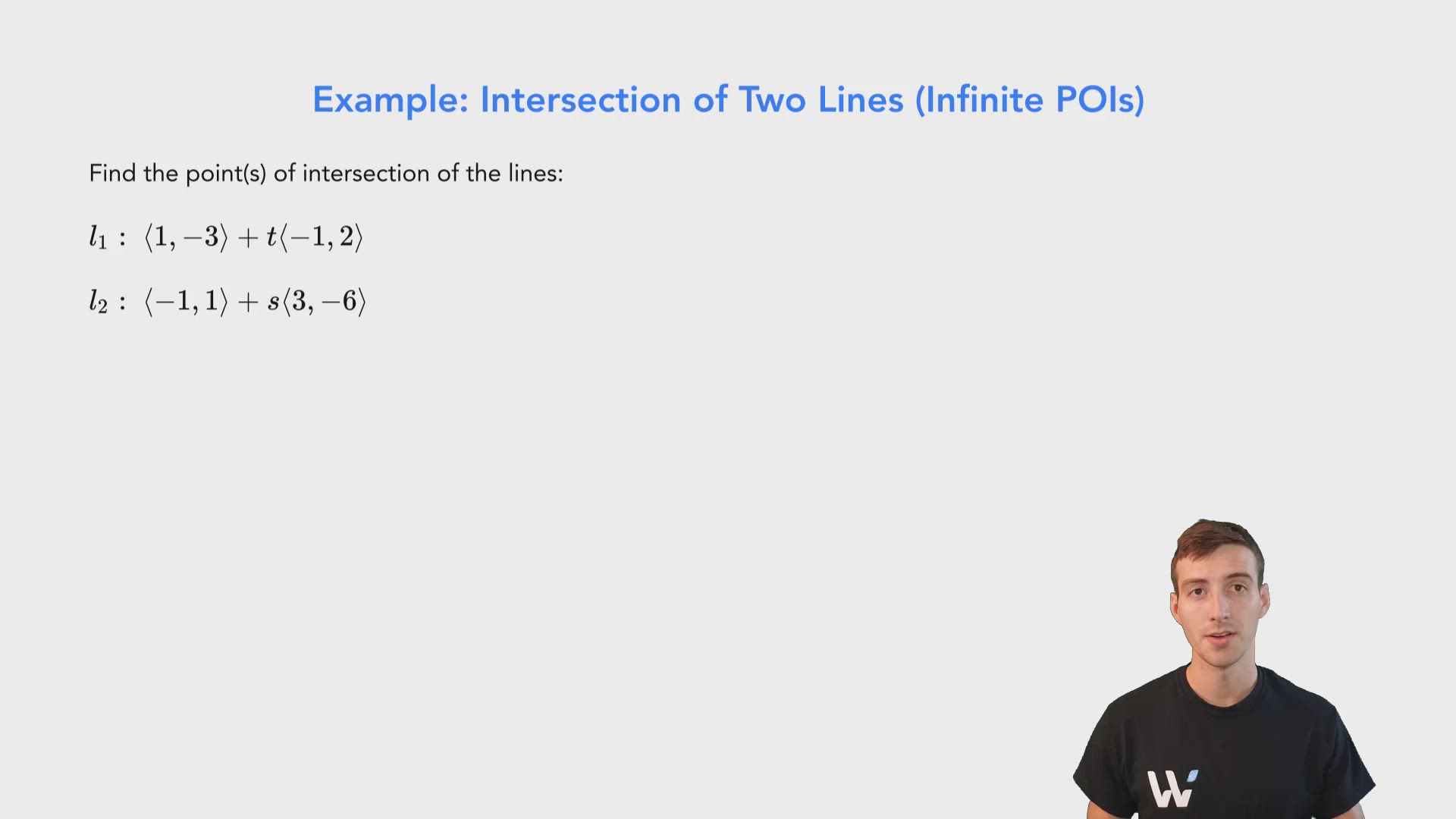
Example: Intersection of Two Lines (Infinite POIs)
Find the point(s) of intersection of the lines:
The direction vectors are and .
Since , the lines are parallel.
Now check if the lines are coincident by seeing if they share a point.
is a point on , so let's see if it's also on (which we convert to parametric form):
We see that is the solution to both equations, so the point is also on .
Since the lines are parallel and share a point, they coincide (same line) and have infinitely many points of intersection.
Alternatively
We can jump straight into solving the parametric equations:
Setting these equations equal, we get
Solving for in the first equation:
Substitute into the second equation:
This is a redundant equation.
Since any value of satisfies the equations, there are infinitely many solutions.
Therefore, the lines are the coincident with infinitely many points of intersection.
Practice: Intersection of Two Lines
Select all of the following statements that are true given the lines:
Practice: Intersection of Two Lines
Determine the point(s) of intersection, if any, of the followings lines, or state whether the lines are parallel or skewed.