Wize University Linear Algebra Textbook > Equations of Lines and Planes
Intersection of a Line and a Plane
Popular Courses
MATH 211
University of Calgary
MATH 1229A/B
Western University
Linear Algebra
University Study Guides
MATH 152
University of British Columbia
MATH 1600A/B
Western University
Linear Algebra
General Course
MAT188H1
University of Toronto
Linear Algebra
University Study Guides
MATH 115
University of Waterloo
MATH-1270
University of Windsor
MATH 1210
University of Manitoba
MATH 111
Queen's University
MATH 1104
Carleton University
MATH 1300
University of Manitoba
MATH 1107
Carleton University
ENGM 1041
Dalhousie University
MATH 114
University of Waterloo
MATH-1260
University of Windsor
MA-UY 2034
New York University
MATH 266
University of Saskatchewan

0:00 / 0:00
Intersection of Lines and Planes
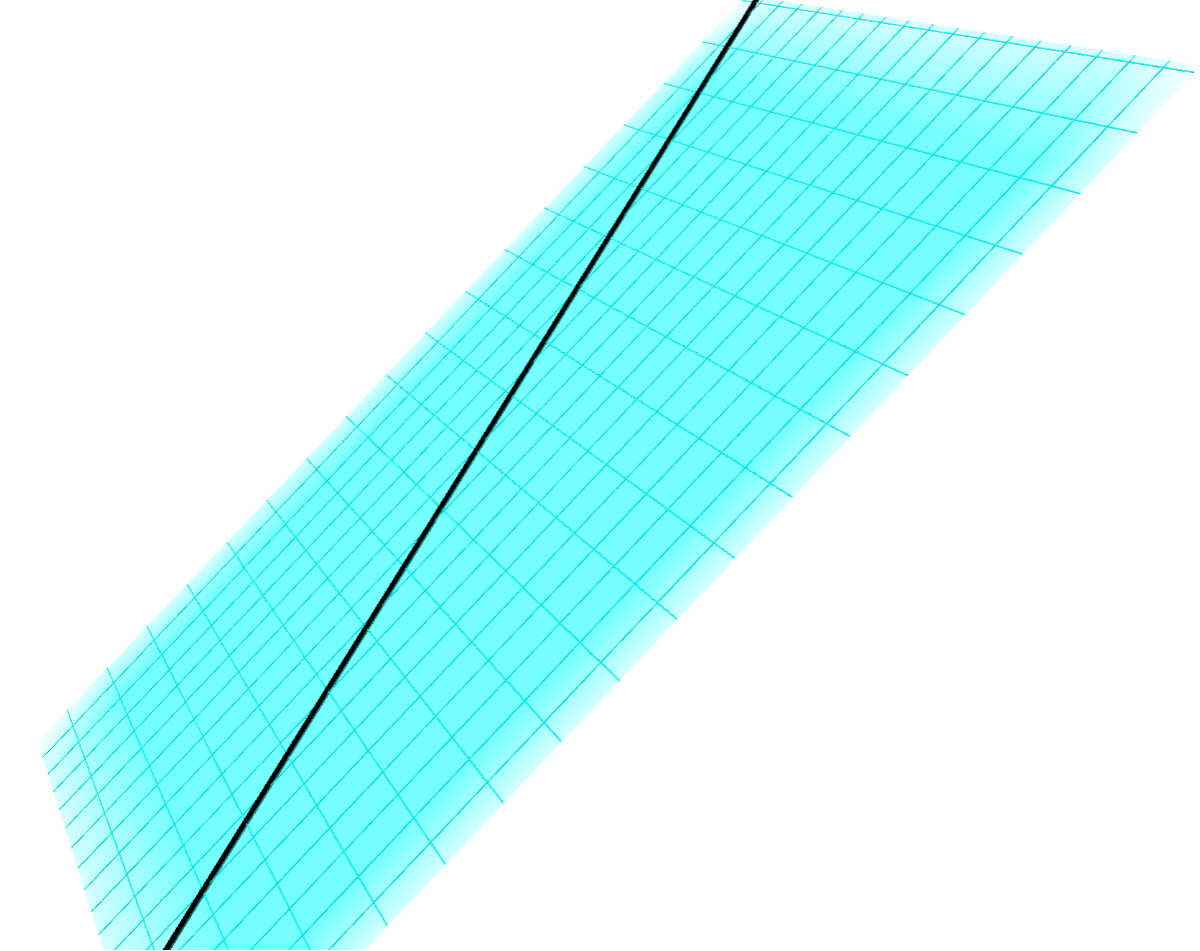
Case 1: Infinitely Many POIs
The line lies on the plane all points on the line are on the plane.
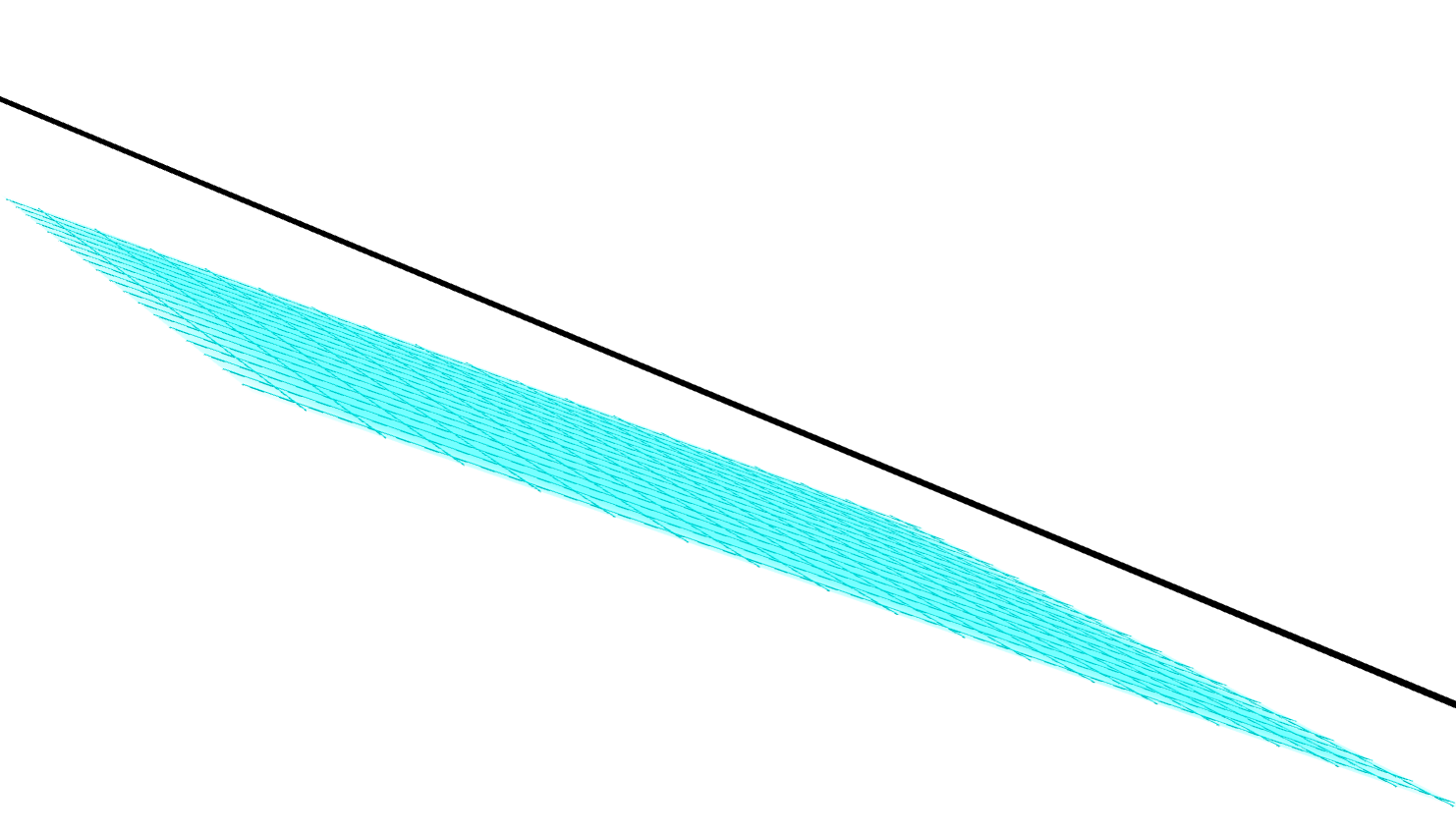
Case 2: No POIs
The line lies on a different parallel plane no points of intersection
Case 3: One POI
- The line does not lie on any parallel plane one point of intersection

Steps to Find Point(s) of Intersection
1. Substitute the line's parametric equations into the standard form of the plane
2. Solve for the parameter:
- A single valid solution one point of intersection
- No consistent solution no intersection (line is on a different, parallel plane)
- Redundant equations infinitely many points of intersection (line lies on the plane)
3. If there is a valid solution, substitute the value of the parameter back into the equation of the line to find the point of intersection.
0:00 / 0:00
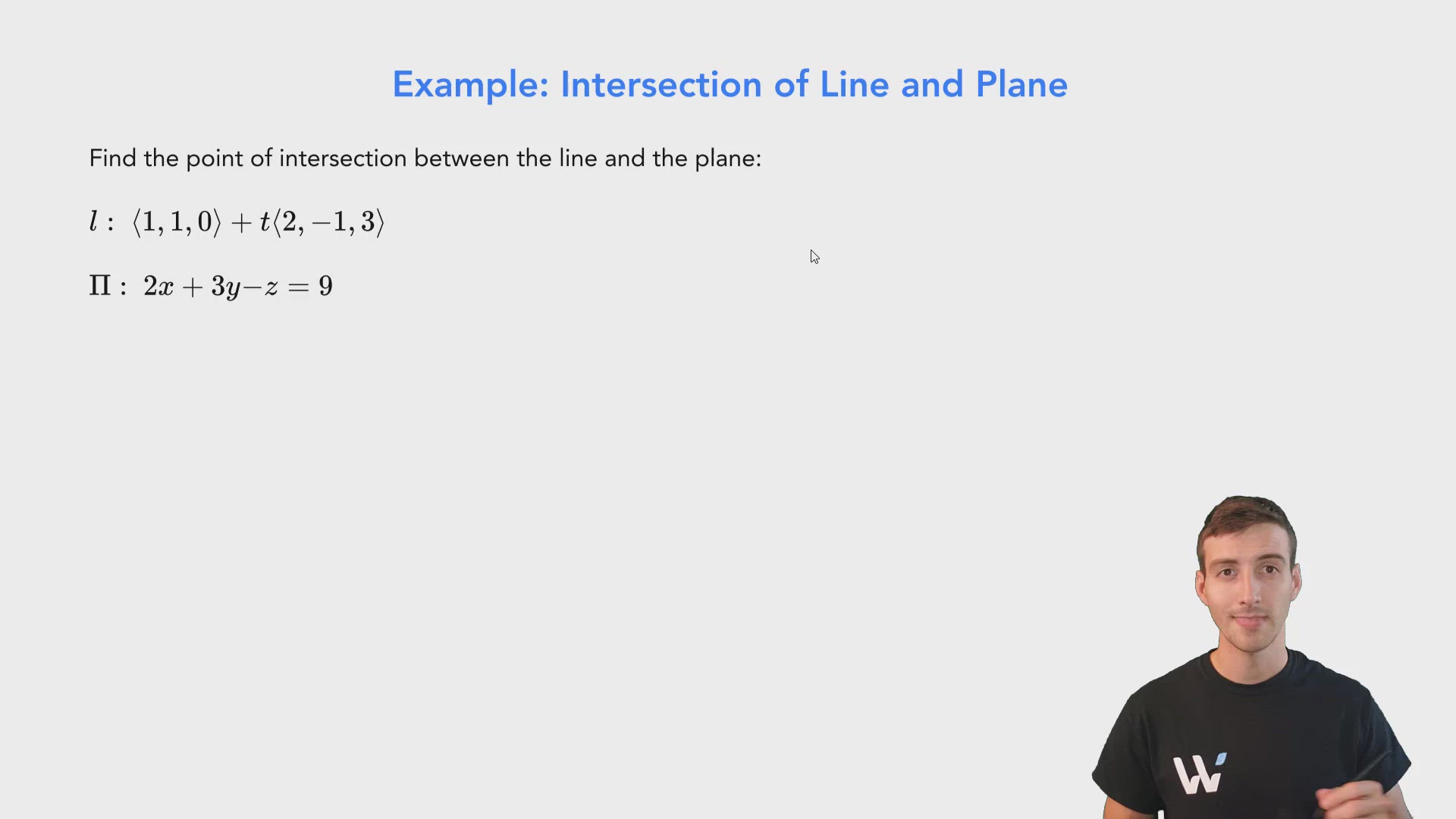
Example: Intersection of Line and Plane
Find the point of intersection between the line and the plane:
Write the line in parametric form:
Substitute these into the equation of the plane:
Therefore there is a valid solution, and we find the point of intersection by substituting into the line:
0:00 / 0:00
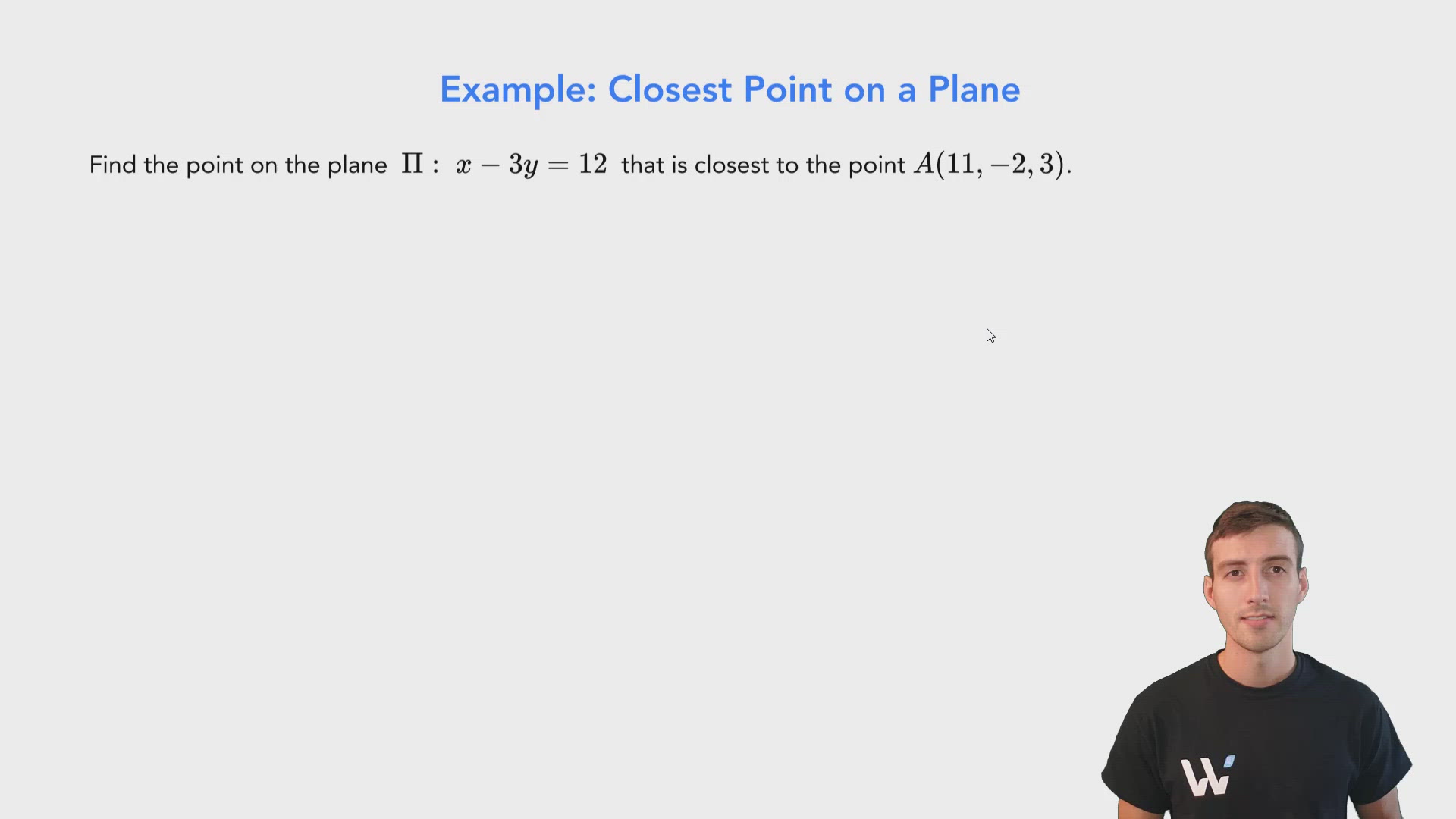
Example: Closest Point on a Plane
Find the point on the plane that is closest to the point .
Let's call the unknown point .
If is the point on the plane that is closest to , then the vector has to be orthogonal to the plane.
We can create a line passing through and , and use the plane's normal vector as its direction vector:
Now we simply find the intersection of this line and the given plane!
Intersection of Line & Plane
Converting the line to parametric form:
Substituting the parametric equations into the equation of the plane:
Now we find the coordinates of , the point on the plane closest to , by plugging into the line's equation:
Practice: Intersection of Lines & Planes
Find the point(s) of intersection between the following line and plane:
Practice: Intersection of Lines & Planes
Find the point of intersection of the line and the plane: