Wize University Linear Algebra Textbook > Systems of Linear Equations (SLEs) (Linear Systems)
Basics of Systems of Linear Equations
Popular Courses
MATH 208
Concordia University
MATH 211
University of Calgary
MATH 1229A/B
Western University
Algebra II
US High School
Linear Algebra
University Study Guides
MATH 133
McGill University
MATH 1ZC3
McMaster University
MATH 152
University of British Columbia
MATH 1600A/B
Western University
Linear Algebra
General Course
MATH 204
Concordia University
MAT188H1
University of Toronto
MATH 125
University of Alberta
Linear Algebra
University Study Guides
NMM 1411A/B
Western University
SC/MATH 1025 3.00
York University
APSC 174
Queen's University
MATH 151
University of Victoria
MATH 102
University of Alberta
MATH 115
University of Waterloo
0:00 / 0:00
Basics of Systems of Linear Equations
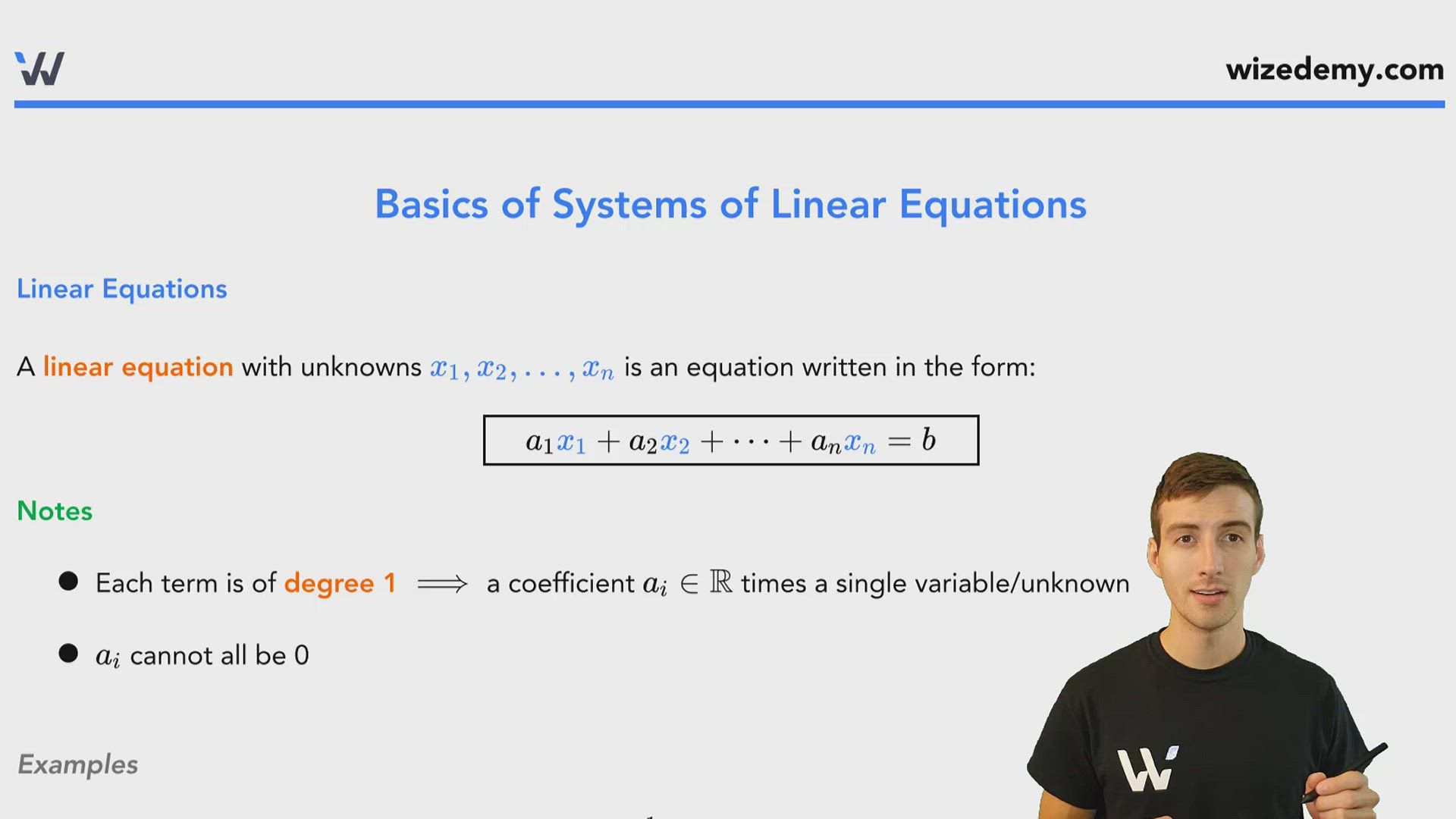
Linear Equations
A linear equation with unknowns is an equation written in the form:
Notes
- Each term is of degree 1 a coefficient times a single variable/unknown
- cannot all be 0
Examples
- linear equation with 2 unknowns:
- linear equation with 4 unknowns:
- non-linear equation with 2 unknowns:
System of Linear Equations
A system of linear equations (SLE) or linear system is a collection of linear equations with the same variables :
A system with equations (rows) and unknowns (terms/columns) is of size .
Solutions to Linear Systems
A solution to an SLE is a vector that satisfies all equations.
Two SLEs are equivalent if they have the same solution.
Example
is a solution to the following equivalent SLEs:
and
Family of Solutions
A -parameter family of solutions to a SLE is a set of solutions which contains parameters (real number variables).
A family of solutions consists of infinitely many solutions (but not every vector is a solution!)
Example
is a 2-parameter family of solutions (with parameters ) to the SLE:
Wize Tip
We can rewrite the general solution to clearly see that it is a 2-parameter family of solutions:
0:00 / 0:00
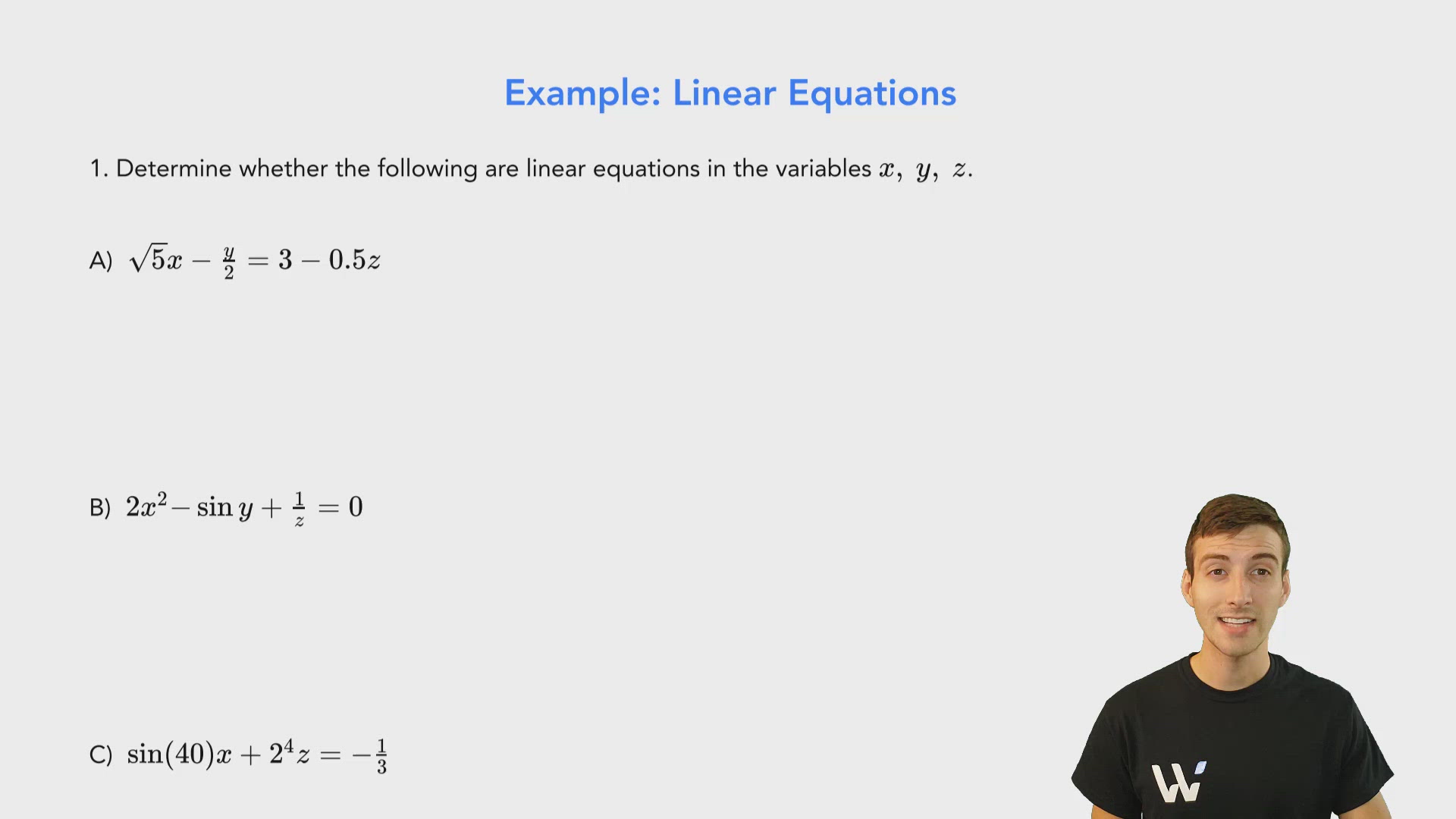
Example: Linear Equations
1. Determine whether the following are linear equations in the variables .
A)
Linear. (Can be rearranged to the standard form)
The variables are all linear with constant coefficients in front.
B)
Non-linear.
is quadratic, is a trigonometric function, is a reciprocal function.
C)
Linear.
are linear with constant coefficients in front, and the coefficient in front of is 0.
D)
Non-linear.
The coefficients for each of the variables is 0 ( does not appear, , and ).
This equation just says , and since there are no variables, it is not linear.
Which of the following are linear equations in the variables ? [Select all that apply]
Determine which vectors are solutions to the following SLE [select all that apply]: