Wize University Linear Algebra Textbook > Vector Spaces and Subspaces
Linear Independence
Popular Courses
Linear Algebra
University Study Guides
MATH 133
McGill University
MATH 1ZC3
McMaster University
MATH 1ZC3
McMaster University
MATH 1600A/B
Western University
Linear Algebra
General Course
MAT 1341
University of Ottawa
MATH 204
Concordia University
MAT188H1
University of Toronto
NMM 1411A/B
Western University
Linear Algebra
University Study Guides
APSC 174
Queen's University
MATH 102
University of Alberta
MATH 115
University of Waterloo
MATH 1B03
McMaster University
MATH 1B03
McMaster University
MAT223H1
University of Toronto
MATH-1270
University of Windsor
MATH 1210
University of Manitoba
MATH-1250
University of Windsor

0:00 / 0:00
Linear Independence
Definition
Suppose you have a set of vectors , and let .
Consider the equation: .
If the only solution to this equation is , then the set is said to be linearly independent.
If there are any non-zero values that satisfy the equation, the set is linearly dependent.
Wize Tip
If any vector can be written as a linear combination of other vectors, then the set is linearly dependent.
Testing Linear Independence
Asking if the set of vectors is linearly independent is equivalent to solving a homogeneous linear system.
Taking the unknowns to be the coefficients , we can write the augmented matrix of the system:
The type of solution determines linear independence:
- Only the trivial solution () linearly independent
- Non-trivial solutions linearly dependent
Shortcut: Determinant
The determinant can be used to determine the number of solutions to a homogeneous linear system.
Let .
- is invertible trivial solution only linearly independent
- is not invertible infinitely many solutions linearly dependent
Examples
Linearly Independent
In , the set is linearly independent.
The only solution to this linear system is .
Check using the determinant:
Linearly Dependent
In , the set is linearly dependent.
This linear system has non-zero solutions, such as .
Moreover, we can see that one vector is a linear combination of the other:.
Check using the determinant:
0:00 / 0:00
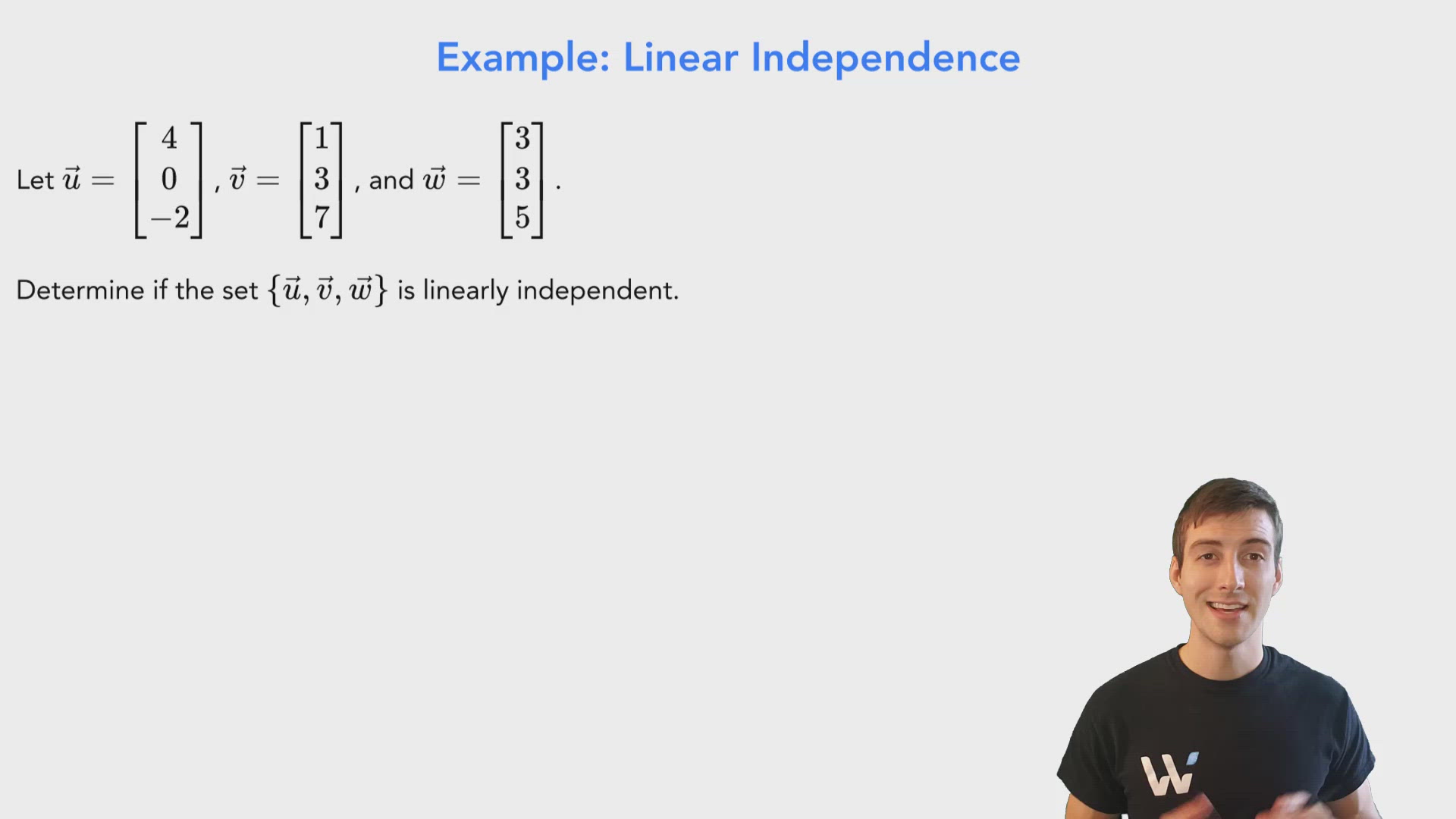
Example: Linear Independence
Let , , and .
Determine if the set is linearly independent.
Using the definition of linear independence, we are looking to find what values of , and are solutions to the equation:
The columns of this augmented matrix are the vectors and .
We can use Gauss-Jordan elimination to find the RREF:
We can then read of the solution directly: .
Instead, let's simply find the determinant of the coefficient matrix:
Since the determinant is not 0, the system has only the trivial solution .
Therefore, is a linearly independent set.
0:00 / 0:00
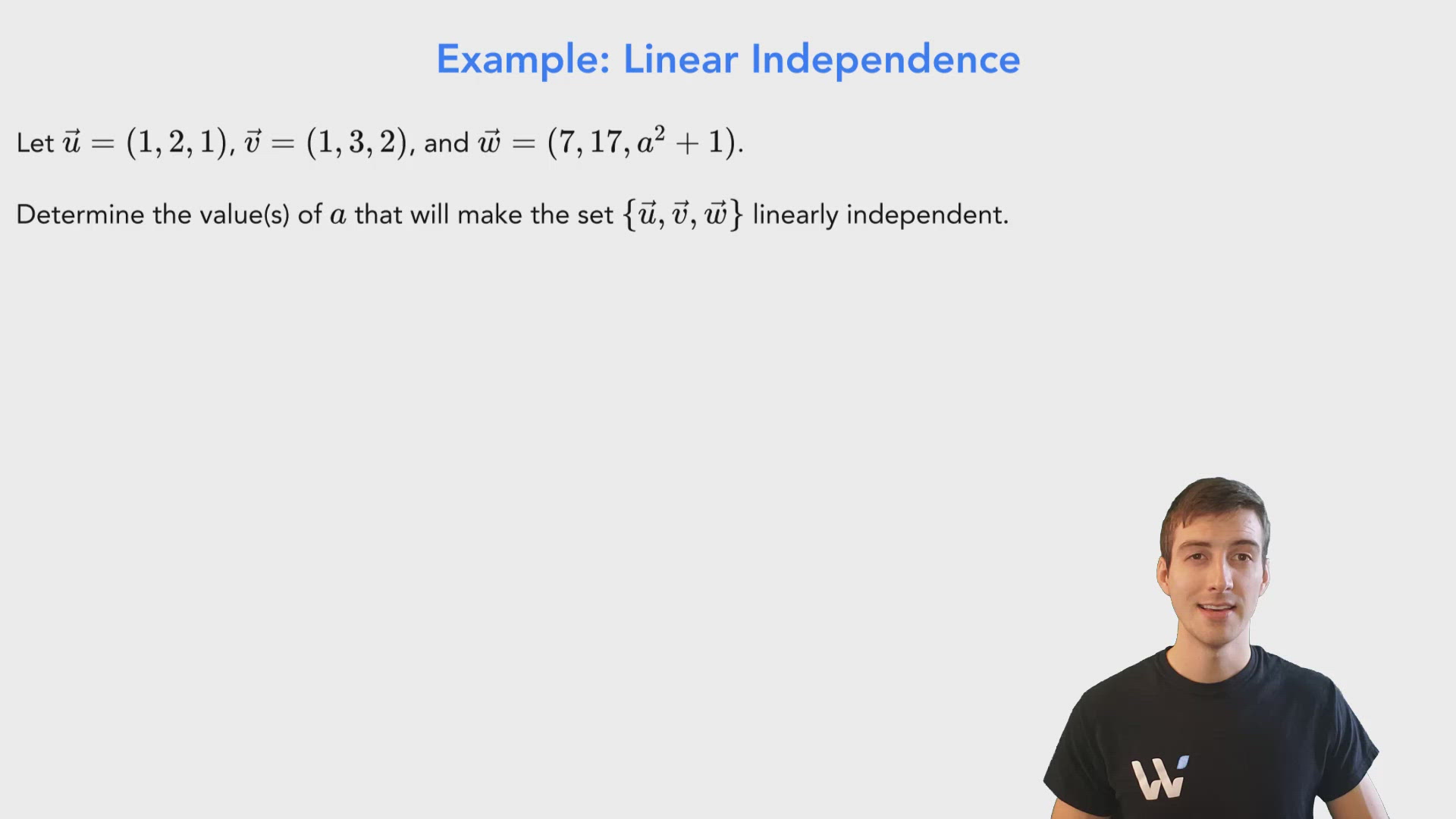
Example: Linear Independence
Let , , and .
Determine the value(s) of that will make the set linearly independent.
Let's find the determinant of the matrix whose columns are and :
Since we want the vectors to be linearly independent, we must make sure the determinant is not 0:
.
Therefore, as long as is not equal to 3 or -3, the vectors will be linearly independent.
Practice: Linear Independence
Let be a linearly independent set of vectors in a vector space .
Define the following vectors in , where :
Determine what conditions must satisfy in order for the set to be linearly independent.