Popular Courses
Linear Algebra
University Study Guides
MATH 1ZC3
McMaster University
MATH 1600A/B
Western University
Linear Algebra
General Course
MATH 204
Concordia University
MAT188H1
University of Toronto
MATH 125
University of Alberta
Linear Algebra
University Study Guides
SC/MATH 1025 3.00
York University
APSC 174
Queen's University
MTH 141
Toronto Metropolitan University
MATH 102
University of Alberta
MATH 115
University of Waterloo
MATH 1B03
McMaster University
MAT223H1
University of Toronto
MATH-1270
University of Windsor
MATH 1210
University of Manitoba
MATH-1250
University of Windsor
MATH 223
McGill University
MATH 111
Queen's University

0:00 / 0:00
Span
The span of a set of vectors is the set of all linear combinations of the vectors in .
Given the set , and allowing to be any real numbers, the span of is:
Wize Concept
is a finite set of vectors.
is an infinite set of vectors: it contains every possible linear combination of the vectors in .
Geometrically
- The span of one non-zero vector is the line through the origin in the direction of :
- The span of two linearly independent vectors is a plane:
Determining if a Vector is in the Span
Given a finite set and a vector , determining if is in is equivalent to solving the linear system with augmented matrix:
If this system has:
- since no linear combination of the vectors produces .
Wize Tip
This is very similar to determining whether a set of vectors is linearly independent!
Instead of augmenting with the zero vector, we check whether by augmenting with .
Spanning Sets or Generating Sets
If is a vector space and , then is called a generating set (or spanning set) of .
Wize Tip
A set of linearly independent vectors always spans (is a generating set of) .
Example
The following are spanning sets of the vector space , since linear combinations of the vectors can produce any vector in .
0:00 / 0:00
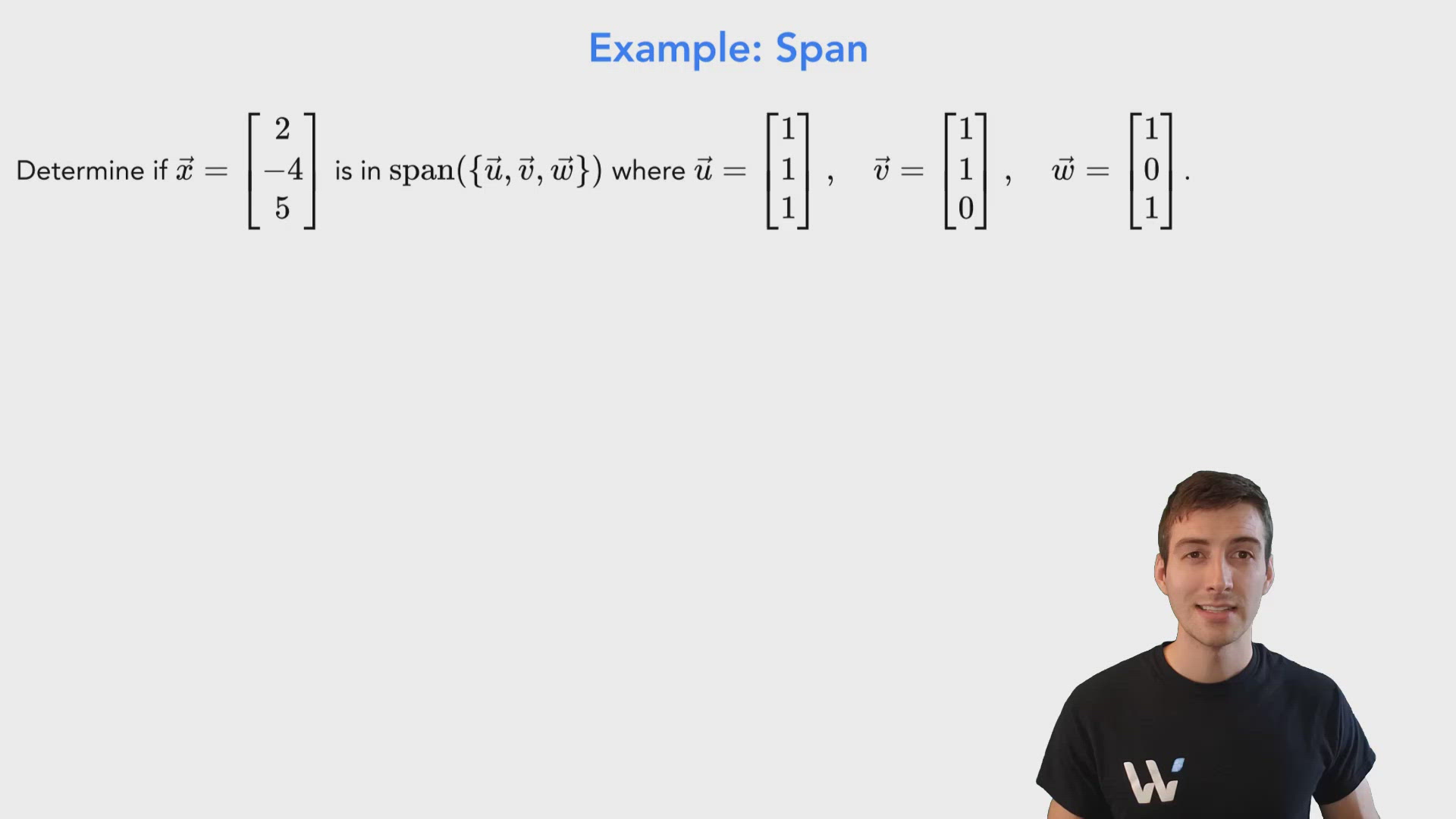
Example: Span
Determine if is in where .
We are looking to find values of and that are solutions to:
This is equivalent to solving the linear system with augmented matrix:
The reduced row echelon form of this matrix is:
Hence the solution is , , .
This means we can write as a linear combination of the vectors: .
Therefore is indeed in .
Alternatively
We can use the determinant of the matrix whose columns are the vectors of interest:
Let
Then , so is invertible, which means the linear system has exactly one solution.
This method does not tell us the solution, but since we know one exists, we conclude that .
Practice: Span
Let be vectors in , and suppose .
Find the value of .

Mark Yourself Question
- Grab a piece of paper and try this problem yourself.
- When you're done, check the "I have answered this question" box below.
- View the solution and report whether you got it right or wrong.
Practice: Spans are Subspaces
Suppose that . Prove that is a subspace of .