0:00 / 0:00

Basis and Dimension

Let VV be a vector space, and let B={v1,,vn}B = \{\vec v_1,\ldots,\vec v_n\} be a set of vectors in VV. BB is a basis for VV if:
  • BB is linearly independent
  • BB is a generating set of VV (VV is the span of the vectors in BB)
In other words, a basis BB is the smallest set such that every vector in VV is a linear combination of the vectors in BB.
PAGE BREAK
Example 1
B={[100],[010],[001]}B=\left\{ \begin{bmatrix} 1\\ 0\\ 0\\ \end{bmatrix}, \begin{bmatrix} 0\\ 1\\ 0\\ \end{bmatrix}, \begin{bmatrix} 0\\ 0\\ 1\\ \end{bmatrix} \right\} is a basis for R3\mathbb{R}^3 because:
  • The vectors in BB are linearly independent
  • Every vector in R3\mathbb{R}^3 can be generated from the vectors in BB
Note: removing any vector would mean that the set is no longer a generating set, so it is as small as possible.
Example 2

B={[1000],[0100],[0010],[0001]}B=\left\{\left[\begin{array}{rr}1&0\\0&0\end{array}\right], \left[\begin{array}{rr}0&1\\0&0\end{array}\right], \left[\begin{array}{rr}0&0\\1&0\end{array}\right], \left[\begin{array}{rr}0&0\\0&1\end{array}\right]\right\} is a basis for M2×2M_{2\times 2}.
PAGE BREAK

Dimension

The dimension of a vector space VVis the number of vectors in its basis, which we denote dim(V)\text{dim}(V).
Example 1
B={[100],[010],[001]}B=\left\{ \begin{bmatrix} 1\\ 0\\ 0\\ \end{bmatrix}, \begin{bmatrix} 0\\ 1\\ 0\\ \end{bmatrix}, \begin{bmatrix} 0\\ 0\\ 1\\ \end{bmatrix} \right\} is a basis for R3\mathbb{R}^3, so dim(R3)=3\text{dim}(\reals^3) = 3.
Example 2
B={[1000],[0100],[0010],[0001]}B=\left\{\left[\begin{array}{rr}1&0\\0&0\end{array}\right], \left[\begin{array}{rr}0&1\\0&0\end{array}\right], \left[\begin{array}{rr}0&0\\1&0\end{array}\right], \left[\begin{array}{rr}0&0\\0&1\end{array}\right]\right\} is a basis for M2×2M_{2\times2}, so dim(M2×2)=4\text{dim}(M_{2 \times 2}) = 4.
0:00 / 0:00

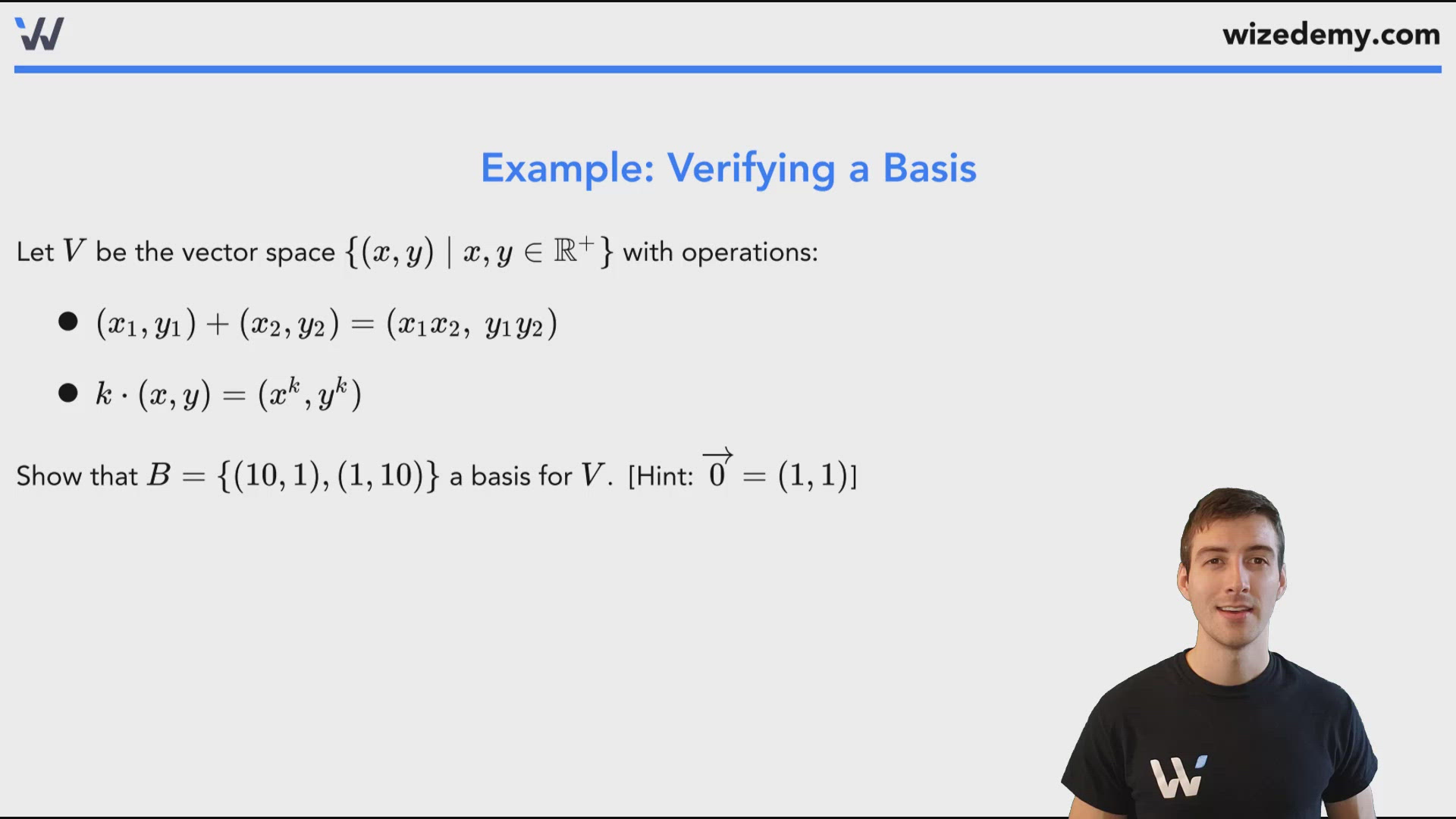
Example: Verifying a Basis

Let VV be the vector space {(x,y)    x,yR+}\{(x,y)\;|\;x,y\in\mathbb{R}^+\} with operations:
  • (x1,y1)+(x2,y2)=(x1x2, y1y2)(x_1,y_1)+(x_2,y_2)=(x_1x_2,\ y_1y_2)
  • k(x,y)=(xk,yk)k\cdot(x,y)=(x^k,y^k)
Show that B={(10,1),(1,10)}B=\left\{ (10,1),(1,10) \right\} a basis for VV. [Hint: 0=(1,1)\overrightarrow{0}=(1,1)]
Step 1
Show that the vectors in BB are linearly independent.
c1(10,1)+c2(1,10)=0    (10c1,1c1)+(1c2,10c2)=(1,1)    (10c1,1)+(1,10c2)=(1,1)    (10c11,110c2)=(1,1)    (10c1,10c2)=(1,1)\begin{array}{rlrrl} c_1\cdot(10,1)+c_2\cdot(1,10)=\vec{0} \quad &\implies& (10^{c_1},1^{c_1})+(1^{c_2},10^{c_2})&=&(1,1)\\[0.5em] &\implies& (10^{c_1},1)+(1,10^{c_2})&=&(1,1)\\[0.5em] &\implies& (10^{c_1}\cdot 1,1\cdot 10^{c_2})&=&(1,1)\\[0.5em] &\implies& (10^{c_1},10^{c_2})&=&(1,1)\\[0.5em] \end{array}
So we need 10c1=110^{c_1}=1 and 10c2=110^{c_2}=1.
The only solution to these equations is c1=c2=0c_1=c_2=0, so BB is linearly independent.
Step 2
Show that BB is a generating set for VV.
We must show that every vector (x,y)(x,y) in VV can be written as a combination of the vectors in BB:
(x,y)=c1(10,1)+c2(1,10)=(10c1,1c1)+(1c2,10c2)=(10c1,1)+(1,10c2)=(10c11,110c2)=(10c1,10c2)\begin{array}{rcl} (x,y)&=&c_1\cdot(10,1)+c_2\cdot(1,10)\\[0.5em] &=&(10^{c_1},1^{c_1})+(1^{c_2},10^{c_2})\\[0.5em] &=&(10^{c_1},1)+(1,10^{c_2})\\[0.5em] &=&(10^{c_1}\cdot 1,1\cdot 10^{c_2})\\[0.5em] &=&(10^{c_1},10^{c_2}) \end{array}
From this we can see that:
x=10c1    c1=log10(x)y=10c2    c2=log10(y)\begin{array}{rcl} x=10^{c_1} &\implies& c_1=\log_{10}(x)\\[0.5em] y=10^{c_2}&\implies&c_2=\log_{10}(y) \end{array}
For every pair (x,y)V(x,y)\in V: (x,y)=log(x)(10,1)+log(y)(1,10)(x,y)=\log(x)\cdot(10,1)+\log(y)\cdot(1,10)
Note that x,yR+x,y \in \reals^+ so the logarithms are well-defined.

Since we can find appropriate coefficients for any values of xx and yy, BB is a generating set for VV.
Therefore, BB is a basis of VV.
0:00 / 0:00

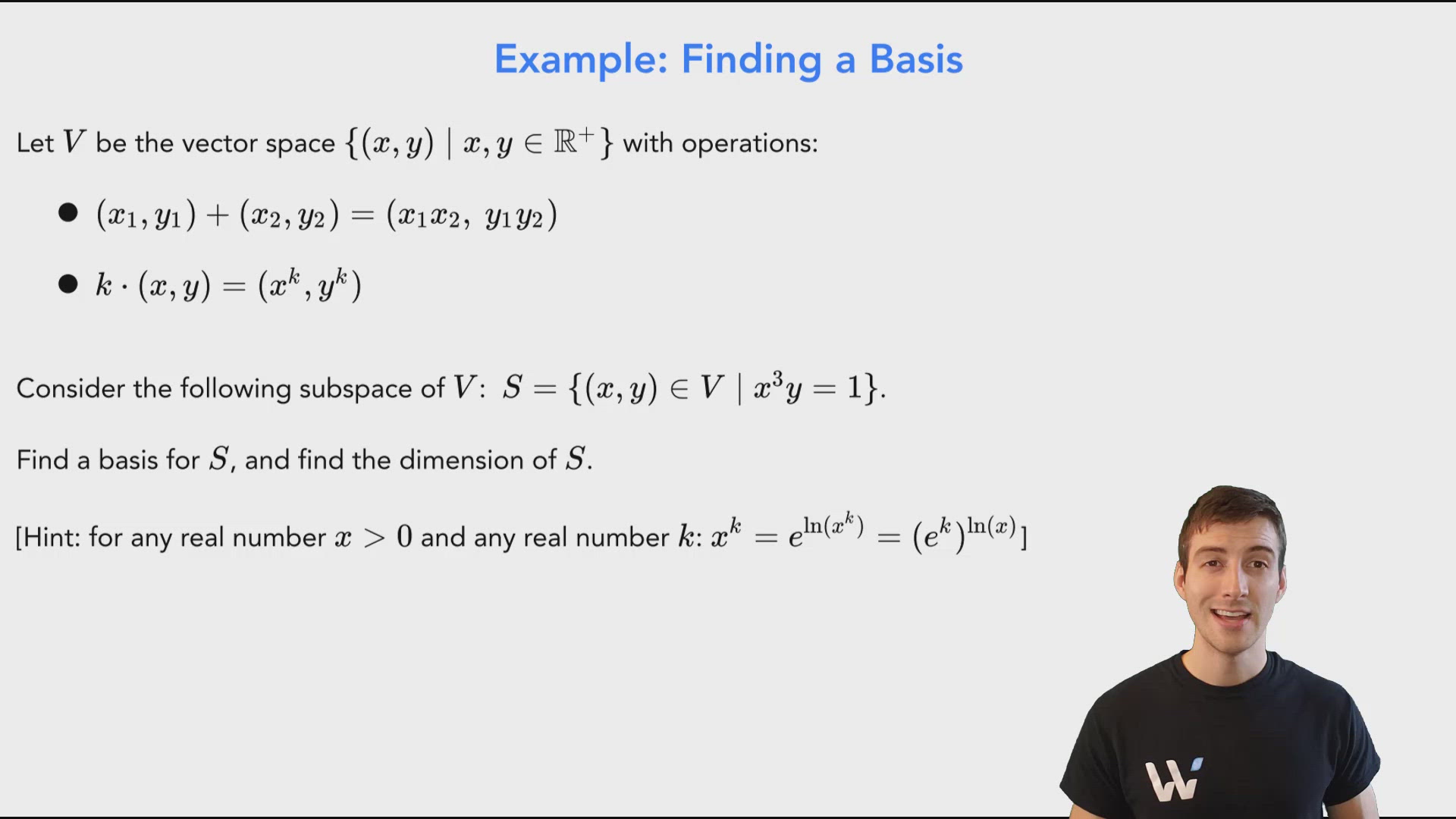
Example: Finding a Basis

Let VV be the vector space {(x,y)    x,yR+}\{(x,y)\;|\;x,y\in\mathbb{R}^+\} with operations:
  • (x1,y1)+(x2,y2)=(x1x2, y1y2)(x_1,y_1)+(x_2,y_2)=(x_1x_2,\ y_1y_2)
  • k(x,y)=(xk,yk)k\cdot(x,y)=(x^k,y^k)
Consider the following subspace of VV: S={(x,y)V    x3y=1}S=\{(x,y)\in V\;|\;x^3y=1\}.
Find a basis for SS, and find the dimension of SS.
[Hint: for any real number x>0x>0 and any real number kk: xk=eln(xk)=(ek)ln(x){\displaystyle x^k=e^{\ln(x^k)}=(e^k)^{\ln(x)}}]

Step 1
To find a basis, first find a generating set for SS.
If x=(x,y)S\vec x=(x,y)\in S is an arbitrary vector, then we know that: x3y=1        y=1x3        y=x3x^3y=1 \;\implies\; y=\frac{1}{x^3} \;\implies\; y=x^{-3}
So x=(x,y)=(x,x3)\vec x=(x,y)=(x,x^{-3}).
Goal: Write x\vec x as a linear combination of vectors in SS.
We will "factor out" the variable xx using the defined operations of VV along with the hint:
(x,x3)=(x1,x3)=((e1)ln(x),(e3)ln(x))using the hint=ln(x)(e1,e3)by the definition of scalar multiplication=ln(x)(e,e3)\begin{array}{lcll} (x,x^{-3}) &=& (x^1,x^{-3})\\[0.5em] &=& \big((e^1)^{\ln(x)},(e^{-3})^{\ln(x)}\big)& \text{using the hint}\\[0.5em] &=& \ln(x)\cdot(e^1,e^{-3}) & \text{by the definition of scalar multiplication}\\[0.5em] &=&\ln(x)\cdot(e,e^{-3}) \end{array}
Note that (e,e3)S(e,e^{-3})\in S because (e)3x3(e3)y=1\underbrace{(e)^3}_{x^3} \underbrace{(e^{-3})}_{y}=1 (or simply: y=x3y=x^{-3}).
We can generate any vector in SS as a scalar multiple of (e,e3)(e,e^{-3}): (x,y)=(x,x3)=ln(x)(e,e3)(x,y)=(x,x^{-3})=\ln(x)\cdot(e,e^{-3})
Therefore, the generating set is B={(e,e3)}B=\{(e,e^{-3})\}.
Step 2
BBis linearly independent because it contains only one vector (and it is not the zero vector).
Therefore, BB is a basis for SS. Since BB contains only one vector, SS is a 1-dimensional subspace of VV.

Practice: Finding a Basis

Let A=[111]A=\left[\begin{array}{rrr} 1&-1&1\\ \end{array}\right] and consider the special subspace of R3\mathbb{R}^3 called the null space:
N={xR3    Ax=0}N=\{\vec x\in\mathbb{R}^3\;|\;A\vec x=\vec{0}\}
Find a basis for NN, and state dim(N)\text{dim}(N).
Extra Practice