Coordinates

Coordinates Relative to the Standard Basis

Wize Concept
Recall that every real vector space Rn\mathbb{R}^n has a standard basis SS.
For example, in R2\mathbb{R}^2 the standard basis is S={[10],[01]}S=\left\{ \begin{bmatrix} 1\\ 0\\ \end{bmatrix} , \begin{bmatrix} 0\\ 1\\ \end{bmatrix} \right\}.

The vector v=[35]\vec v = \begin{bmatrix} 3\\ 5\\ \end{bmatrix} is a linear combination of the standard basis vectors.
The coefficients are called the coordinates of v\vec v relative to the basis SS:
v=[35]=3[10]+5[01]\vec v = \begin{bmatrix} \colorOne 3\\ \colorTwo 5\\ \end{bmatrix} = \colorOne 3 \begin{bmatrix} 1\\ 0\\ \end{bmatrix} + \colorTwo 5 \begin{bmatrix} 0\\ 1\\ \end{bmatrix}

We can use [  ]S[ \ \ ]_S to write that this vector's coordinates are relative to the basis SS : [v]S=[35][\vec v]_S = \begin{bmatrix} \colorOne 3\\ \colorTwo 5\\ \end{bmatrix}
In other words, the coordinates of v\vec v are the coefficients from the linear combination of the basis vectors that create v\vec v.

Wize Tip
We use the standard basis in Rn\reals^n by default, so we do not need to use the bracket notation [  ]S[ \ \ ]_S in this case.

PAGE BREAK

Coordinates Relative to a General Basis

Suppose that B={v1,v2,,vn}B=\{\vec v_1,\vec v_2,\dots,\vec v_n\} is a basis for an nn-dimensional vector space VV. Let v\vec v be a vector in VV such that:
v=c1v1+c2v2++cnvn\vec v = \colorTwo{\mathbf{c_1}}\vec v_1 + \colorTwo{\mathbf{c_2}}\vec v_2 + \cdots + \colorTwo{\mathbf{c_n}}\vec v_n
Then the coordinates of v\vec v relative to the basis BB are given by the coefficients:
[v]B=[c1c2cn][\vec v]_B = \begin{bmatrix} \colorTwo{\mathbf{c_1}}\\ \colorTwo{\mathbf{c_2}}\\ \vdots\\ \colorTwo{\mathbf{c_n}} \end{bmatrix}
Example
The set B={[31],[11]}B=\left\{ \begin{bmatrix} 3\\ 1\\ \end{bmatrix} , \begin{bmatrix} 1\\ -1\\ \end{bmatrix} \right\} is a basis for R2\mathbb{R}^2.

Let u=[35]\vec u = \begin{bmatrix} 3\\ 5\\ \end{bmatrix}, then we can find coefficients a,b\textbf{a}, \textbf{b} such that
[35]=a[31]+b[11]\begin{bmatrix} 3\\ 5\\ \end{bmatrix} = \textbf{a} \begin{bmatrix} 3\\ 1\\ \end{bmatrix} + \textbf{b} \begin{bmatrix} 1\\ -1\\ \end{bmatrix}

This is just a 2×22 \times 2 system of linear equations! Try solving and you will find that:

u=[35]=2[31]+(3)[11]\vec u= \begin{bmatrix} 3\\ 5\\ \end{bmatrix} =\colorTwo{\mathbf{2}} \begin{bmatrix} 3\\ 1\\ \end{bmatrix} + (\colorTwo{\mathbf{-3}}) \begin{bmatrix} 1\\ -1\\ \end{bmatrix}

Therefore, the coordinate vector of u\vec u relative to the basis BB is:

[u]B=[23][\vec u]_B= \begin{bmatrix} \colorTwo{\mathbf{2}}\\ \colorTwo{\mathbf{-3}}\\ \end{bmatrix}

PAGE BREAK

Geometric Interpretation

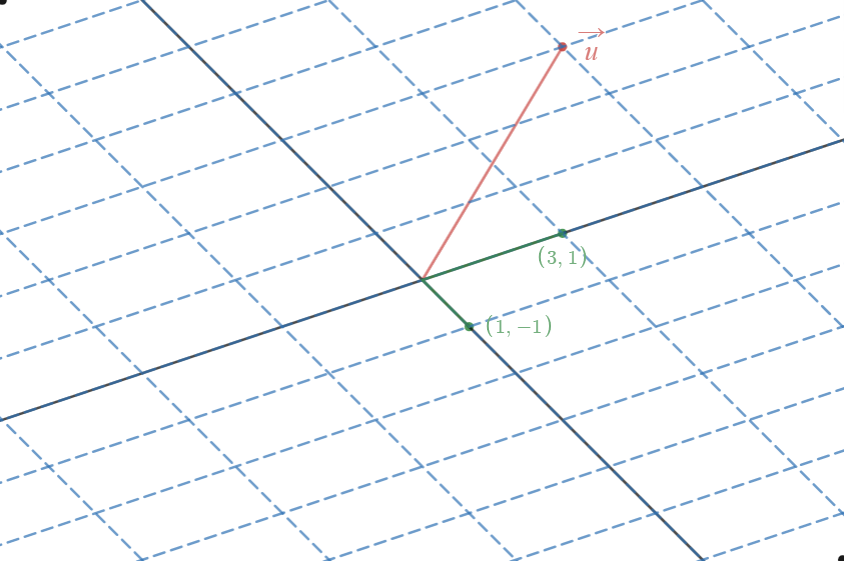
A basis for a vector space defines a coordinate system.
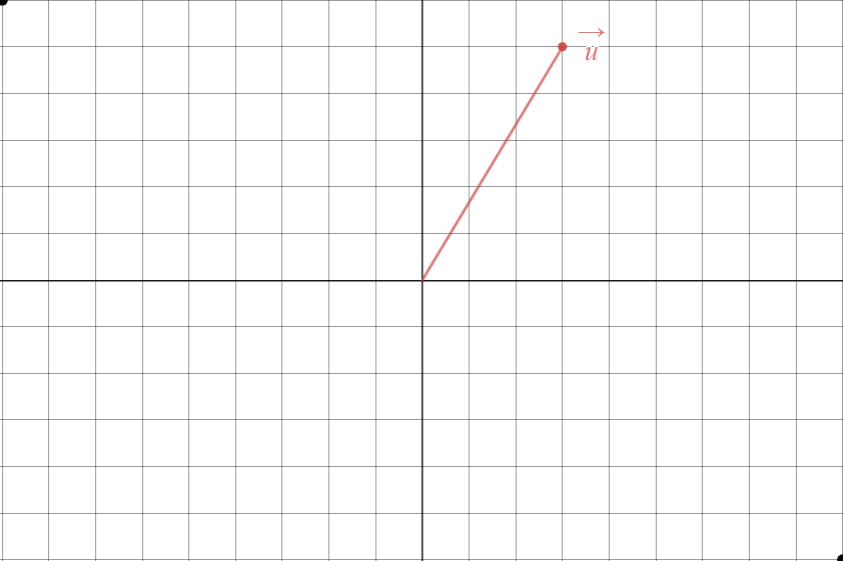
In the standard basis for R2\mathbb{R}^2, the vectors [10]\begin{bmatrix} 1\\ 0\\ \end{bmatrix} and [01]\begin{bmatrix} 0\\ 1\\ \end{bmatrix} define the standard coordinate system with the xx and yy axes.
The basis vectors [31]\begin{bmatrix} 3\\ 1\\ \end{bmatrix} and [11]\begin{bmatrix} 1\\ -1\\ \end{bmatrix} define a different coordinate system with axes along these vectors.
These two different coordinate systems give us different ways of representing the same vector u\vec u:


Example: Coordinates

It can be shown that the set B={1+x2,  x+x2,  1+2x+x2}B=\{1+x^2,\ \ x+x^2,\ \ 1+2x+x^2\} is a basis for the polynomial vector space P2P_2.
Find the coordinate vector of p(x)=1+4x+7x2p(x)=1+4x+7x^2 relative to the basis BB.

Wize Tip
The vector space P2P_2 is said to be isomorphic to R3\reals^3, meaning they are essentially "equivalent".
Every polynomial p(x)=c+bx+ax2p(x)=c+bx+ax^2 in P2P_2 can be written as the vector [cba]\begin{bmatrix} c\\ b\\ a\\ \end{bmatrix} in R3\mathbb{R}^3.
This lets us transform the problem into an equivalent one in R3\mathbb{R}^3.

Let's include the 0 coefficients in the basis BB:
B={1+0x+1x2,  0+1x+1x2,  1+2x+1x2}B=\{1+0x+1x^2,\ \ 0+1x+1x^2,\ \ 1+2x+1x^2\}
We can then transform this into the following basis for R3\mathbb{R}^3:
B={[101],[011],[121]}B=\left\{ \begin{bmatrix} 1\\ 0\\ 1\\ \end{bmatrix}, \begin{bmatrix} 0\\ 1\\ 1\\ \end{bmatrix}, \begin{bmatrix} 1\\ 2\\ 1\\ \end{bmatrix} \right\}
Our given polynomial can be written as the following vector in R3\mathbb{R}^3:
p=[147]\colorOne{ \vec p = \begin{bmatrix} 1\\ 4\\ 7\\ \end{bmatrix}}
Let's find the coordinates of p\vec p. These are the coefficients from the linear combination of the basis vectors of BB that create p\vec p:
[p]B=[c1c2c3][\vec p]_B = \begin{bmatrix} \colorTwo{\mathbf{c_1}}\\ \colorTwo{\mathbf{c_2}}\\ \colorTwo{\mathbf{c_3}} \end{bmatrix} such that c1[101]+c2[011]+c3[121]=[147]\colorTwo{\bm c_1} \begin{bmatrix} 1\\ 0\\ 1\\ \end{bmatrix} + \colorTwo{\bm c_2} \begin{bmatrix} 0\\ 1\\ 1\\ \end{bmatrix} + \colorTwo{\bm c_3} \begin{bmatrix} 1\\ 2\\ 1\\ \end{bmatrix} = \colorOne{ \begin{bmatrix} 1\\ 4\\ 7\\ \end{bmatrix} }
This is equivalent to solving the system:
[101101241117]RREF[100201060011]\left[\begin{array}{rrr|r} 1&0&1&\colorOne 1\\ 0&1&2&\colorOne 4\\ 1&1&1&\colorOne 7 \end{array}\right] \quad \xrightarrow{RREF} \quad \left[\begin{array}{rrr|r} 1&0&0&2\\ 0&1&0&6\\ 0&0&1&-1 \end{array}\right]
Therefore, [p]B=[261][\vec p]_B = \begin{bmatrix} \colorTwo{\mathbf{2}}\\ \colorTwo{\mathbf{6}}\\ \colorTwo{\mathbf{-1}} \end{bmatrix}.
We can check this:
2(1+x2)+6(x+x2)+(1)(1+2x+x2)=2+2x2+6x+6x212xx2=1+4x+7x2=p(x)\begin{array}{rcl} &&\colorTwo{\mathbf{2}}(1+x^2) + \colorTwo{\mathbf{6}}(x+x^2) + (\colorTwo{\mathbf{-1}})(1+2x+x^2)\\[0.5em] &=& 2+2x^2+6x+6x^2-1-2x-x^2\\[0.5em] &=& 1+4x+7x^2\\[0.5em] &=& p(x) \quad \colorThree{\checkmark} \end{array}

Practice: Coordinates

Let B1={[120],[352],[473]}B_1= \left\{ \begin{bmatrix} -1\\ 2 \\0\\ \end{bmatrix} , \begin{bmatrix} 3\\ -5\\ 2\\ \end{bmatrix} , \begin{bmatrix} 4\\ -7\\ 3\\ \end{bmatrix} \right\} and B2={[231],[111],[130]}B_2= \left\{ \begin{bmatrix} 2\\ -3 \\1\\ \end{bmatrix} , \begin{bmatrix} 1\\ 1\\ -1\\ \end{bmatrix} , \begin{bmatrix} -1\\ -3\\ 0\\ \end{bmatrix} \right\} be two bases of R3\mathbb{R}^3.
Suppose [x]B1=[487][\vec x]_{\small B_1} = \begin{bmatrix} -4\\ 8\\ -7\\ \end{bmatrix}.
What is x\vec x (the coordinates relative to the standard basis)?

Practice: Coordinates

Find the coordinates of the polynomial p(x)=5+x3x23x3p(x)=5+x-3x^2-3x^3 relative to the following basis of P3P_3:
B={(1+x),  (x+x2),  (x2+x3),  (1x3)}B = \{(1+x),\ \ (x+x^2),\ \ (x^2+x^3),\ \ (1-x^3)\}

1st coordinate:
2nd coordinate:
3rd coordinate:
4th coordinate:
Extra Practice