Wize University Linear Algebra Textbook > Vector Spaces and Subspaces
Column Space and Null Space (Range and Kernel)
Popular Courses
Linear Algebra
University Study Guides
MATH 133
McGill University
MATH 1ZC3
McMaster University
MATH 1600A/B
Western University
Linear Algebra
General Course
MAT188H1
University of Toronto
Linear Algebra
University Study Guides
NMM 1411A/B
Western University
APSC 174
Queen's University
MTH 141
Toronto Metropolitan University
MATH 102
University of Alberta
MATH 115
University of Waterloo
MATH 1B03
McMaster University
MAT223H1
University of Toronto
MATH-1270
University of Windsor
MATH 1210
University of Manitoba
MATH-1250
University of Windsor
MATH 223
McGill University
MATH 111
Queen's University
MATH 1104
Carleton University

0:00 / 0:00
Column Space and Null Space
Given a matrix , there are some special subspaces we can define.
Column Space
The column space (or range, or image) of is the set of all possible vectors that result from multiplying by any vector .
Why is it called the column space?
Think of as a matrix of column vectors:
Then for any vector , we have:
This is simply a linear combination of the columns.
So, the column space can also be defined as the span of the columns of :
Wize Tip
You can make sure you have the right number of vectors by checking the rank:
Null Space
The null space (or kernel) is the set of vectors that, when left multiplied by , produce the zero vector:
Wize Concept
Recall that is a homogeneous system:
Solve for by row-reducing , then setting each row of the system equal to 0.
Wize Tip
You can make sure you have the right number of vectors by checking the rank:
Fundamental Subspaces
The row space of matrix is the span of its rows (or simply the column space of the transpose!).
The left null space of is the null space of the transpose, .
Together, these four subspaces are called the fundamental subspaces of the matrix :
- column space, : the result of multiplying for any .
- row space, : the result of multiplying for any .
- null space, : the vectors that result in .
- left null space, : the vectors that result in .
0:00 / 0:00
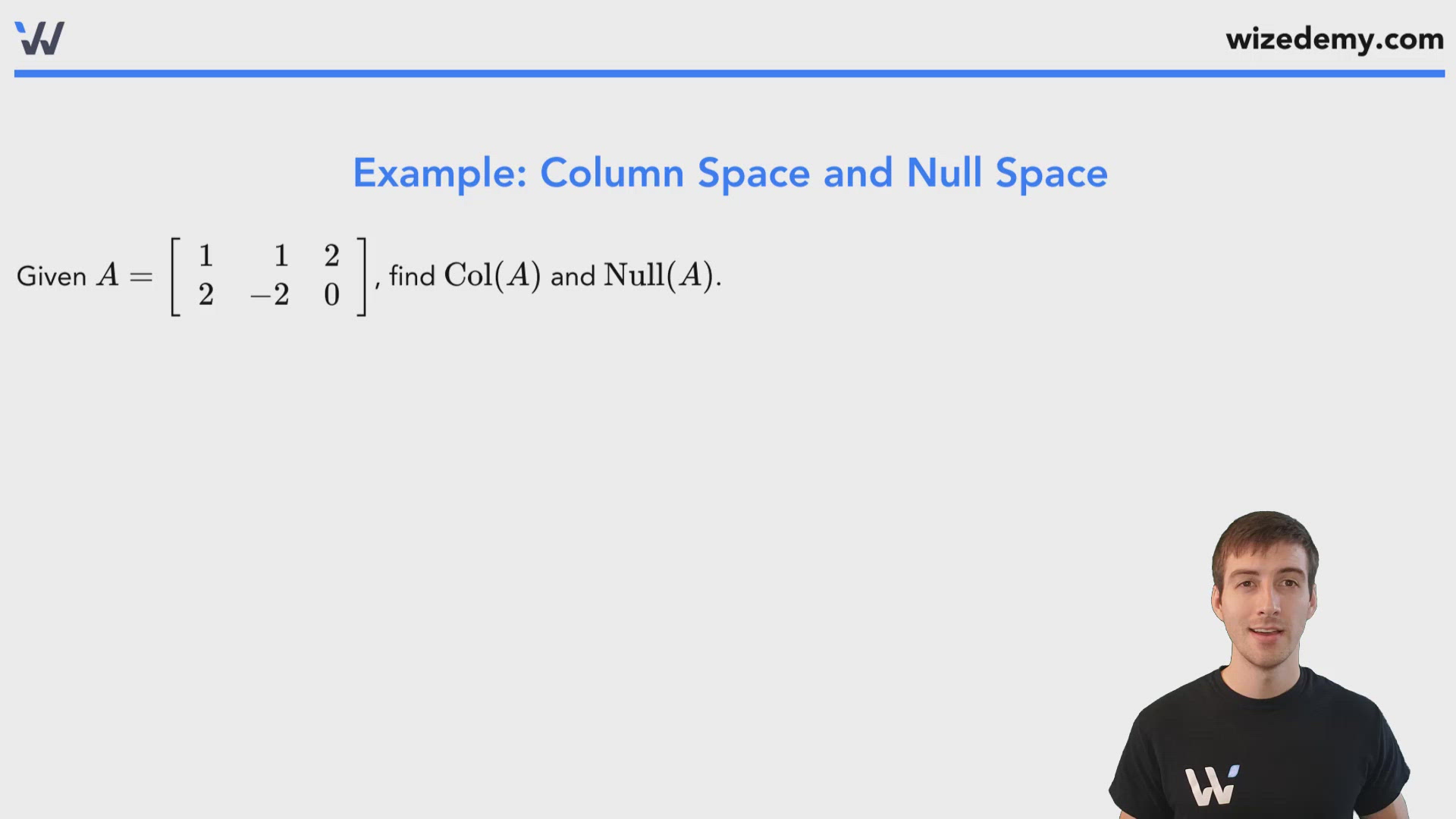
Example: Column Space and Null Space
Given , find and .
Column Space
is the span of the columns of A.
We can write the columns as vectors: .
Notice that are two linearly independent vectors, so we already know that they form a generating set for .
That is, any vector can be written as a linear combination of the vectors .
Adding the third column, is still a generating set for (although it is not linearly independent).
Therefore:
Null Space
To find , we must find the vectors such that .
Let's row reduce to solve this homogeneous linear system:
Rewriting as a linear system with a parameter for the free variable, and setting each row equal to 0:
This means that matrix times any multiple of produces .
Wize Tip
The number of free variables/parameters is always equal to the number of vectors in the null space.
Therefore, and:

Mark Yourself Question
- Grab a piece of paper and try this problem yourself.
- When you're done, check the "I have answered this question" box below.
- View the solution and report whether you got it right or wrong.
Practice: Column Space and Null Space
Find and .