Wize University Linear Algebra Textbook > Products of Vectors
Volume of a Parallelepiped (Triple Product)
Popular Courses
MATH 211
University of Calgary
MATH 1229A/B
Western University
Linear Algebra
University Study Guides
MATH 1ZC3
McMaster University
MATH 152
University of British Columbia
Linear Algebra
General Course
MAT188H1
University of Toronto
Linear Algebra
University Study Guides
MATH 115
University of Waterloo
MATH 1B03
McMaster University
MATH-1270
University of Windsor
MATH 1210
University of Manitoba
MATH 1104
Carleton University
MATH 136
University of Waterloo
MATH 1300
University of Manitoba
SC/MATH 1021 3.00
York University
MATH 1107
Carleton University
ENGM 1041
Dalhousie University
MATH 114
University of Waterloo
MATH-1260
University of Windsor
0:00 / 0:00
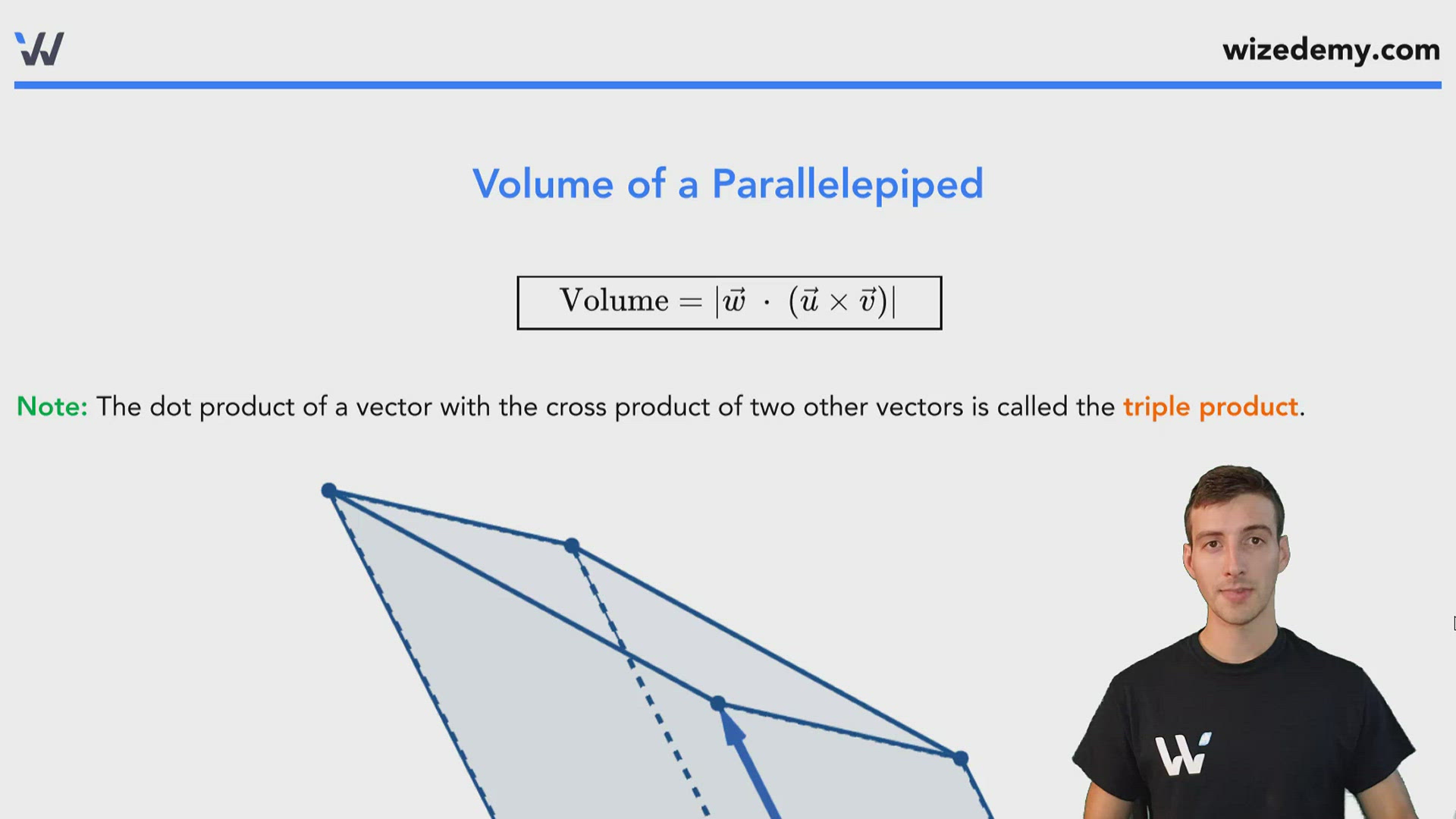
Volume of a Parallelepiped
Note: The dot product of a vector with the cross product of two other vectors is called the triple product (or box product).

Steps
Given three vectors that define a parallelepiped:
1. Find the cross product of two of the vectors
Wize Tip
Pick the two "simplest" vectors when taking the cross product (look for 0s and 1s)
2. Find the dot product of the resulting vector and the remaining vector
3. Take the absolute value of the answer
0:00 / 0:00
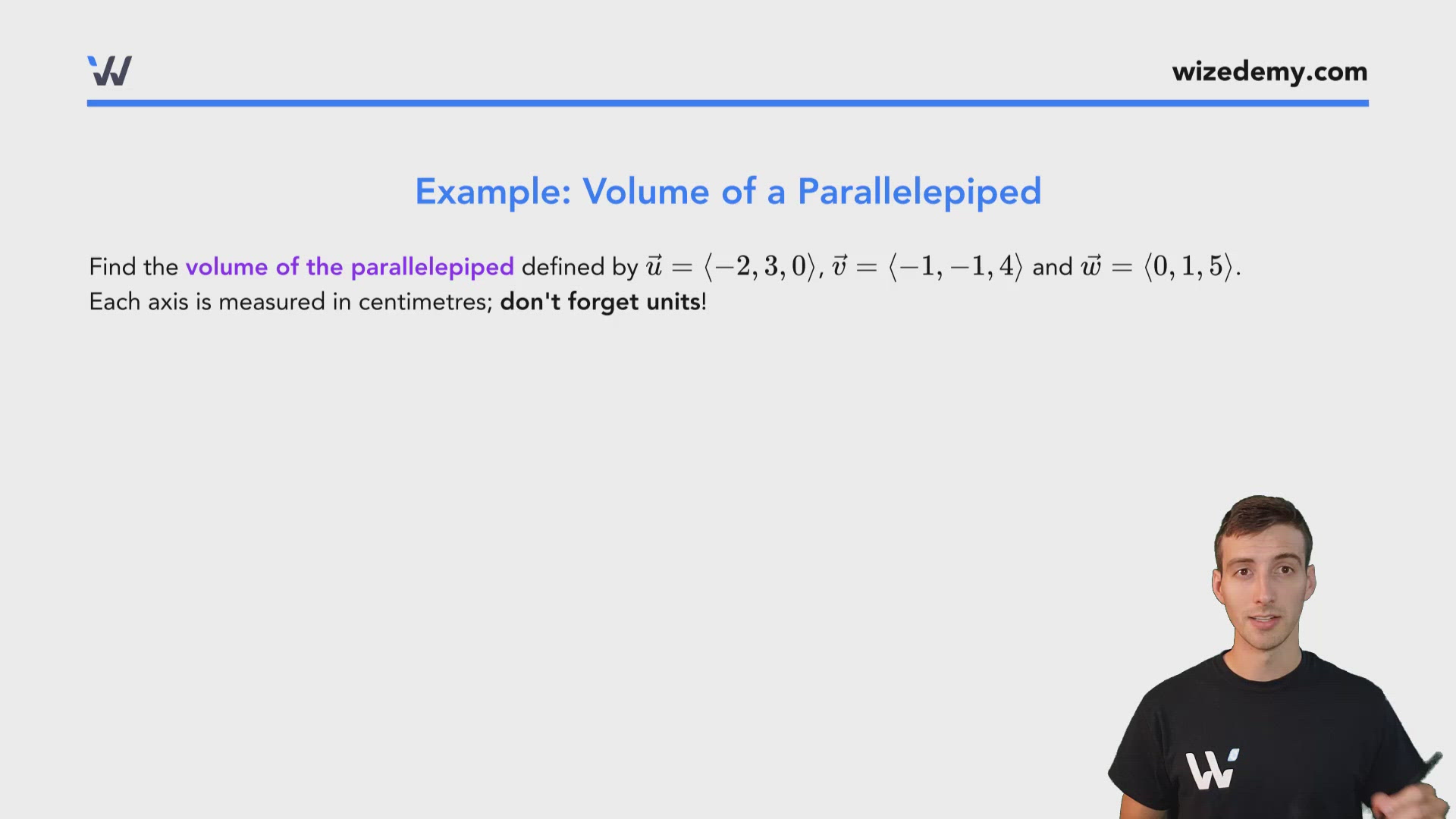
Example: Volume of a Parallelepiped
Find the volume of the parallelepiped defined by , and .
Each axis is measured in centimetres; don't forget units!
We choose to start with and since they contain 0s.
Practice: Volume of a Parallelepiped
A parallelepiped is defined by the vectors , and .
Each axis is measured in feet.