Popular Courses
MATH 211
University of Calgary
MATH 1229A/B
Western University
Linear Algebra
University Study Guides
MATH 133
McGill University
MATH 152
University of British Columbia
MATH 1600A/B
Western University
Linear Algebra
General Course
MAT188H1
University of Toronto
MATH 125
University of Alberta
Linear Algebra
University Study Guides
SC/MATH 1025 3.00
York University
MTH 141
Toronto Metropolitan University
MATH 102
University of Alberta
MATH 115
University of Waterloo
MAT223H1
University of Toronto
MATH 123
McGill University
MATH-1270
University of Windsor
MATH 1210
University of Manitoba
MATH 111
Queen's University
MA122
Wilfrid Laurier University
0:00 / 0:00
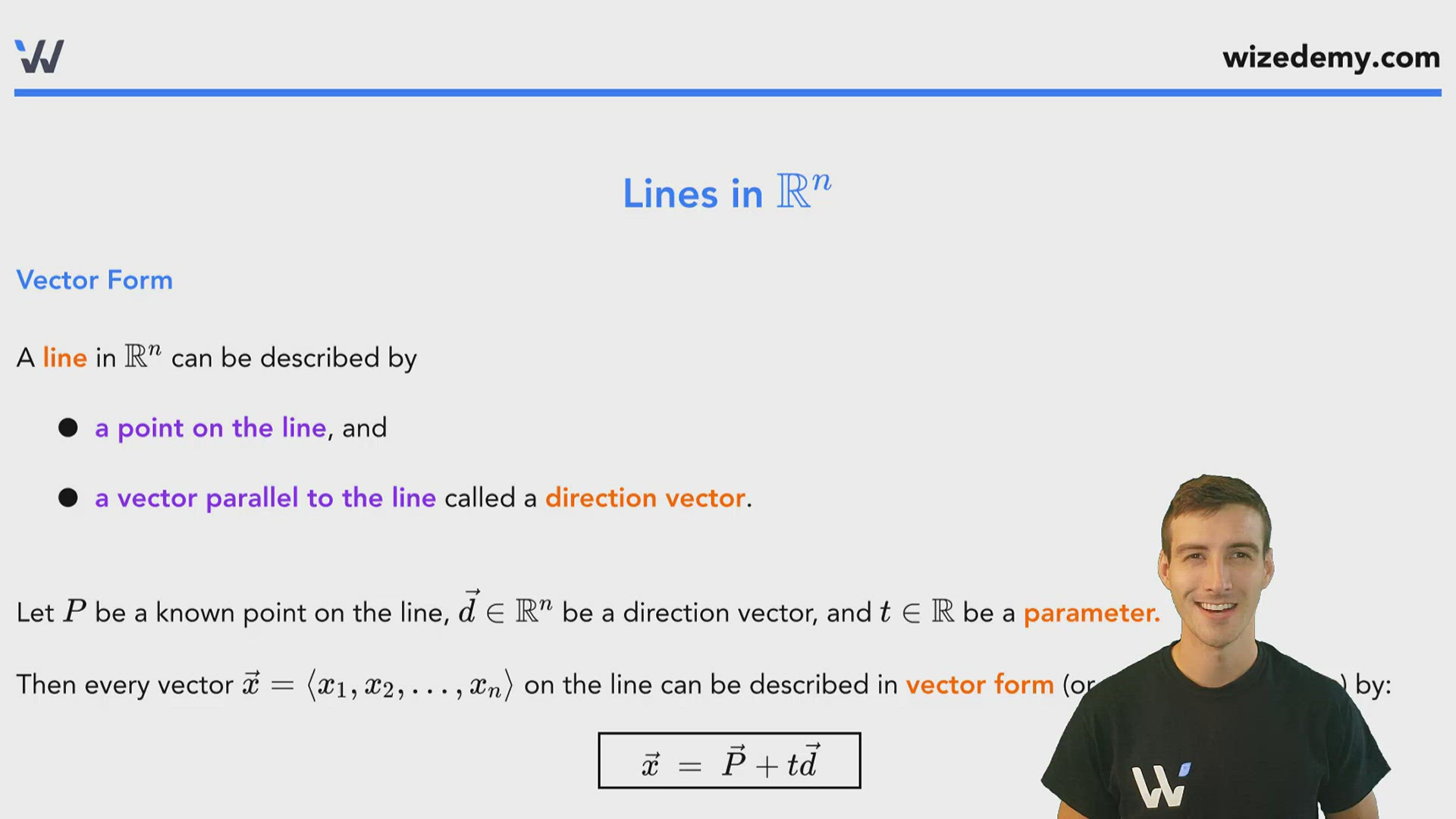
Lines in
Vector Form
A line in can be described by
- a point on the line, and
- a vector parallel to the line called a direction vector.
Let be a known point on the line, be a direction vector, and be a parameter.
Then every vector on the line can be described in vector form (or point-parallel form) by:
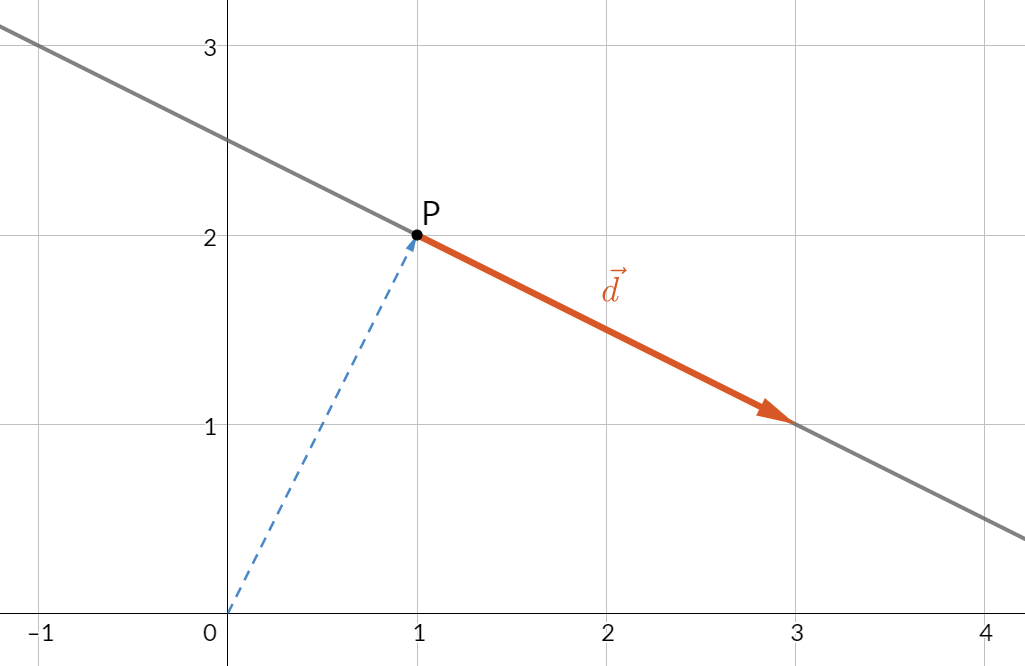
Geometrically
Start at point and run along a direction vector to form a line!
Parametric Form
We can break up the vector form into separate parametric equations.
Example:
- Known point on the line:
- Direction vector:
Symmetric Form
Solving for the parameter for each parametric equation and equating the solutions, we obtain the symmetric form of a line:
Two-Point Form
We can also describe a line using just two points.
Given points and on the line, we may write the line as:
Show that this is equivalent to vector form with .
Lines in
Lines in have some special forms. Note that these forms describe hyperplanes in .
Point-Normal Form
Given a point on the line and a normal (orthogonal) vector :
Wize Concept
Recall: given a direction vector , we can "switch and flip" to find an orthogonal vector:
Standard Form
Given a point on the line and a normal vector , and with :
Show that point-normal form is equivalent to standard form.
Wize Tip
- Two lines are parallel if their direction vectors are parallel:
- Two lines coincide (same line) if they are parallel and they share one point
- Two lines are orthogonal if their direction vectors are orthogonal:

0:00 / 0:00
Example: Lines in
Find the vector form, parametric form, and two-point form of the line that passes through the points and .
Given two points, we can immediately write the two-point form:
Using vector form instead, we first need to find the direction vector:
Now we can use either point or point as our known point.
Using the known point we have:
Splitting the vector form into its parametric equations yields:
Exam Tip
For a multiple choice question, you might have to use instead of if you don't see this answer.
0:00 / 0:00
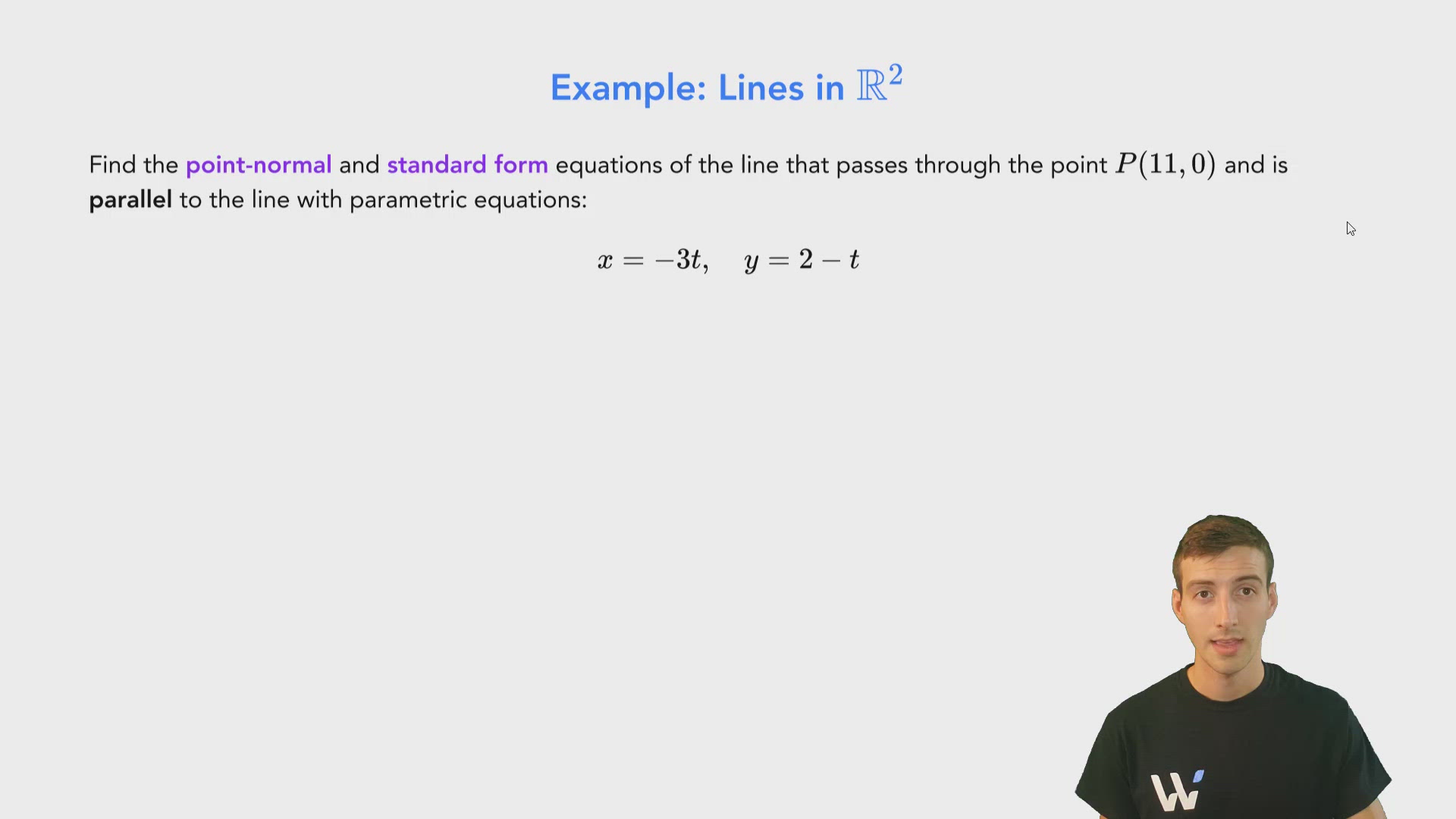
Example: Lines in
Find the point-normal and standard form equations of the line that passes through the point and is parallel to the line with parametric equations:
The given line's parametric equations can be written as:
Since the line we want is parallel to this one, we use the direction vector:
We want our line to pass through , so the vector form equation of our line is:
Since we want the point-normal and standard form, we need a normal vector:
Use "switch and flip" on to get .
So the point-normal form is:
For the standard form, all that's left to do is calculate .
So we read off the coefficients from for the LHS, and the RHS is simply :
Practice: Point on Line
Find all values of such that the point lies on the line
Practice: Lines in
Various pieces of information can be given to find the equation of a line.
Given Two Points
Find the vector form and standard form of the equation of the line that passes through the points and .
Practice: Lines in
Find the parametric equations of the line passing through the point and parallel to the line with equations:
Answer below with the appropriate coefficients:
x = + t
y = + t
z = + t