Popular Courses
MATH 211
University of Calgary
MATH 1229A/B
Western University
Linear Algebra
University Study Guides
MATH 152
University of British Columbia
MATH 1600A/B
Western University
Linear Algebra
General Course
MAT188H1
University of Toronto
Linear Algebra
University Study Guides
SC/MATH 1025 3.00
York University
MTH 141
Toronto Metropolitan University
MATH 102
University of Alberta
MATH 115
University of Waterloo
MATH 105
University of British Columbia
MAT223H1
University of Toronto
MATH-1270
University of Windsor
MATH 1210
University of Manitoba
MATH 111
Queen's University
MA122
Wilfrid Laurier University
MATH 1104
Carleton University
MATH 136
University of Waterloo

0:00 / 0:00
Planes in
A plane is an infinite flat surface in 3D space.

Planes can be described using various pieces of information:
- A point on the plane and a normal vector (orthogonal to the plane)
- Two lines on the plane
- Three points on the plane
Point-Normal Form
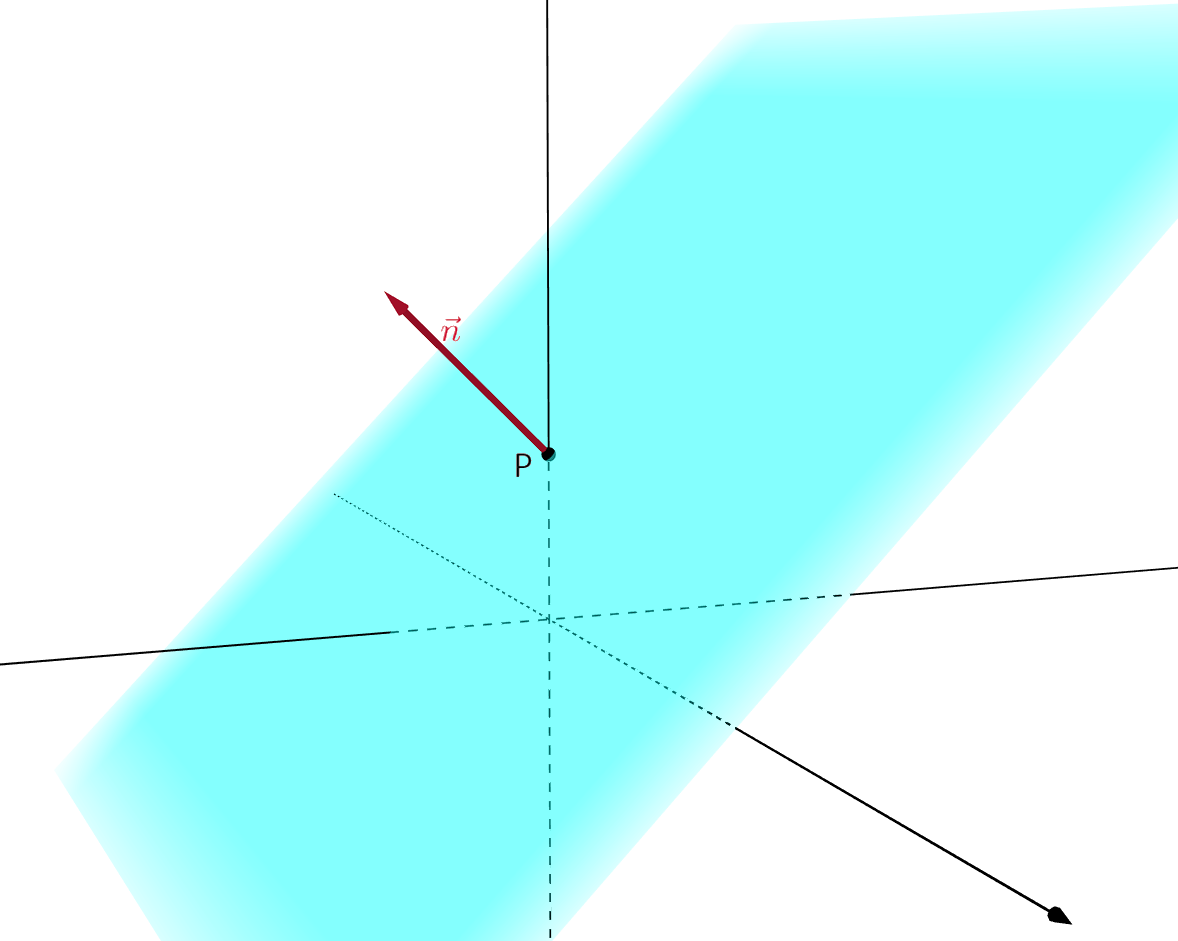
A plane in can be described in point-normal form (or vector form) using one point on the plane, and one normal vector.
Given a known point on the plane and a normal vector :
Standard Form
Simplifying the point-normal form gives the standard form (or scalar form) of a plane in , using :
Geometrically
Parametric Form
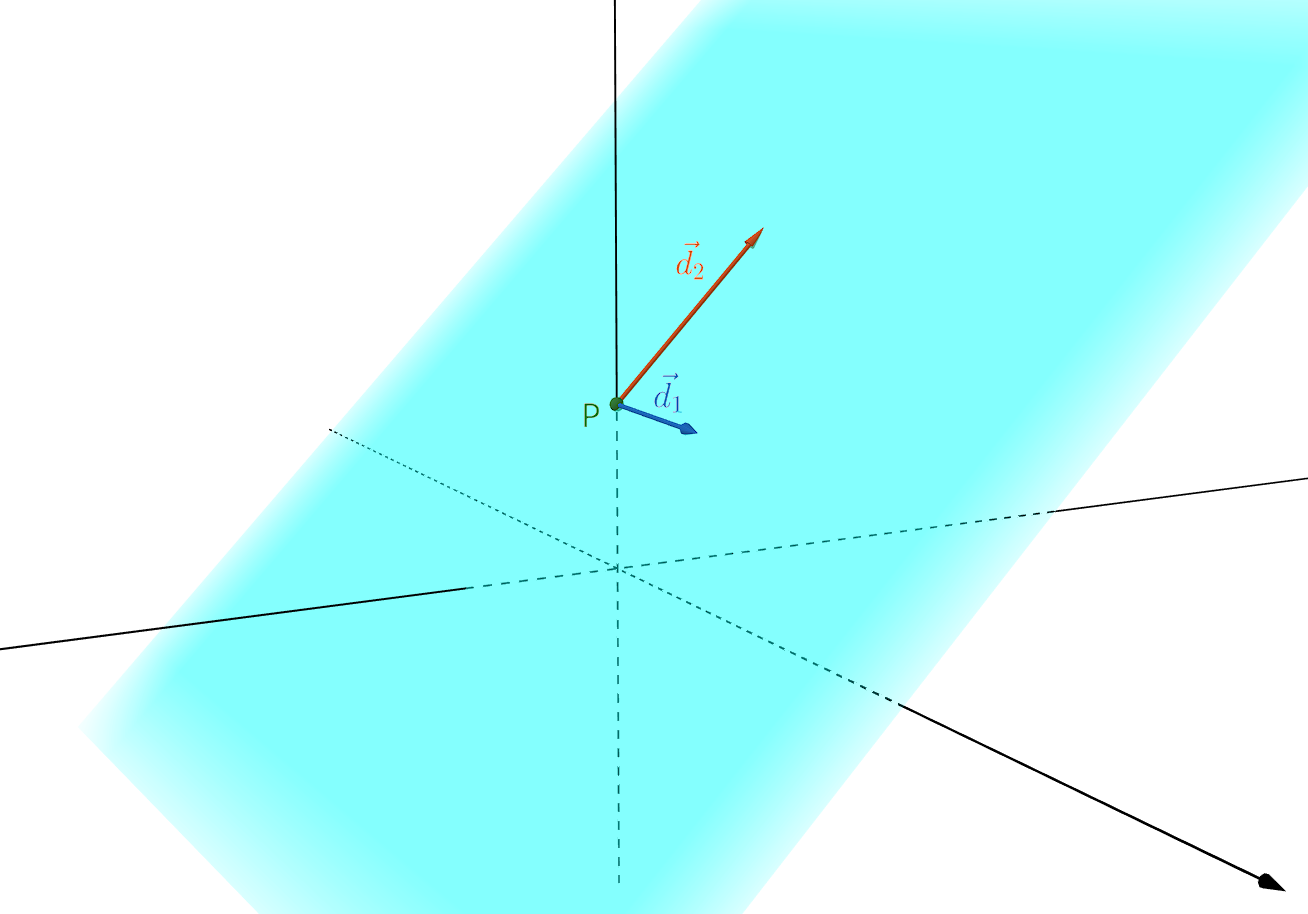
Given a point on the plane , and two non-collinear vectors in the plane , we may introduce two parameters, :
Geometrically
Given Two Lines on the Plane
Steps
- Find the normal vector where are the direction vectors of the lines.
- Find any point on one of the lines (this is a known point on the plane).
- Use and to write the equation of the plane in point-normal form or standard form, or use and to write the plane in parametric form.
Given Three Points on the Plane
Knowing three points that lie in the plane allows us to find two lines on the plane, so we can proceed as above.
Steps
- Find direction vectors in the plane: for example, let and .
- Find the normal vector where are the direction vectors of the lines.
- Use and to write the equation of the plane in point-normal form or standard form, or use and to write the plane in parametric form.
0:00 / 0:00
Example: Planes in
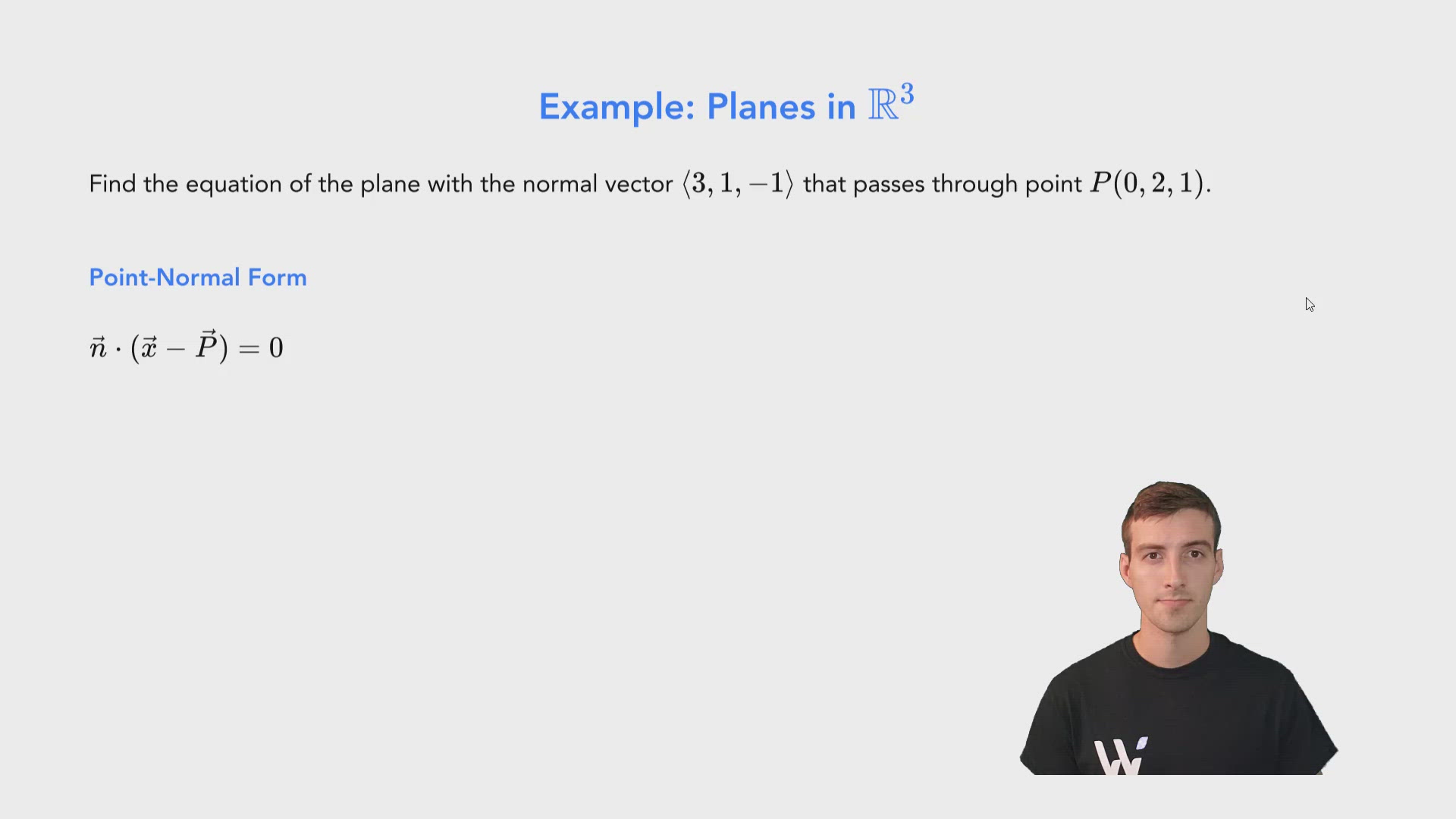
Find the equation of the plane with the normal vector that passes through point .
Point-Normal Form
Substituting:
We could simplify to obtain a scalar equation:
Standard form
where and
Now we substitute into the standard form formula using the normal vector where , , :
0:00 / 0:00
Example: Planes in
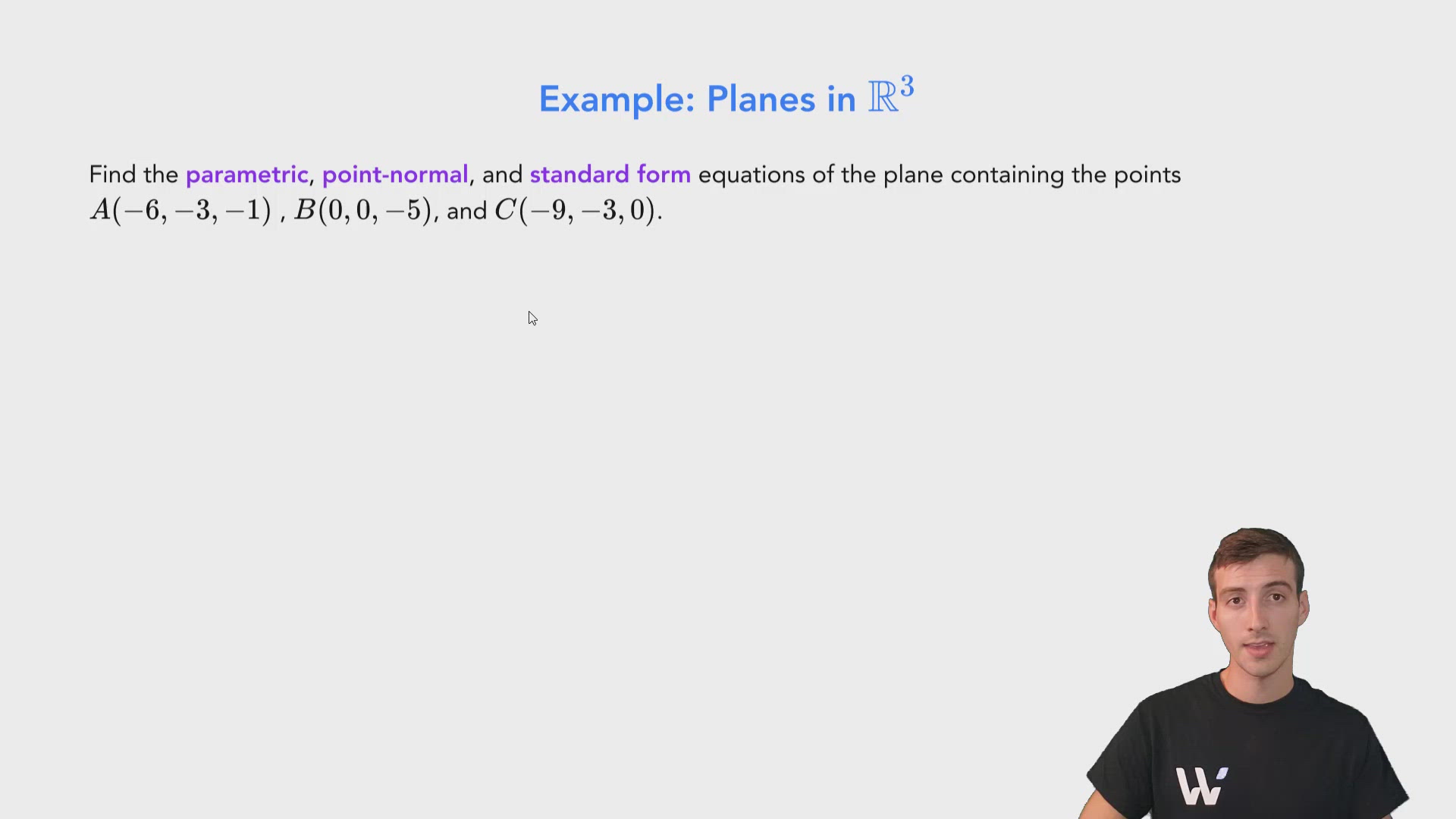
Find the parametric, point-normal, and standard form equations of the plane containing the points , , and .
We start by finding two direction vectors:
We can now write the plane in parametric form with point and vectors :
To write the plane in point-normal or standard form, we need to find a normal vector so we find the cross product of the direction vectors:
Using and point we can write:
Alternatively
We could have jumped straight to standard form using the formula:
Practice: Parallel Planes in
Find the values of and such that the following planes are parallel:
Practice: Planes in
Find the standard form equation of the plane that contains the points .
Practice: Planes in (Tricky)
Consider the points , , and , and suppose we know the vector .
Find the equation of the plane containing point , and perpendicular to the line passing through points and .