Wize University Linear Algebra Textbook > Systems of Linear Equations (SLEs) (Linear Systems)
Geometric Interpretation of Linear Systems
Popular Courses
MATH 211
University of Calgary
MATH 1229A/B
Western University
Linear Algebra
University Study Guides
MATH 152
University of British Columbia
MATH 1600A/B
Western University
Linear Algebra
General Course
MAT188H1
University of Toronto
Linear Algebra
University Study Guides
SC/MATH 1506 3.00
York University
APSC 174
Queen's University
MTH 141
Toronto Metropolitan University
MATH 115
University of Waterloo
ADM 1305
University of Ottawa
MAT223H1
University of Toronto
MATH 123
McGill University
MATH-1270
University of Windsor
MATH 1210
University of Manitoba
MATH-1250
University of Windsor
MATH 223
McGill University
MATH 1104
Carleton University

0:00 / 0:00
Geometric Interpretation of Solutions to SLEs
Linear systems are made up of equations of hyperplanes (e.g. lines in ; planes in ).
A solution is the intersection of all the hyperplanes.
: Intersection of Lines
- No intersection
- Unique point of intersection (2 lines cross)
- Infinitely many points of intersection
- Line 1-parameter family of solutions (same line)
Example
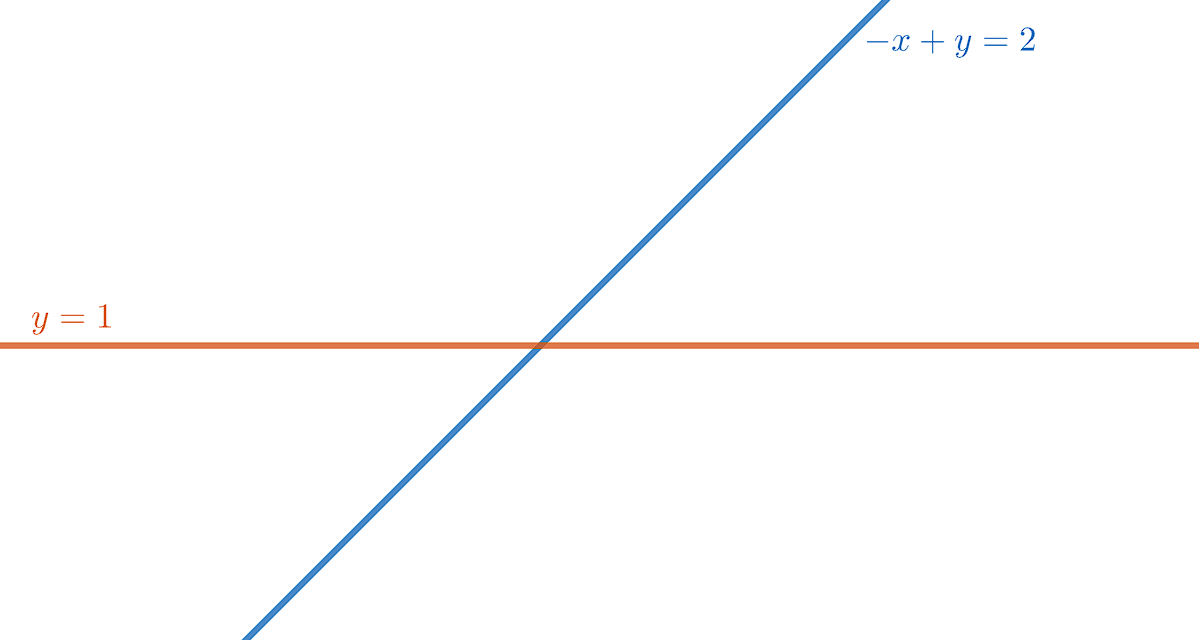
: Intersection of Planes
- No intersection
- Unique point of intersection (requires 3 planes)
- Infinitely many points of intersection
- Line 1-parameter family of solutions (2 planes intersect)
- Plane 2-parameter family of solutions (2 of the same plane)
Example
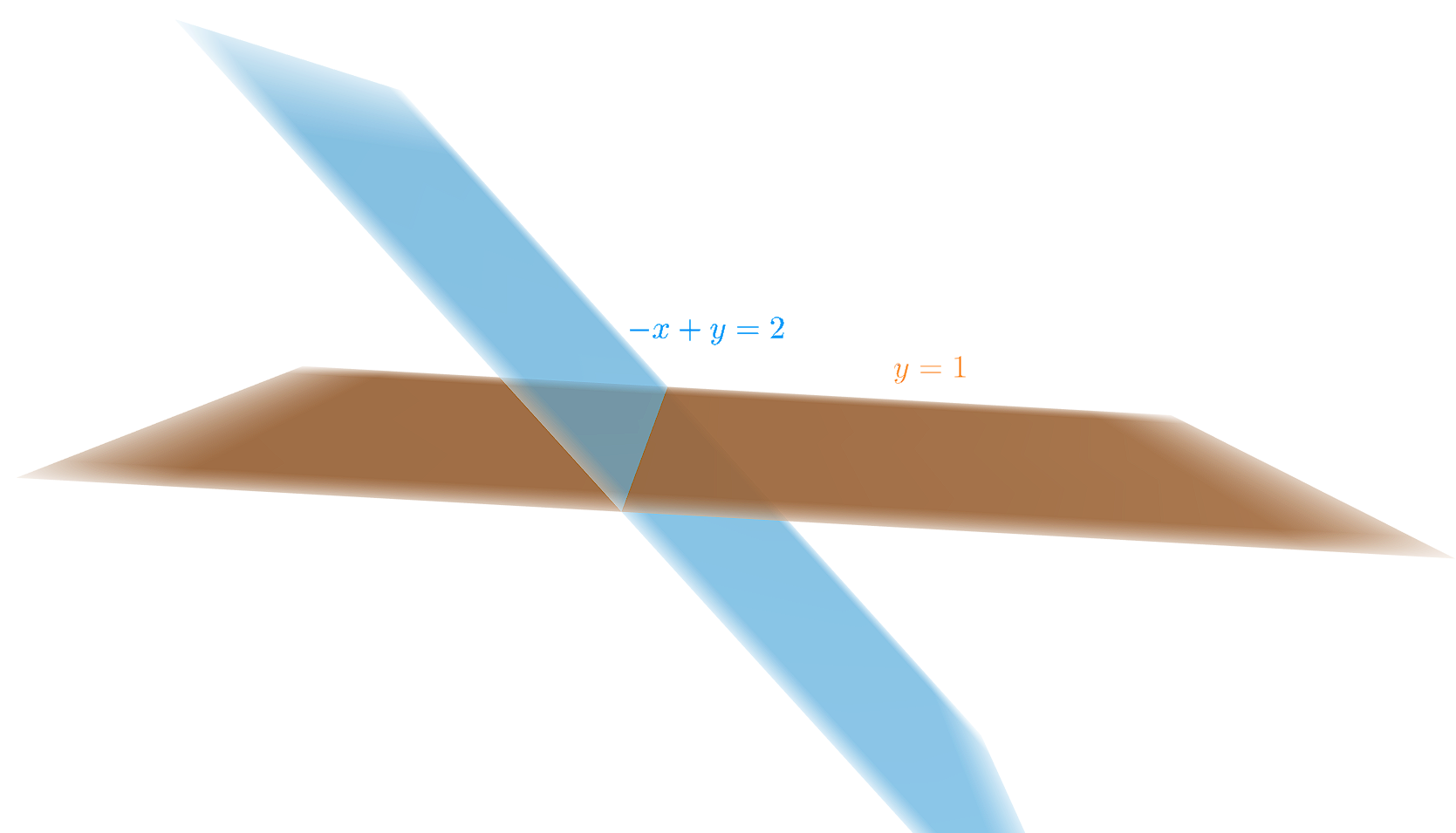
0:00 / 0:00
Example: Geometric Interpretation of a Linear System
Solve the system of linear equations and interpret the solution geometrically:
Steps
- Let's first write this in augmented matrix form:
- Turn the matrix into RREF using EROs:
- Find all solutions to the SLE:
The coefficient matrix has just one leading 1, but 2 columns/variables:
Thus, there is free variable (). Let .
Rewrite the augmented matrix back into a system of linear equations:
Therefore, the solution is .
- Interpret the solution geometrically:
We were given a system of linear equations in 2 variables .
Each equation is a hyperplane: in , hyperplanes are simply lines (in general, a hyperplane in is dimensional).
So we have 2 lines, but both lines are identical (hence reducing to a row of 0s).
This means the lines intersect everywhere on the line defined by .
Consider the following augmented matrix in RREF:
If the unknowns in this system are , find the solution(s) to the linear system.
Then, determine which of the following is the correct geometrical interpretation of the solution.