Popular Courses
MATH 211
University of Calgary
MATH 1229A/B
Western University
Algebra II
US High School
Linear Algebra
University Study Guides
MATH 133
McGill University
MATH 152
University of British Columbia
MATH 1600A/B
Western University
Linear Algebra
General Course
MATH 204
Concordia University
MAT188H1
University of Toronto
Linear Algebra
University Study Guides
SC/MATH 1506 3.00
York University
APSC 174
Queen's University
MATH 151
University of Victoria
MATH 115
University of Waterloo
MAT133Y1
University of Toronto
ADM 1305
University of Ottawa
MAT223H1
University of Toronto
MATH 123
McGill University
MATH-1270
University of Windsor
0:00 / 0:00
Solutions of a Linear System
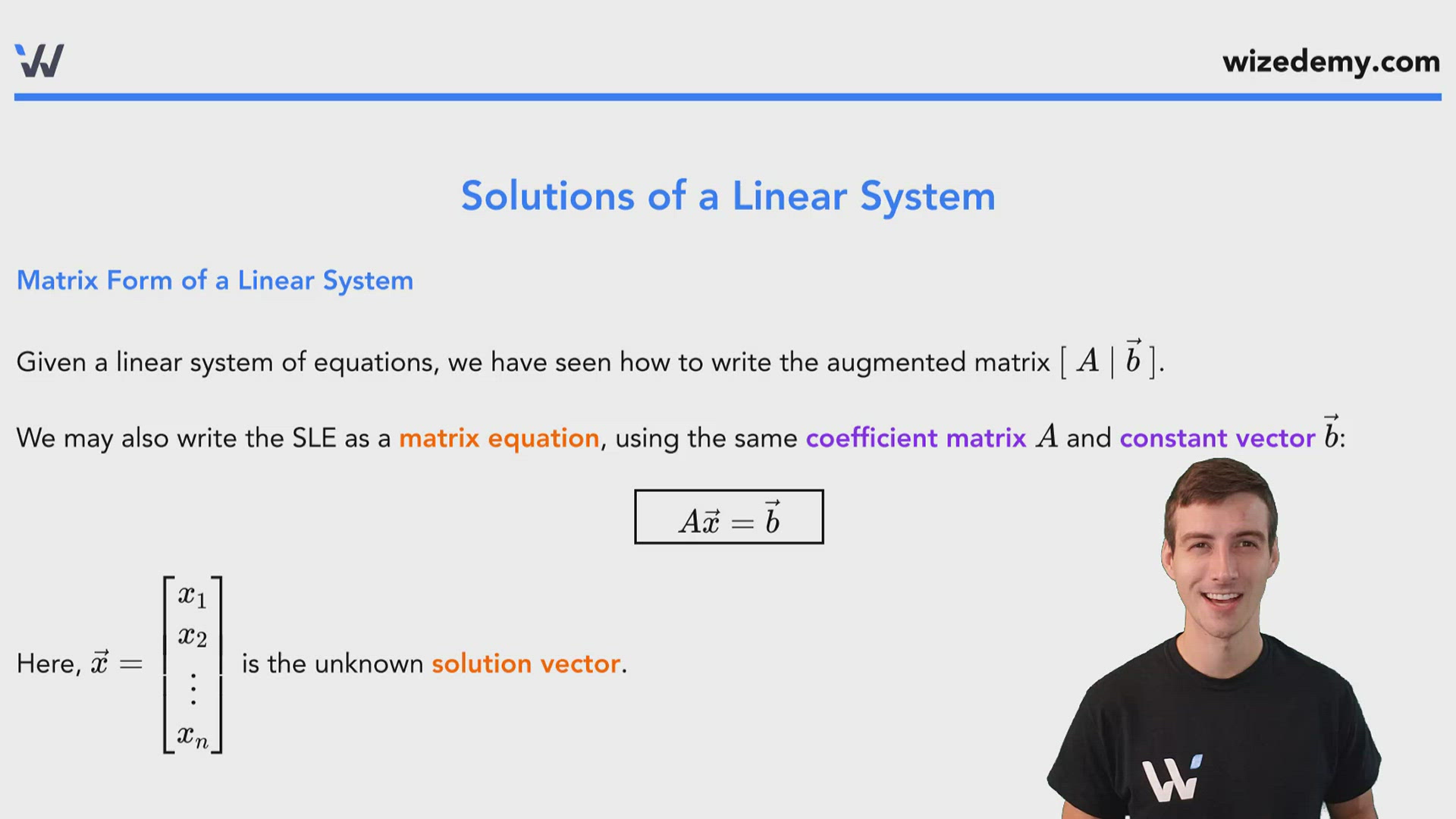
Matrix Form of a Linear System
Given a linear system of equations, we have seen how to write the augmented matrix .
We may also write the SLE as a matrix equation, using the same coefficient matrix and constant vector :
Here, is the unknown solution vector.
Procedure to Solve
- Write the linear system as an augmented matrix
- Turn the matrix into RREF using EROs
- Find all solutions
- Use rank to determine the number of solutions
- Turn the augmented matrix back into a system of linear equations (assign parameters if needed)
- Solve for any missing variables
Example 1
Find the general solution to the system represented by the augmented matrix:
Example 2
Find the general solution to the system represented by the augmented matrix:
free variable.
Note that and have leading 1s in their columns, but does not.
is a free variable, and we assign it a parameter: let .
0:00 / 0:00
Homogeneous Linear Systems
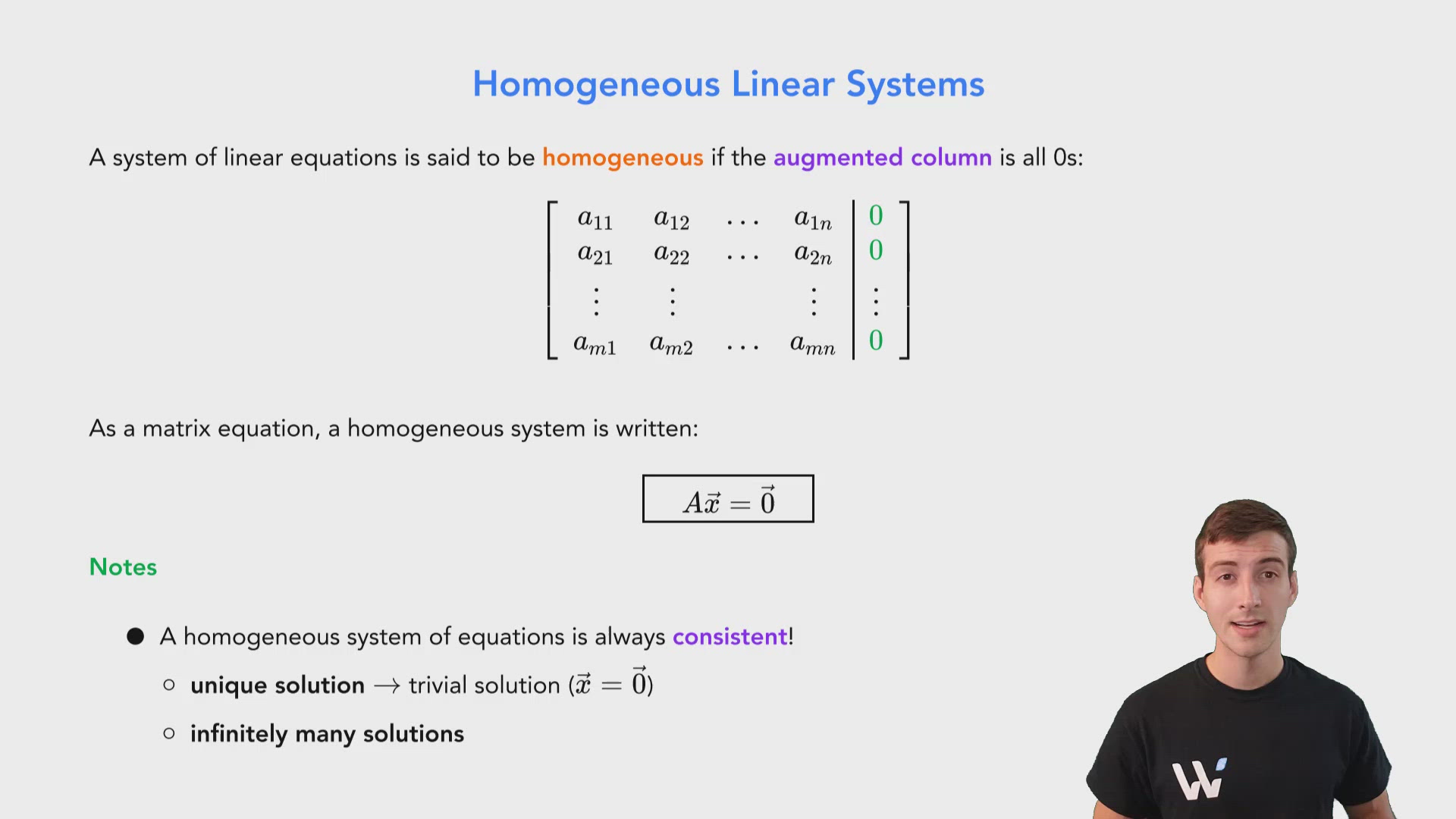
A system of linear equations is said to be homogeneous if the augmented column is all 0s:
As a matrix equation, a homogeneous system is written:
Notes
- A homogeneous system of equations is always consistent!
- unique solution trivial solution ()
- infinitely many solutions
- The general solution is a linear combination of basic solutions (vectors that appear next to parameters)
Example
represents a system with general solution:
The vectors being multiplied by parameters are non-unique basic solutions.
Wize Concept
Any linear combination of basic solutions is another basic solution.
0:00 / 0:00
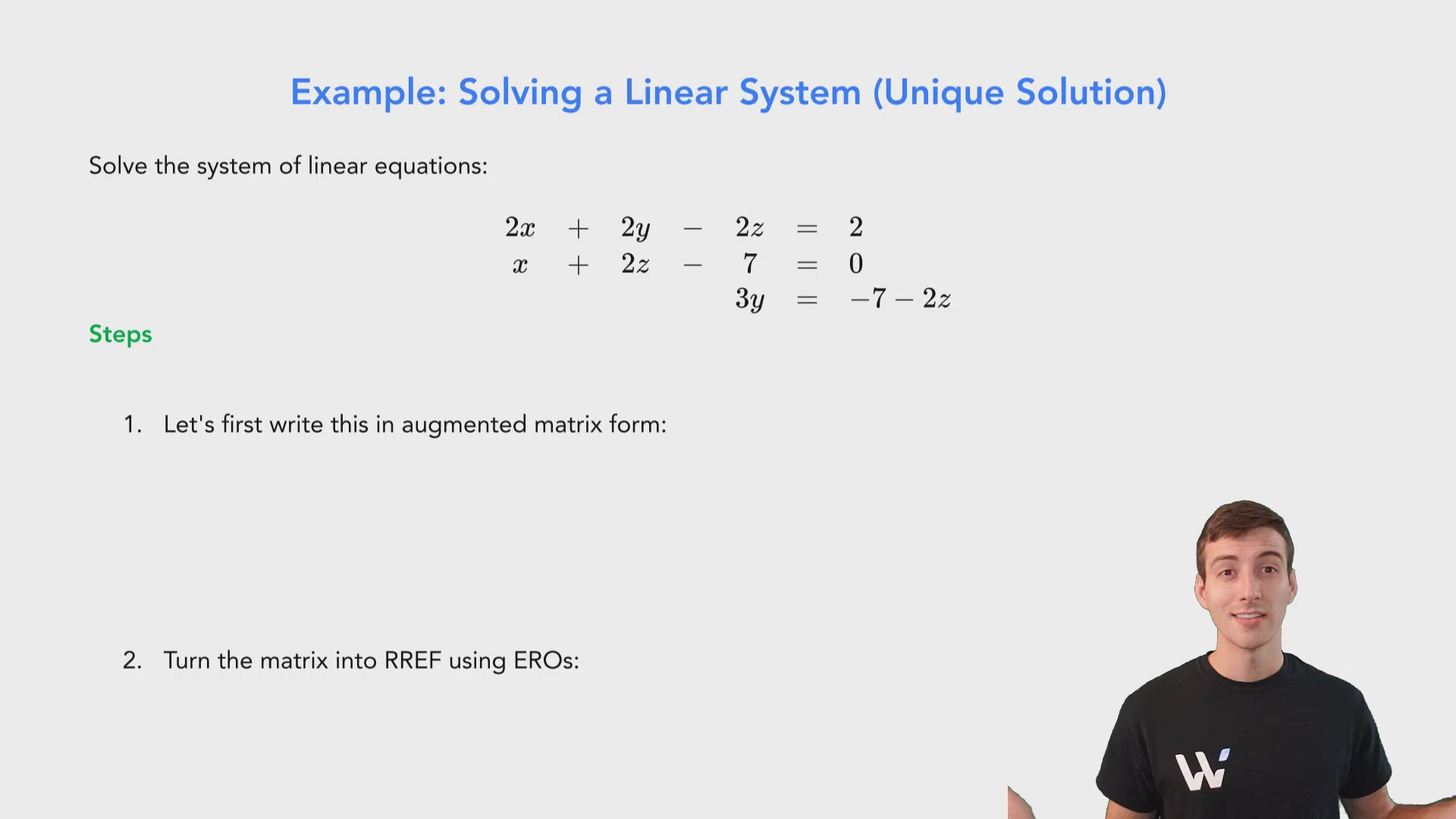
Example: Solving a Linear System (Unique Solution)
Solve the system of linear equations:
Steps
- Let's first write this in augmented matrix form:
- Turn the matrix into RREF using EROs:
- Find all solutions to the SLE:
The coefficient matrix has 3 leading 1s and 3 columns: there is a unique solution.
Rewrite the augmented matrix back into a system of linear equations:
Therefore, the unique solution is
0:00 / 0:00
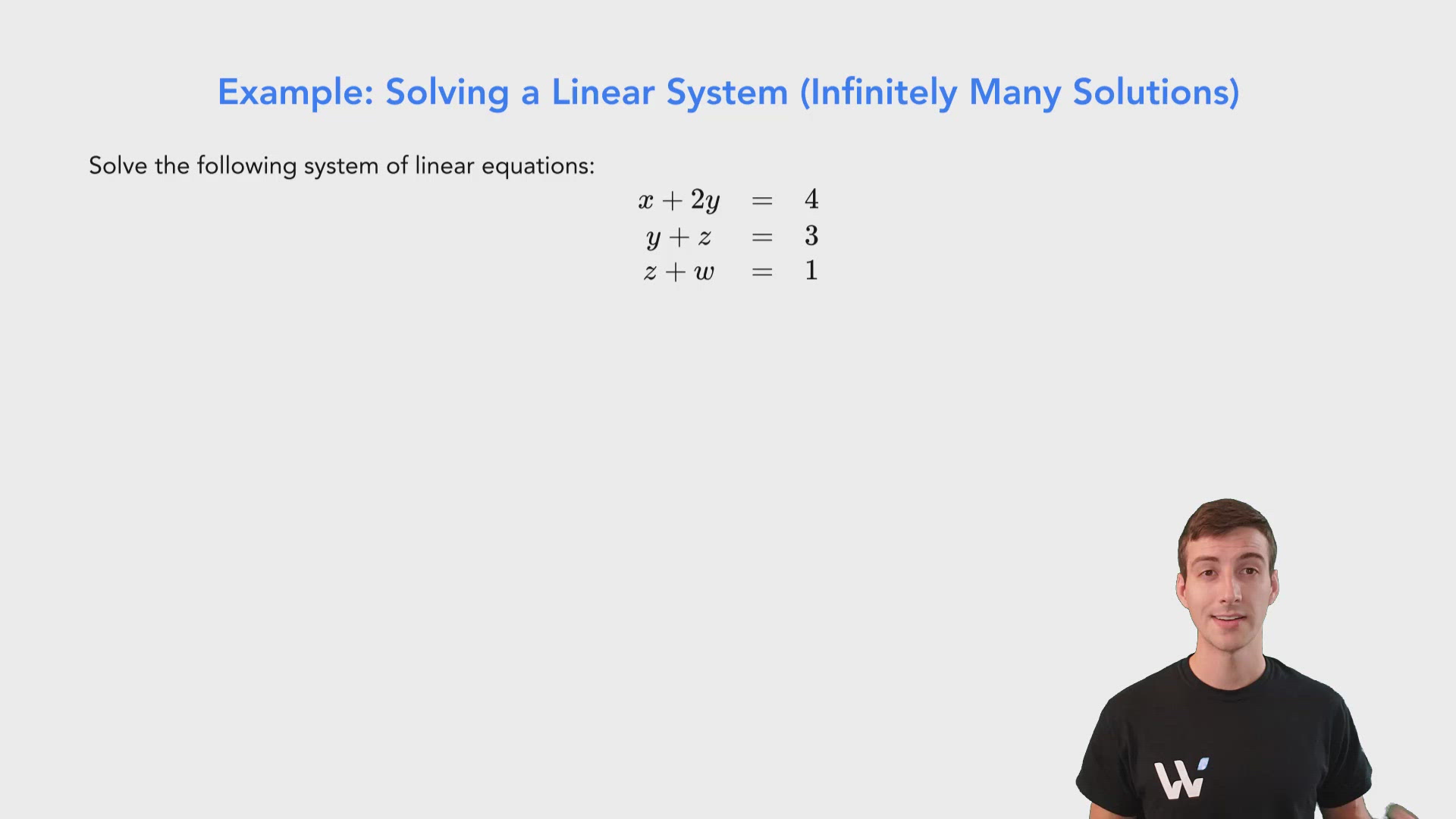
Example: Solving a Linear System (Infinitely Many Solutions)
Solve the following system of linear equations:
The standard form of the linear system is and the augmented matrix is .
(Note that the order of the variables does not matter, but be consistent!)
We need to reduce the matrix to RREF:
There are 3 leading 1s and 4 columns in the RREF, so , so there are infinitely many solutions.
so there is one free variable (1-parameter family of solutions).
Let's assign a parameter to the free variable (the column with a missing leading 1, ) and rewrite the SLE using the RREF.
Let . (Remember to include this equation in the list of equations we obtain from the RREF. We need a solution for all variables!)
Therefore, the 1-parameter family of solutions is .
Solve the following system of linear equations. What type of solution is it?
Solve the following homogeneous system of linear equations. What type of solution is it?