Wize University Linear Algebra Textbook > Differential Equations
Basics of Differential Equations
Popular Courses
Linear Algebra
University Study Guides
MATH 1ZC3
McMaster University
MATH 152
University of British Columbia
Linear Algebra
General Course
Linear Algebra
University Study Guides
APSC 174
Queen's University
MATH 1B03
McMaster University
MATH-1270
University of Windsor
MATH 1210
University of Manitoba
MATH 1104
Carleton University
MATH 1300
University of Manitoba
MAT 1302
University of Ottawa
MATH 1107
Carleton University
STATS 1LL3
McMaster University
ENGM 1041
Dalhousie University
MATH 114
University of Waterloo
MATH-1260
University of Windsor
MA-UY 2034
New York University
MATH 266
University of Saskatchewan
MA 26500
Purdue University
0:00 / 0:00
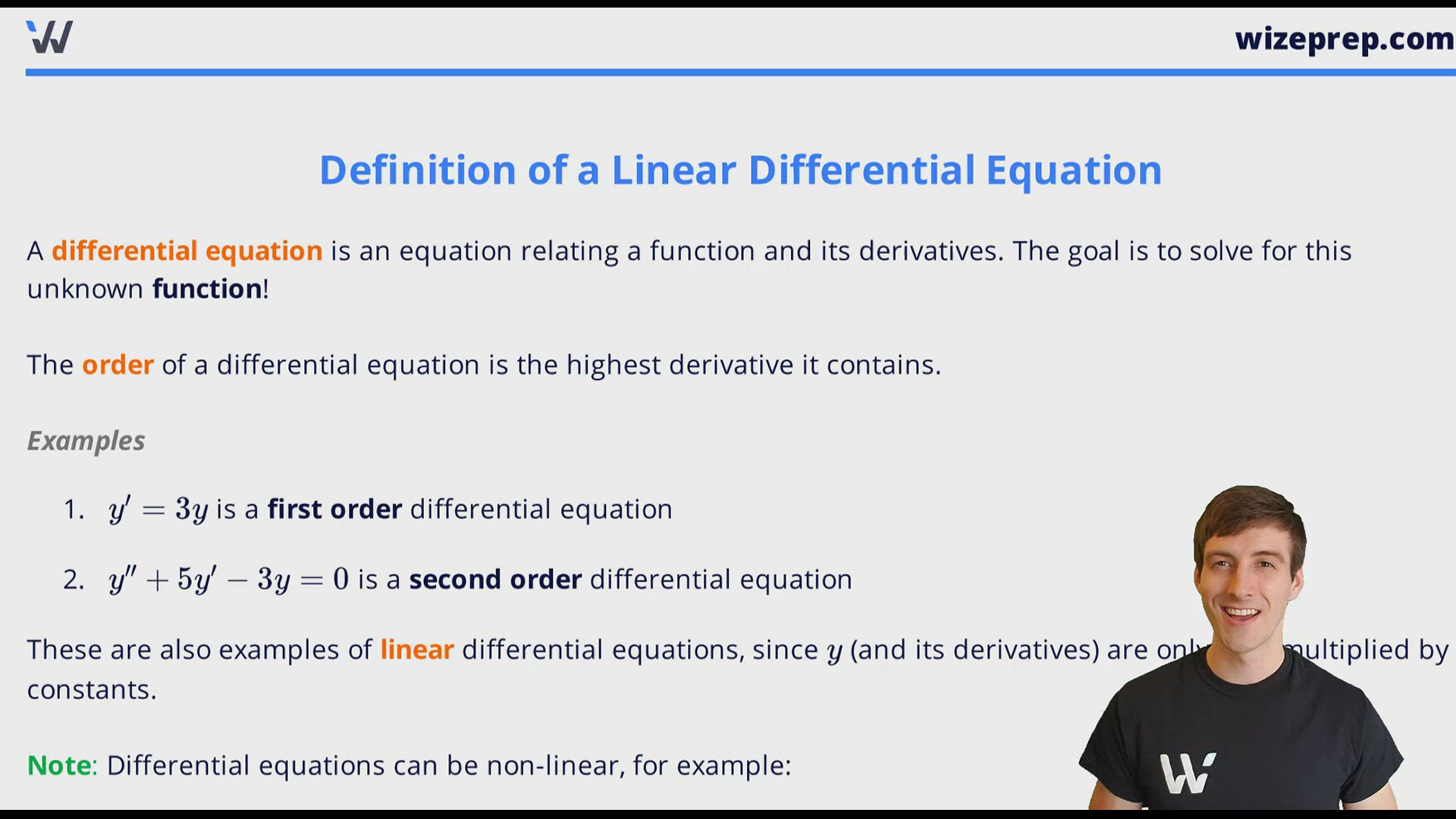
Definition of a Linear Differential Equation
A differential equation is an equation relating a function and its derivatives. The goal is to solve for this unknown function!
The order of a differential equation is the highest derivative it contains.
Examples
- is a first order differential equation
- is a second order differential equation
These are also examples of linear differential equations, since (and its derivatives) are only ever multiplied by constants.
Note: Differential equations can be non-linear, for example:
We will only be focusing on linear differential equations.

0:00 / 0:00
Simplest Differential Equation:
The simplest differential equation (DE) is:
You should memorize the solution to this equation:
where is an arbitrary constant (it can be any number).
Wize Tip
Note that the solution to a differential equation is always a function.
Check
To verify the solution, we plug it into the DE and check that LHS=RHS.
Since LHS=RHS, we've shown that our solution does indeed satisfy .
Examples
a) . What function satisfies this relationship?
Check your answer by taking the derivative of your solution.
b) . What is the solution?
0:00 / 0:00
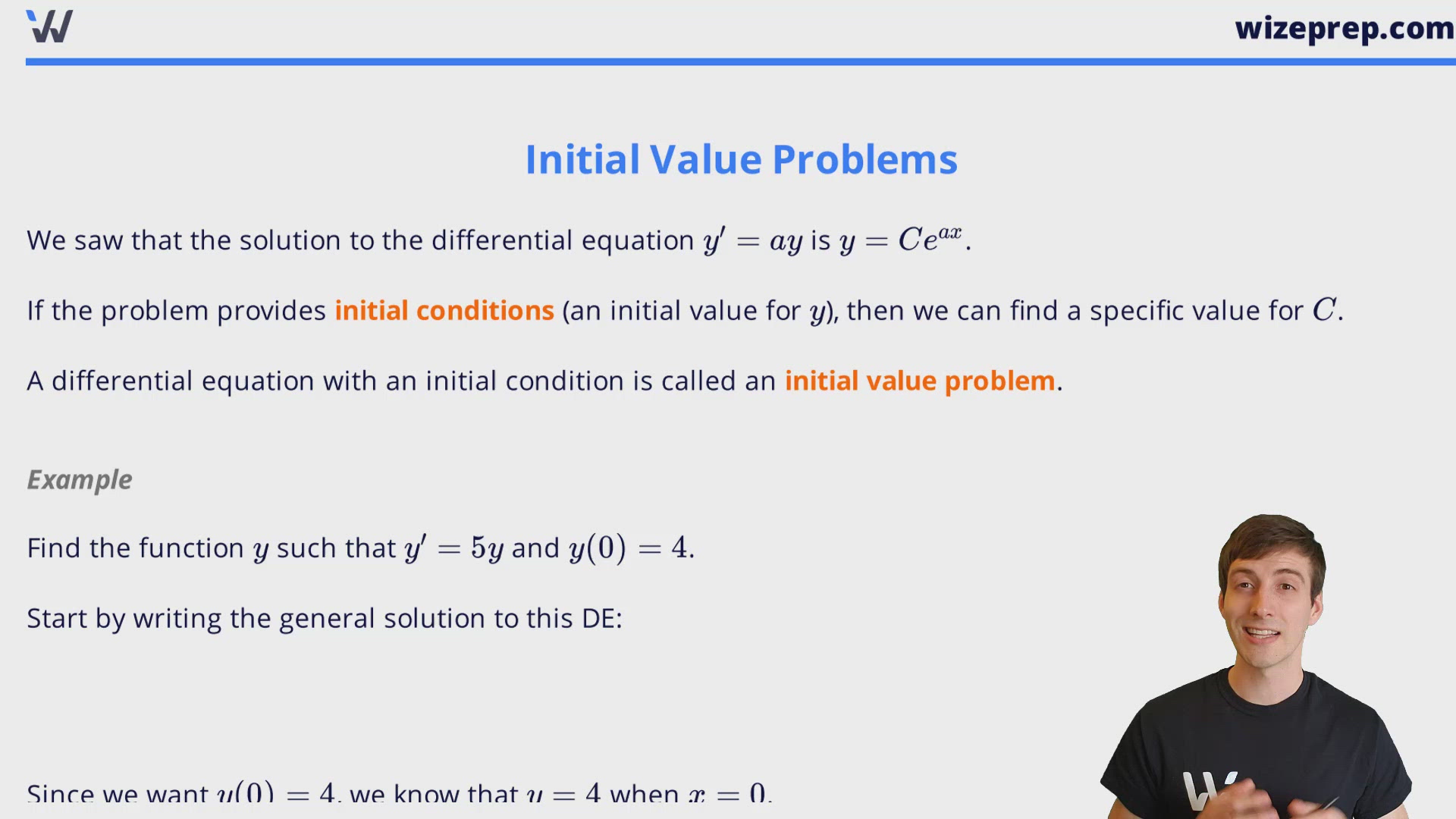
Initial Value Problems
We saw that the solution to the differential equation is .
If the problem provides initial conditions (an initial value for ), then we can find a specific value for .
A differential equation with an initial condition is called an initial value problem.
Example
Find the function such that and .
Start by writing the general solution to this DE:
Since we want , we know that when .
Plug these into our solution, and solve for :
Therefore, the solution is
0:00 / 0:00
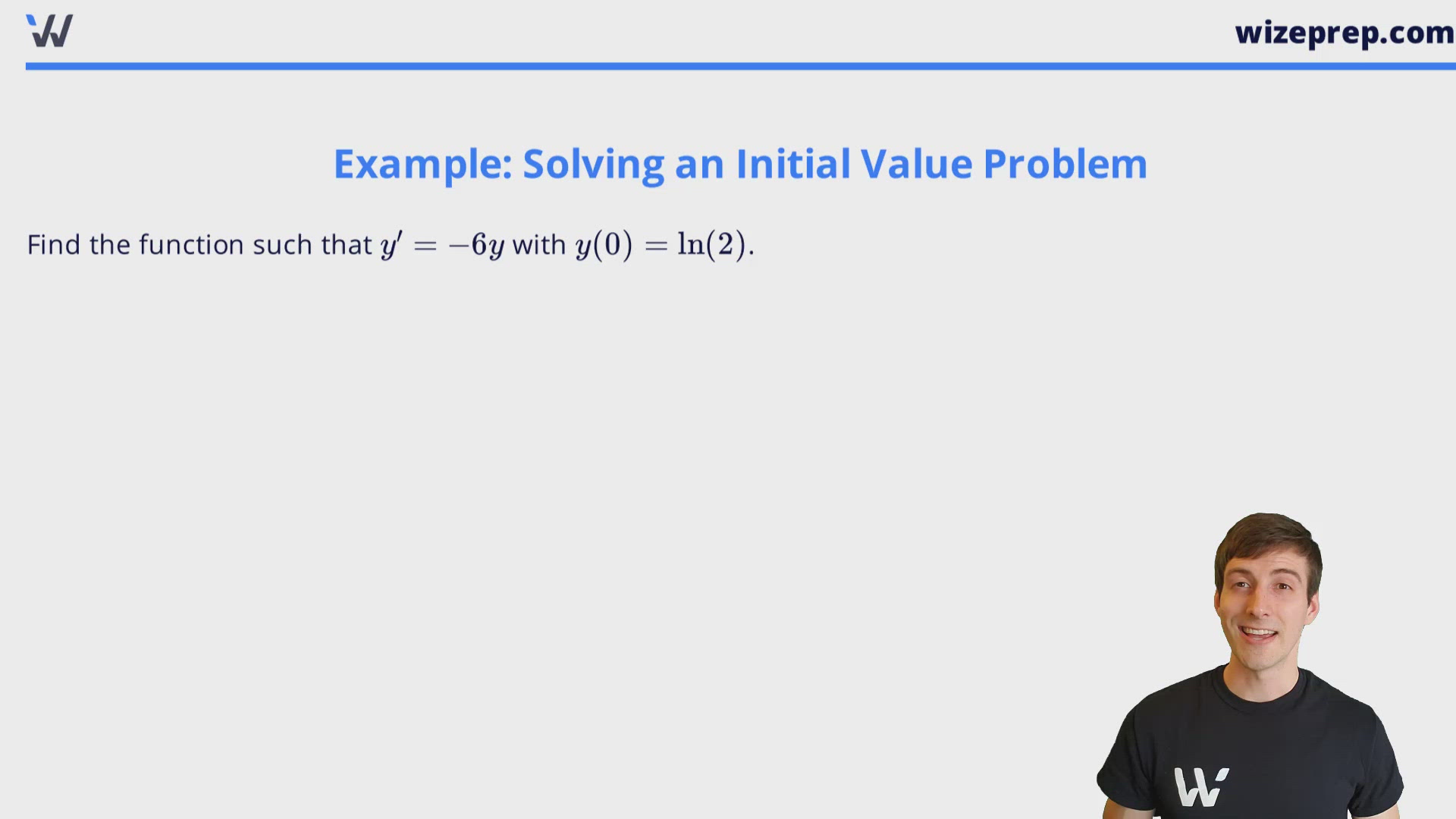
Example: Solving an Initial Value Problem
Find the function such that with .
We want when . Plugging these values into our solution, we solve for :
So the solution is therefore:
Practice: Simple Differential Equations
For each differential equation (DE), find the general solution (i.e. the function that satisfies it):
a)
b)
c)
(Don't forget the arbitrary constant, )
Practice: Initial Value Problems
Find the function that satisfies the differential equation with initial condition .