0:00 / 0:00

Systems of Linear Differential Equations

General form

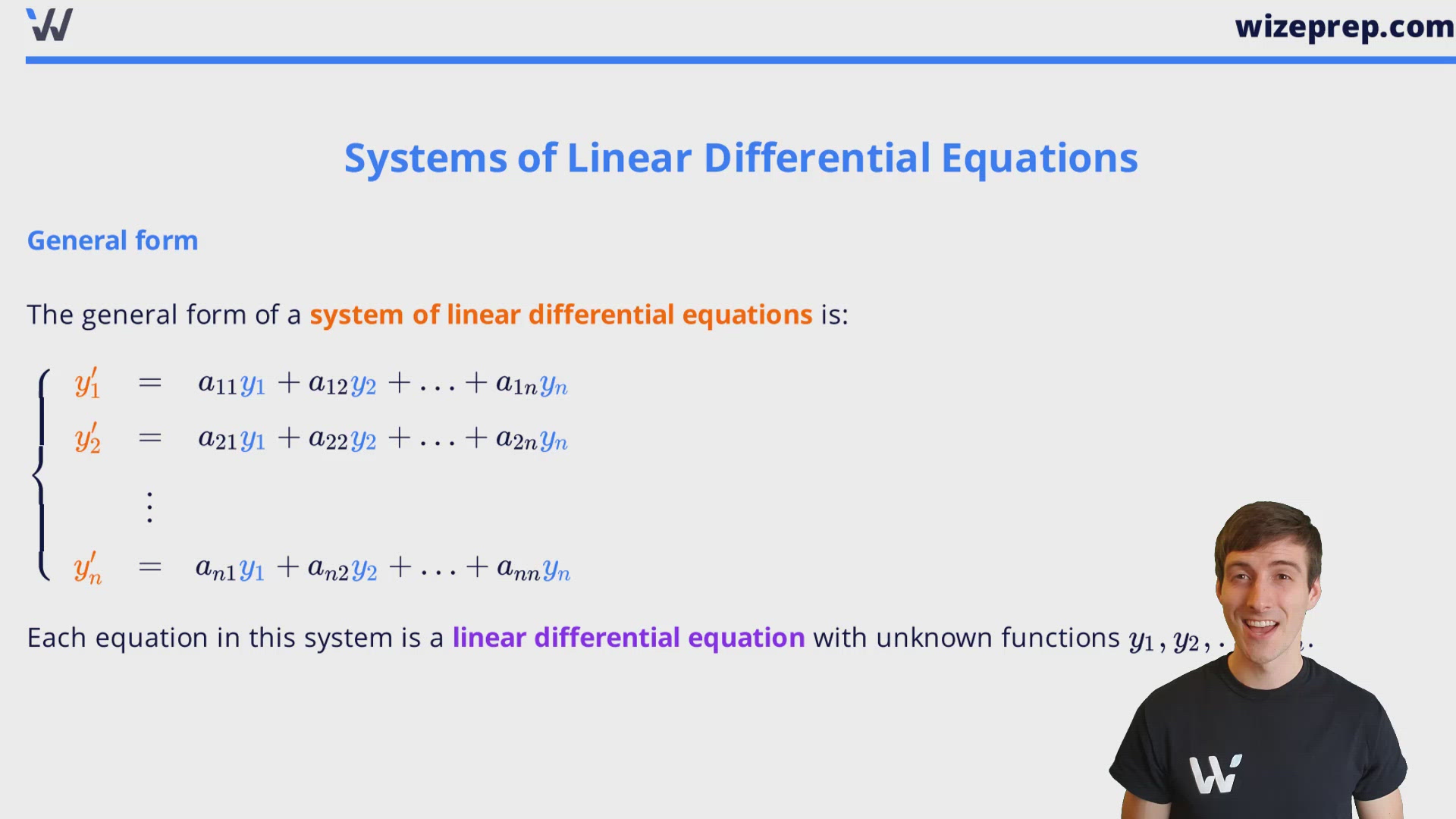
The general form of a system of linear differential equations is:
{y1=a11y1+a12y2++a1nyny2=a21y1+a22y2++a2nynyn=an1y1+an2y2++annyn\left\{\begin{array}{ccc} \colorFour{y_1'}&=&a_{11}\colorOne{y_1}+a_{12}\colorOne{y_2}+\ldots+a_{1n}\colorOne{y_n}\\[0.5em] \colorFour{y_2'}&=&a_{21}\colorOne{y_1}+a_{22}\colorOne{y_2}+\ldots+a_{2n}\colorOne{y_n}\\[0.5em] &\vdots\\[0.5em] \colorFour{y_n'}&=&a_{n1}\colorOne{y_1}+a_{n2}\colorOne{y_2}+\ldots+a_{nn}\colorOne{y_n} \end{array}\right.
Each equation in this system is a linear differential equation with unknown functions y1,y2,,yny_1, y_2, \ldots, y_n.
Note: We will only consider systems where the number of unknowns is the same as the number of equations (n×nn\times n).

Matrix Form

A system of linear differential equations can be written in matrix form. The general system above is given by:
[y1y2yn]y =[a11a12a1na21a22a2nan1an2ann]A[y1y2yn]yor:y =Ay\colorFour{\underbrace{ \left[ \begin{array}{c} y_1'\\[0.5em] y_2'\\[0.5em] \vdots\\[0.5em] y_n' \end{array} \right]}_{\normalsize \vec y\ '}} = \underbrace{ \left[ \begin{array}{cccc} a_{11}&a_{12}&\cdots&a_{1n}\\[0.5em] a_{21}&a_{22}&\cdots&a_{2n}\\[0.5em] \vdots&\vdots&&\vdots\\[0.5em] a_{n1}&a_{n2}&\cdots&a_{nn}\\[0.5em] \end{array} \right]}_{\normalsize A} \colorOne{ \underbrace{ \left[ \begin{array}{c} y_1\\[0.5em] y_2\\[0.5em] \vdots\\[0.5em] y_n \end{array} \right]}_{\normalsize \vec y}} \text{\qquad or:\quad } \boxed{\quad \colorFour{\vec y\ '}=A \colorOne{\vec y} \quad}
PAGE BREAK
Example
{y1=2y12y2y2=3y1+4y2\left\{\begin{array}{rcl} y_1'&=&2y_1-2y_2\\[0.5em] y_2'&=&3y_1+4y_2 \end{array}\right.
Can be written as:
[y1y2]=[2234]A[y1y2]or: y=Ay\left[ \begin{array}{r} y_1'\\[0.5em] y_2' \end{array} \right] = \underbrace{ \left[ \begin{array}{rr} 2&-2\\[0.5em] 3&4 \end{array} \right]}_{\normalsize A} \left[ \begin{array}{r} y_1\\[0.5em] y_2 \end{array} \right]\text{\qquad or: \quad} \vec y'=A\vec y
We wish to find functions y1\vec y_1 and y2\vec y_2 that are solutions to this system. Find out how in the next lesson!
0:00 / 0:00

Solving a System of Linear DEs

In your course, you might have seen a full derivation (using diagonalization) to solve systems of linear DEs.
Here, I'll simply show you the important steps to quickly solve a system of linear differential equations: y=Ay\vec y' = A \vec y
Steps

1) Find the eigenvalues and associated eigenvectors of matrix AA: eigenvalueseigenvectorsλ1x1λ2x2λnxn\begin{array}{ccc} \text{eigenvalues} && \text{eigenvectors}\\ \colorTwo{\lambda_1} &\longleftrightarrow& \colorThree{\vec x_1}\\ \colorTwo{\lambda_2} &\longleftrightarrow& \colorThree{\vec x_2}\\ \vdots && \vdots\\ \colorTwo{\lambda_n} &\longleftrightarrow& \colorThree{\vec x_n}\\ \end{array}

2) The solution vector y\vec y is given by:
y=(C1eλ1x)x1+(C2eλ2x)x2++(Cneλnx)xn\boxed{\quad \vec y = (C_1e^{\colorTwo{\lambda_1} x})\colorThree{\vec x_1} +(C_2e^{\colorTwo{\lambda_2} x})\colorThree{\vec x_2} +\ldots +(C_ne^{\colorTwo{\lambda_n} x})\colorThree{\vec x_n} \quad}
where C1,C2,,CnC_1, C_2, \ldots, C_n are arbitrary constants.
0:00 / 0:00

Example: Solving a System of Linear Differential Equations

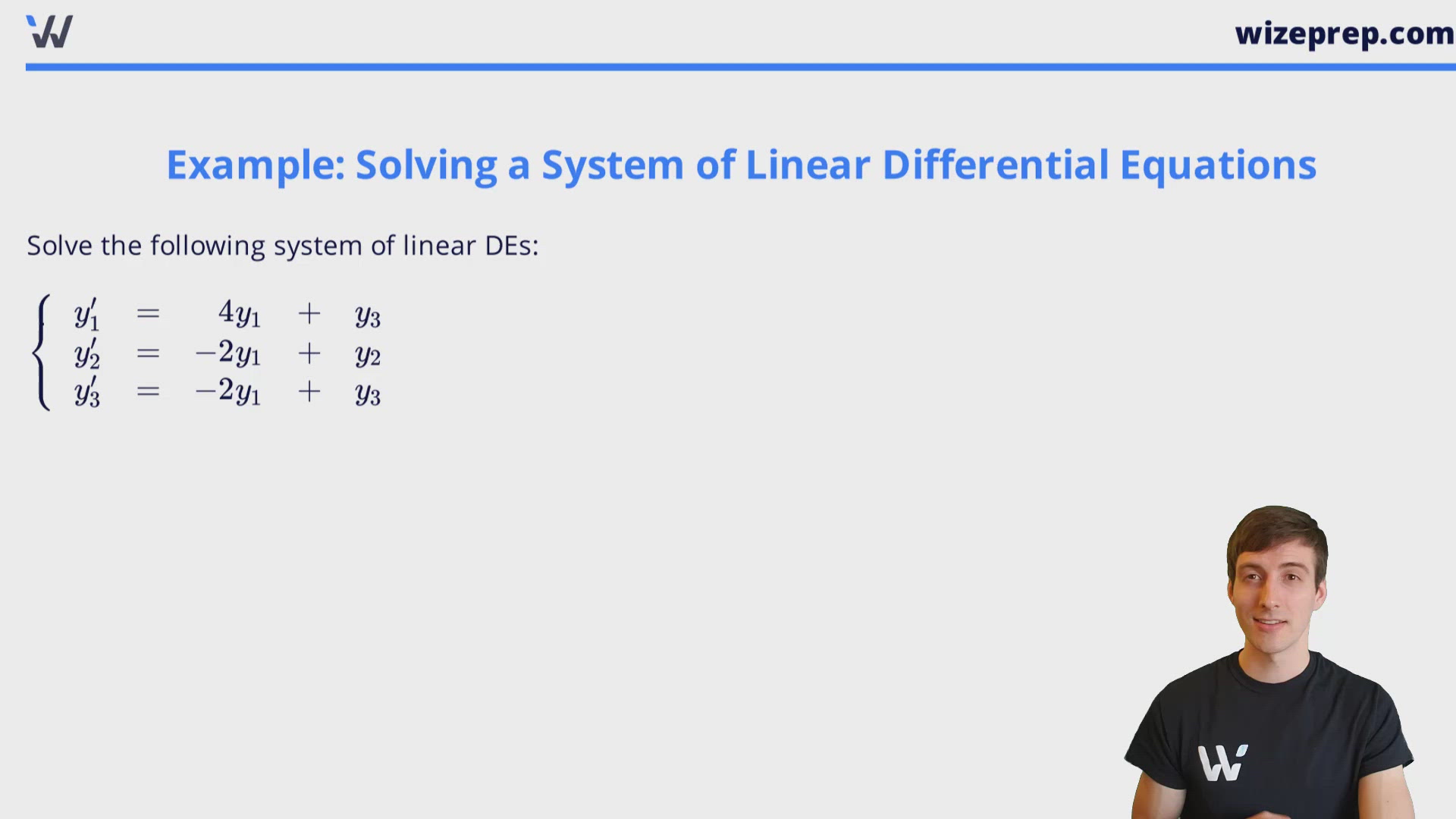
Solve the following system of linear DEs:
{y1=4y1+y3y2=2y1+y2y3=2y1+y3\left\{\begin{array}{rcrcr} y_1'&=&4y_1&+&y_3\\ y_2'&=&-2y_1&+&y_2\\ y_3'&=&-2y_1&+&y_3 \end{array}\right.
This system can be written in matrix-vector form as:
[y1y2y3]=[401210201][y1y2y3]    A=[401210201]\left[ \begin{array}{r} y_1'\\ y_2'\\ y_3' \end{array} \right] = \left[ \begin{array}{rrr} 4&0&1\\ -2&1&0\\ -2&0&1 \end{array} \right] \left[ \begin{array}{r} y_1\\ y_2\\ y_3 \end{array} \right] \implies A=\left[ \begin{array}{rrr} 4&0&1\\ -2&1&0\\ -2&0&1 \end{array} \right]
It can be shown that the eigenvalues and eigenvectors of AA are:
λ1=1    λ2=2    λ3=3x1=[010]    x2=[122]    x3=[111]\begin{array}{l|l|l} \colorTwo{\lambda_1}={1} & \;\;\colorTwo{\lambda_2}={2} &\;\; \colorTwo{\lambda_3}={3}\\ \colorThree{\vec x_1}=\begin{bmatrix} 0\\1\\0 \end{bmatrix} & \;\; \colorThree{\vec x_2}=\begin{bmatrix} -1\\2\\2 \end{bmatrix} &\;\; \colorThree{\vec x_3}=\begin{bmatrix} -1\\1\\1 \end{bmatrix} \end{array}
The eigenvalues are the coefficients of xx (in the exponent), and we multiply each term by the corresponding eigenvector:
y=(C1eλ1x)x1+(C2eλ2x)x2+(C3eλ3x)xn    [y1y2y3]=C1e1x[010]+C2e2x[122]+C3e3x[111]\begin{aligned} \vec y &= (C_1e^{\colorTwo{\lambda_1} x})\colorThree{\vec x_1} +(C_2e^{\colorTwo{\lambda_2} x})\colorThree{\vec x_2} +(C_3e^{\colorTwo{\lambda_3} x})\colorThree{\vec x_n}\\[1.5em] \implies \begin{bmatrix} y_1\\y_2\\y_3 \end{bmatrix}&= C_1e^{1 x}\begin{bmatrix} 0\\1\\0 \end{bmatrix} +C_2e^{2 x}\begin{bmatrix} -1\\2\\2 \end{bmatrix} +C_3e^{3 x}\begin{bmatrix} -1\\1\\1 \end{bmatrix} \end{aligned}

Multiplying into each vector yields the following solution:

{y1=0C1ex1C2e2x1C3e3xy2=1C1ex+2C2e2x+1C3e3xy3=0C1ex+2C2e2x+1C3e3x\left\{\begin{array}{rllll} y_1&=&0C_1e^x&-1C_2e^{2x}&-1C_3e^{3x}\\[0.5em] y_2&=&1C_1e^{x}&+2C_2e^{2x}&+1C_3e^{3x}\\[0.5em] y_3&=&0C_1e^x&+2C_2e^{2x}&+1C_3e^{3x} \end{array}\right.
    {y1=C2e2xC3e3xy2=C1ex+2C2e2x+C3e3xy3=2C2e2x+C3e3x\implies \boxed{ \left\{\begin{array}{rll} y_1&=&-C_2e^{2x}-C_3e^{3x}\\[0.5em] y_2&=&C_1e^{x}+2C_2e^{2x}+C_3e^{3x}\\[0.5em] y_3&=&2C_2e^{2x}+C_3e^{3x} \end{array}\right. }

Practice: Solving a System of Linear DEs

Solve the following linear system of differential equations:
{y1=2y13y2y2=6y1y2\left\{\begin{array}{rcrcr} y_1'&=&2y_1&-&3y_2\\ y_2'&=&-6y_1&-&y_2\\ \end{array}\right.

Hint: Recall that an eigenvector can be any scalar multiple of the basic vector you found.
If your answer isn't here, try negating one of your eigenvectors (multiply by the scalar -1).

Practice: Solving a System of Linear DEs (Initial Value Problem)

Find the general solution of the following linear system of differential equations:
{y1=5y1+y2y2=8y1+2y2\left\{\begin{array}{rcrcr} y_1'&=&-5y_1&+&y_2\\ y_2'&=&8y_1&+&2y_2\\ \end{array}\right.
Then, solve for the arbitrary constants given the initial conditions:
y1(0)=5y_1(0)=5 , y2(0)=1y_2(0)=-1
Write the equations for the solution functions y1(x)y_1(x) and y2(x)y_2(x).
Extra Practice