Wize University Organic Chemistry Textbook > The Basics (Lewis Structures, Bonding, VSEPR)
Lewis Structures and Formal Charges
Popular Courses
MCAT
General Course
DAT
General Course
CHEM 2213A/B
Western University
Organic Chemistry
University Study Guides
Organic Chemistry
General Course
CHEM 233
University of British Columbia
CHEM 261
University of Alberta
Organic Chemistry
University Study Guides
CHEM 351
University of Calgary
CHEM 281
Queen's University
CHM 1321
University of Ottawa
CHM136H1
University of Toronto
CHEM 212
McGill University
CHEM 231
University of Victoria
CHEM 2OA3
McMaster University
CHEM 2223B
Western University
CHM 2120
University of Ottawa
CHEM 263
University of Alberta
CHEM 282
Queen's University
SC/CHEM 2020 3.00
York University

0:00 / 0:00
Lewis Structures and Formal Charges
Lewis Structures
Lewis structures (or Lewis dot diagrams) allow us to see how electrons are arranged around an atom (or atoms) by showing bonding pairs of electrons (BP e-s) and lone pairs of electrons (LP e-s). This lets us determine the molecular shape and geometry.
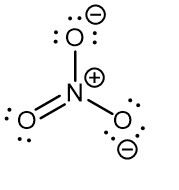
Example 1: provide a Lewis Structure for NO3-
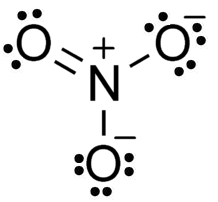
Formal Charges
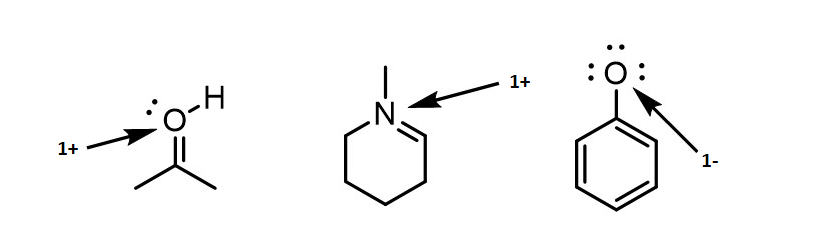
Formal charges allow us to see the charge on an atom (either neutral, positive, or negative) in a Lewis structure. Each atom will have a charge, usually neutral, that will be dictated by the number of bonds or lone pairs. Formal charge is effectively electronic book-keeping!
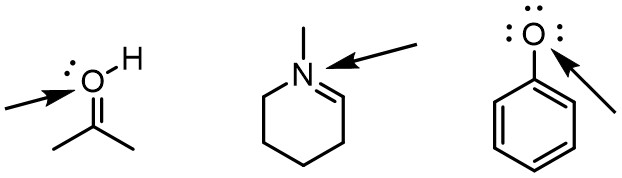
Example 2: what is the formal charge on the indicated atom in the structures below?

0:00 / 0:00
How to Draw Lewis Structures
- Position most electropositive atom in the middle with more electronegative atoms around it
- Add valence electrons (be aware of overall molecule charge) and form bonds between the central and terminal atoms (1 bond = 2 electrons, 2 bonds = 4 electrons, 3 bonds = 6 electrons)
- If necessary, complete the octets of the terminal atoms by moving electrons out from the central atom
- Calculate formal charges and add double bonds if necessary
- Check to make sure all atoms that should follow the octet rule have complete octets
Wize Tip
Some atoms may not follow the octet rule! Typical atoms that are electron deficienct are hydrogen (H, makes one bond) and boron (B, makes three bonds). Typical atoms that make more than four bonds are phosphorus (P, five bonds) and sulphur (S, six bonds)
Watch Out!
Carbon (C) and nitrogen (N) can form a maximum of 4 bonds!
Example: Draw the Lewis Structure for CO32-
0:00 / 0:00
Example: Lewis Structures
Provide a Lewis structure for the nitrate anion, NO3-, showing all lone pairs and formal charges.
0:00 / 0:00
Example: Lewis Structures
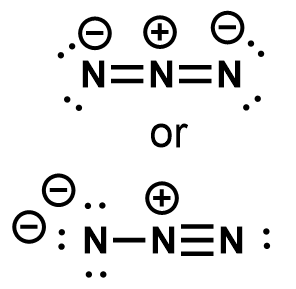
Provide a Lewis structure for the azide anion, N3-, showing all lone pairs and formal charges.

Mark Yourself Question
- Grab a piece of paper and try this problem yourself.
- When you're done, check the "I have answered this question" box below.
- View the solution and report whether you got it right or wrong.
Practice: Drawing Lewis Structures
Provide a Lewis structure for the iodonium cation, I3+, showing all lone pairs and formal charges.
Mark Yourself Question
- Grab a piece of paper and try this problem yourself.
- When you're done, check the "I have answered this question" box below.
- View the solution and report whether you got it right or wrong.
Practice: Drawing Lewis Structures
Provide a Lewis structure for the sulfate anion, SO42–, showing all lone pairs and formal charges.