Wize University Organic Chemistry Textbook > The Basics (Lewis Structures, Bonding, VSEPR)
Bonding: Valence Bond Theory, Hybridization, MO Theory, and Resonance
Popular Courses
MCAT
General Course
CHEM 2213A/B
Western University
Organic Chemistry
University Study Guides
DAT
General Course
Organic Chemistry
General Course
CHEM 233
University of British Columbia
CHEM 261
University of Alberta
Organic Chemistry
University Study Guides
CHEM 351
University of Calgary
CHEM 281
Queen's University
CHM 1321
University of Ottawa
CHM136H1
University of Toronto
CHEM 212
McGill University
CHEM 231
University of Victoria
CHEM 2OA3
McMaster University
CHEM 2223B
Western University
CHM 2120
University of Ottawa
CHEM 263
University of Alberta
CHEM 282
Queen's University
SC/CHEM 2020 3.00
York University
What are Bonding Models?
There are many models to explain a chemical bond. They include but are not limited to:
- Lewis dot structures/line structures/VSEPR: simplest and least informative
- Valence bond theory and hybridization: most commonly used in organic chemistry
- Molecular orbital (MO) theory: most complicated and most informative
This course will cover each of these topics individually!
Practice: Valence Bond Theory, Hybridization, and MO Theory
An organic compound possessing an alkene functional group is shown below.
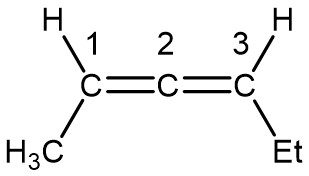
For each of C1, C2, and C3: define the hybridization, determine the bond angle around the carbon atom, and state the geometry.