Wize University Organic Chemistry Textbook > The Basics (Lewis Structures, Bonding, VSEPR)
Bonding 1: Valence Bond Theory
Popular Courses
MCAT
General Course
DAT
General Course
CHEM 2213A/B
Western University
Organic Chemistry
University Study Guides
Organic Chemistry
General Course
CHEM 233
University of British Columbia
CHEM 261
University of Alberta
Organic Chemistry
University Study Guides
CHEM 351
University of Calgary
CHEM 281
Queen's University
CHM 1321
University of Ottawa
CHM136H1
University of Toronto
CHEM 212
McGill University
CHEM 231
University of Victoria
CHEM 2OA3
McMaster University
CHEM 2223B
Western University
CHM 2120
University of Ottawa
CHEM 263
University of Alberta
CHEM 282
Queen's University
SC/CHEM 2020 3.00
York University

0:00 / 0:00
Valence Bond Theory and Hybridization
Valence bond theory and hybridization is a mathematical model (i.e. it isn't a "real thing"!) that allows us to explain molecular geometry of atoms and lone pairs around a central atom while considering the orbitals present.
Let's take the simplest example of an organic molecule we can imagine – methane (CH4).
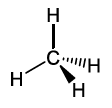
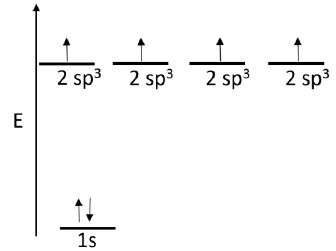
We know carbon to make four bonds to four hydrogen atoms, but when we consider the orbitals and electron configuration, there is a problem. There are only two unpaired electrons to make bonds!
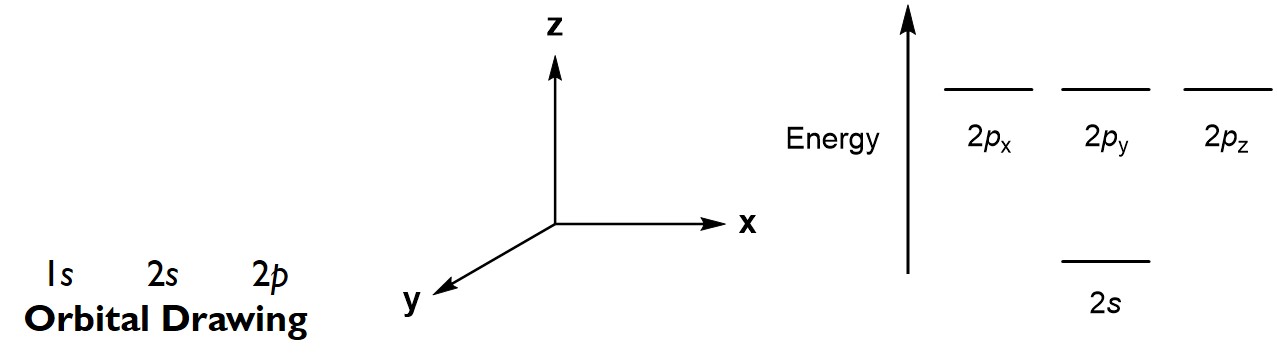
Hybridization
In order to explain this, the s-orbital and p-orbitals "hybridize" in order to form to form every sigma bond (single bond).
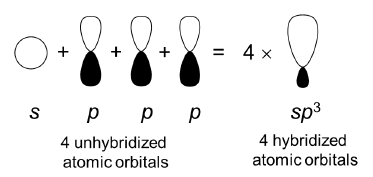
The new orbitals are shown below. The hybrid orbitals have the same (degenerate) energy and can form sigma-
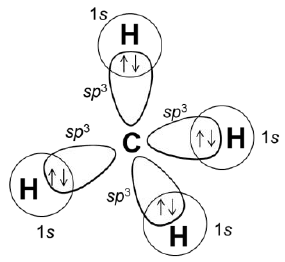
Returning to methane, these hybrid orbitals are able to make sigma bonds with the 1s orbital of the hydrogen atoms.
Let’s apply the same concept to a molecule containing a C=C double bond. Consider ethene (C2H4):
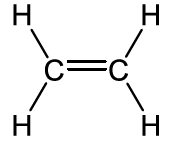
In this case, each carbon atom makes three sigma bonds and one pi bond. The pi bond requires an hybridized p-orbital, the rest of the orbitals on the carbon will hybridize to make sigma bonds.

Wize Tip
Pi bonds require unhybridized p-orbitals. Sigma bonds and lone pairs require s/p hybrid orbitals
Wize Tip
Bond strength: triple bonds > double bonds > single bonds
Bond length: triple bonds < double bonds < single bonds
Bond length and bond strength are inversely proportional!
0:00 / 0:00
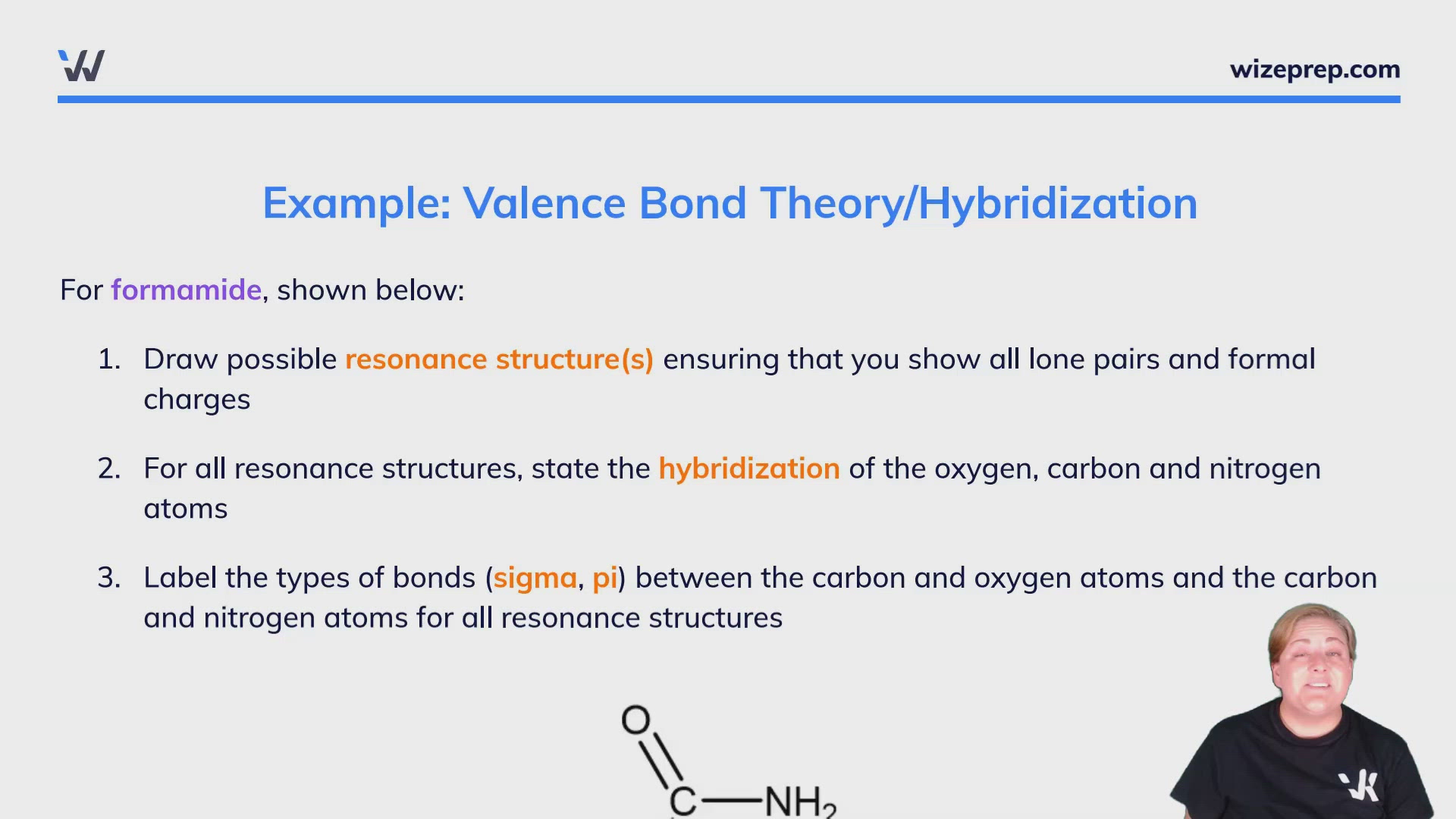
Example: Valence Bond Theory/Hybridization
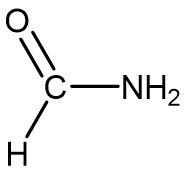
For formamide, shown below:
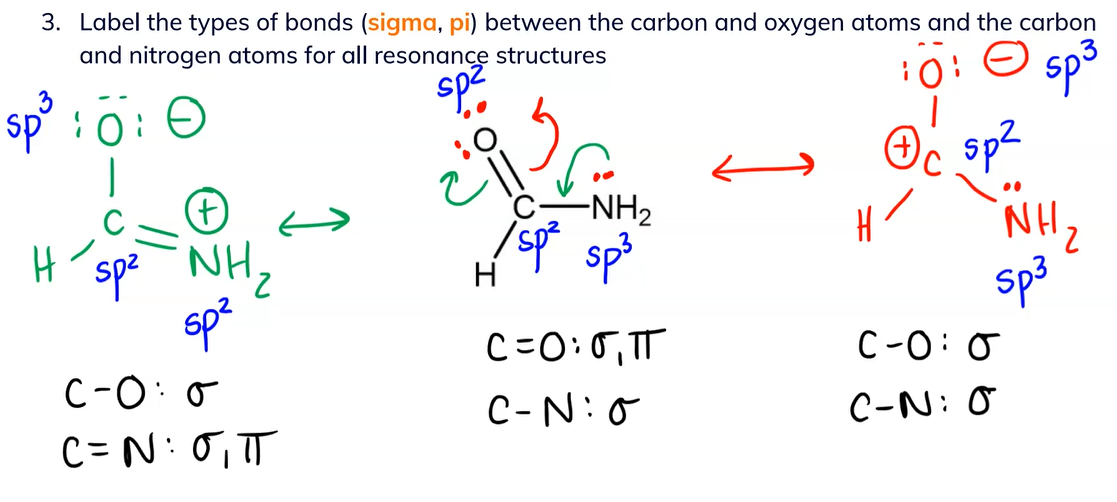
- Draw possible resonance structure(s) ensuring that you show all lone pairs and formal charges
- For all resonance structures, state the hybridization of the oxygen, carbon and nitrogen atoms
- Label the types of bonds (sigma, pi) between the carbon and oxygen atoms and the carbon and nitrogen atoms for all resonance structures