Popular Courses
MCAT
General Course
DAT
General Course
CHEM 2213A/B
Western University
Organic Chemistry
University Study Guides
Organic Chemistry
General Course
CHEM 233
University of British Columbia
CHEM 261
University of Alberta
Organic Chemistry
University Study Guides
CHEM 351
University of Calgary
CHEM 281
Queen's University
CHM 1321
University of Ottawa
CHM136H1
University of Toronto
CHEM 212
McGill University
CHEM 231
University of Victoria
CHEM 2OA3
McMaster University
CHEM 2223B
Western University
CHM 2120
University of Ottawa
CHEM 263
University of Alberta
SC/CHEM 2020 3.00
York University
CHY 142
Toronto Metropolitan University
Summary Sheet
Lewis Structures and Formal Charge
- Position most electropositive atom in the middle, with more electronegative atoms around it
- Add valence electrons (be aware of overall molecule charge) and form bonds between the central and terminal atoms (1 bond = 2 electrons)
- Complete the octets of the terminal atoms by moving electrons out from the central atom
- Calculate formal charges and add double bonds if necessary
- Check to make sure all atoms have complete octets, and that if they don't it is allowed*
Carbon and Nitrogen can ONLY form 4 bonds!!!
Formal charge is calculated using the following equation:
FC(atom) = # valence e- - (lone pair e- + number of bonds)
Key Terms
- Valence Bond Theory: Defines the orbitals involved in bonding for each atom in a compound.
- Hybridization: The combination of atomic orbitals (usually s and p orbitals) to form bonding orbitals
- Molecular Orbital (MO) Theory: How the (usually hybridized) atomic orbitals combine to form bonds. Each bond involves the formation of a bonding (either a σ-bond or π-bond) and a related antibonding (σ*-bond or π*-bond) orbital by overlapping orbitals.
- Resonance: The state attributed to certain molecules of having a structure that cannot adequately be represented by a single structural formula but is a composite of two or more structures of higher energy.
- Valence-Shell Electron-Pair Repulsion (VSEPR): The geometry and shape of a molecule is dictated by the atom's hybridization (number of σ-bonds and π-bonds). It is important to consider lone pairs, they also occupy space!
- Electronegativity: Tendency of an atom to bring electrons close, in a bond.
- Polarity: For a molecule to be overall polar (posses a net dipole) it needs: 1. A Polar Covalent Bond 2. Appropriate Geometry.
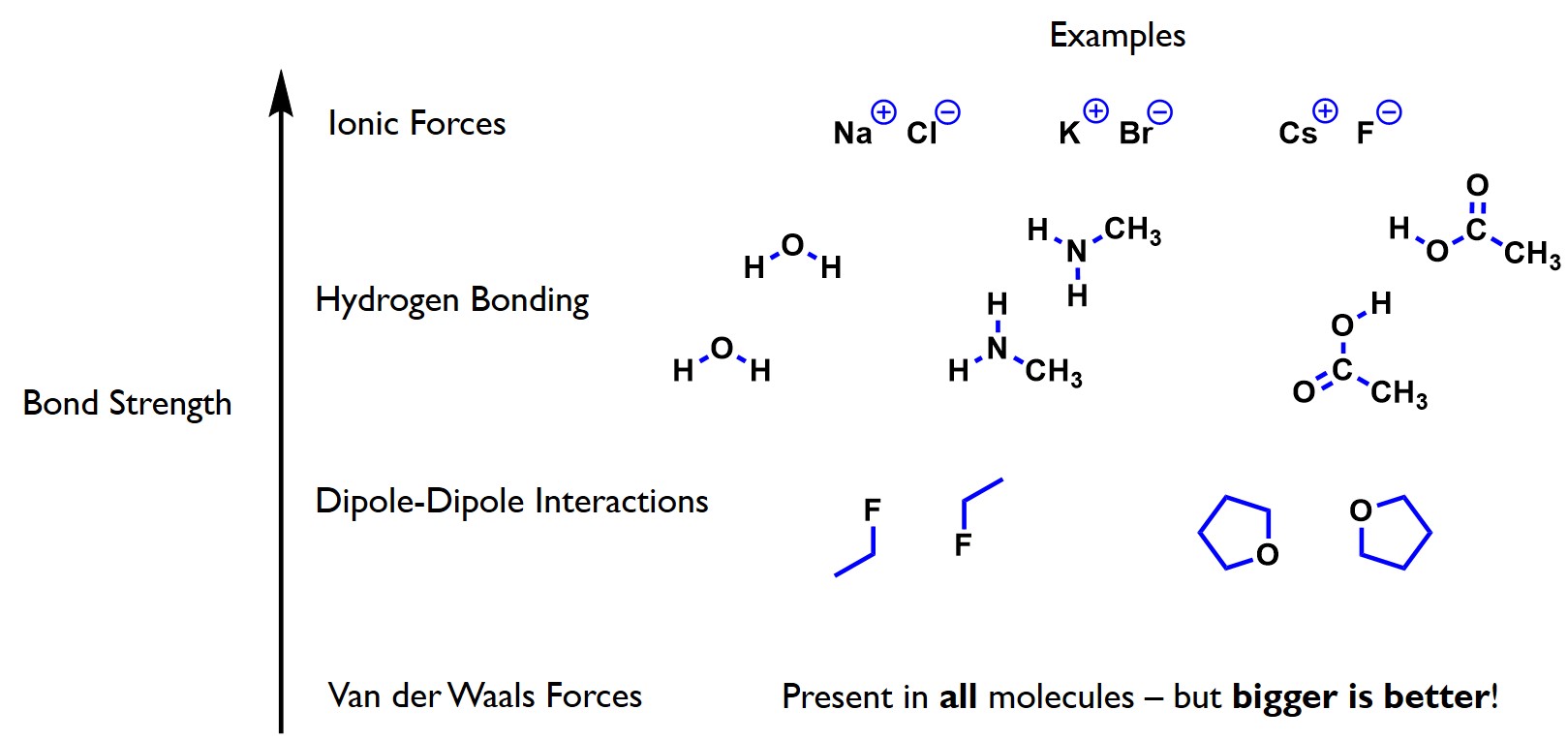
- Intermolecular Forces: Attractions between compounds holding them together that influence their relative boiling and melting points. More (stronger) intermolecular forces = higher boiling/melting points.