Wize University Organic Chemistry Textbook > Intro to Orgo (Functional Groups, Drawing, Naming)
Drawing Organic Compounds in 3D
Popular Courses
MCAT
General Course
DAT
General Course
CHEM 2213A/B
Western University
Organic Chemistry
University Study Guides
Organic Chemistry
General Course
CHEM 233
University of British Columbia
CHEM 261
University of Alberta
Organic Chemistry
University Study Guides
CHEM 351
University of Calgary
CHEM 123
University of British Columbia
CHEM 281
Queen's University
CHM 1321
University of Ottawa
CHM136H1
University of Toronto
CHEM 212
McGill University
CHEM 231
University of Victoria
CHEM 2OA3
McMaster University
CHEM 2223B
Western University
CHM 2120
University of Ottawa
CHEM 263
University of Alberta
CHEM 282
Queen's University

0:00 / 0:00
Drawing Organic Compounds in 3D
Organic compounds can be draw in two-dimensions (2D) or three-dimensions (3D). Three-dimensional structures are helpful for understanding chirality, stereochemistry, and isomers.
There are multiple ways to represent molecules in 3D:
- Wedge/dash formula
- Newman projections
- Fischer projections
Wedge/Dash Formula
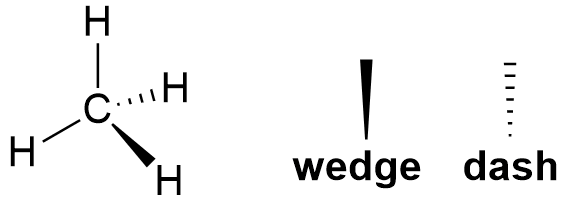
In a wedge/dash formula there are three kinds of lines. Straight lines are in the plane of the page, wedges are out of the plane of the page, and dashes are behind the plane of the page.
Newman Projections
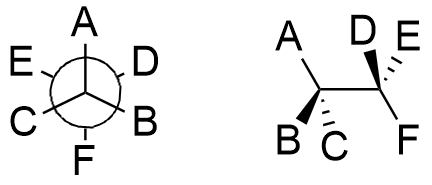
Newman projections look down the axis of a bond (usually a carbon-carbon bond in an alkane) and and place the substituents (groups) around those atoms which are connected to the axis in a position that allows us to understand their overlap.
Fischer Projections
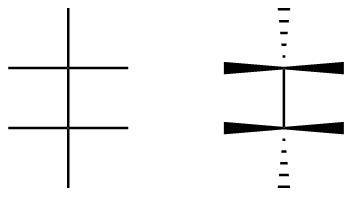
Fischer projections are a good way to see two adjacent chiral centres. On a Fischer projection the horizontal arms are coming out of the plane (i.e. are wedges) and the vertical arms are going behind the plane (i.e. are dashes).
0:00 / 0:00
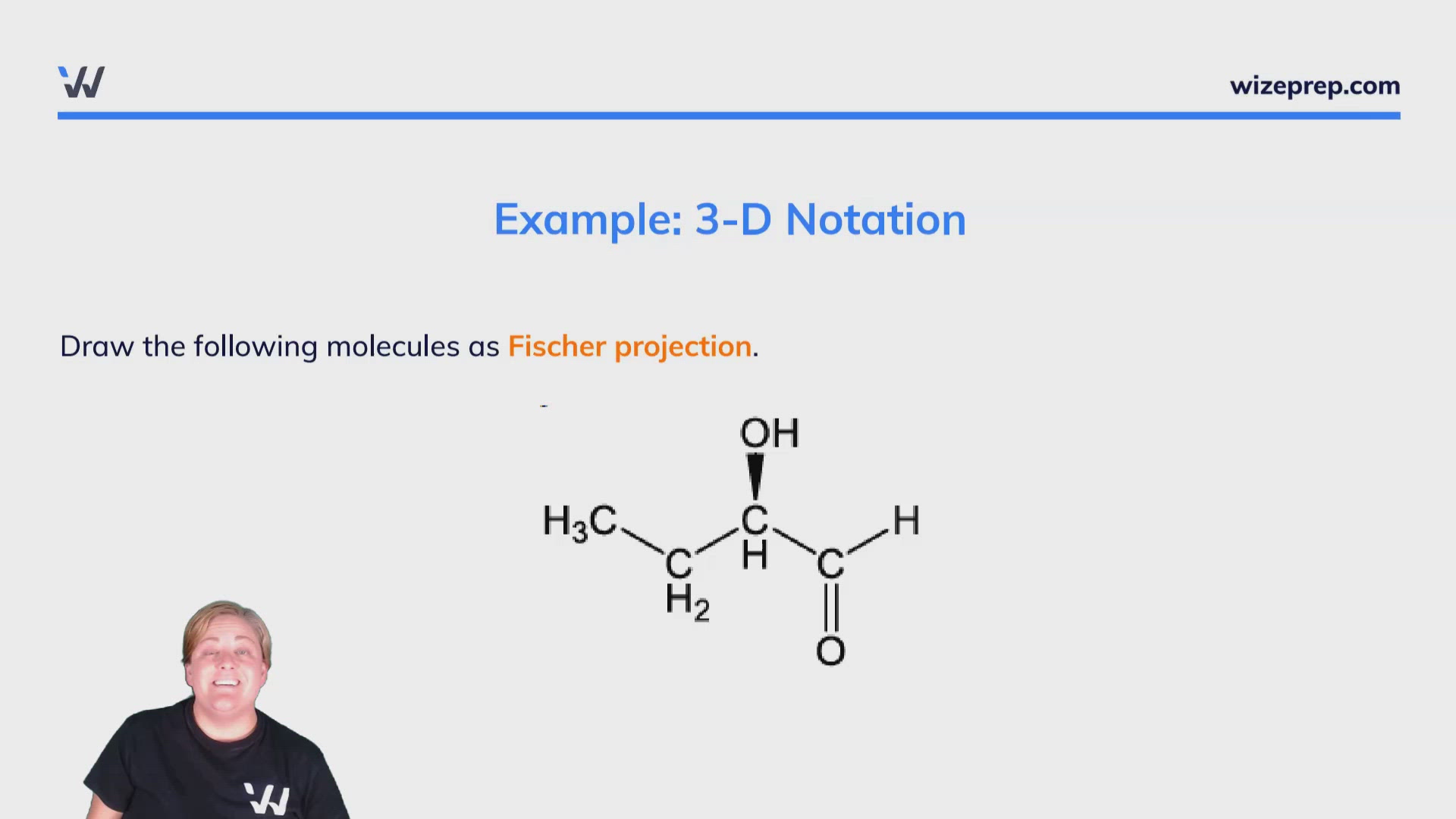
Example: 3-D Notation
Draw the following molecules as Fischer projection.
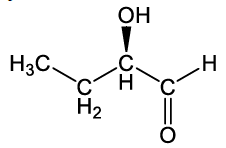
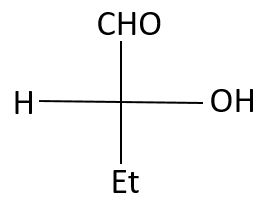
0:00 / 0:00
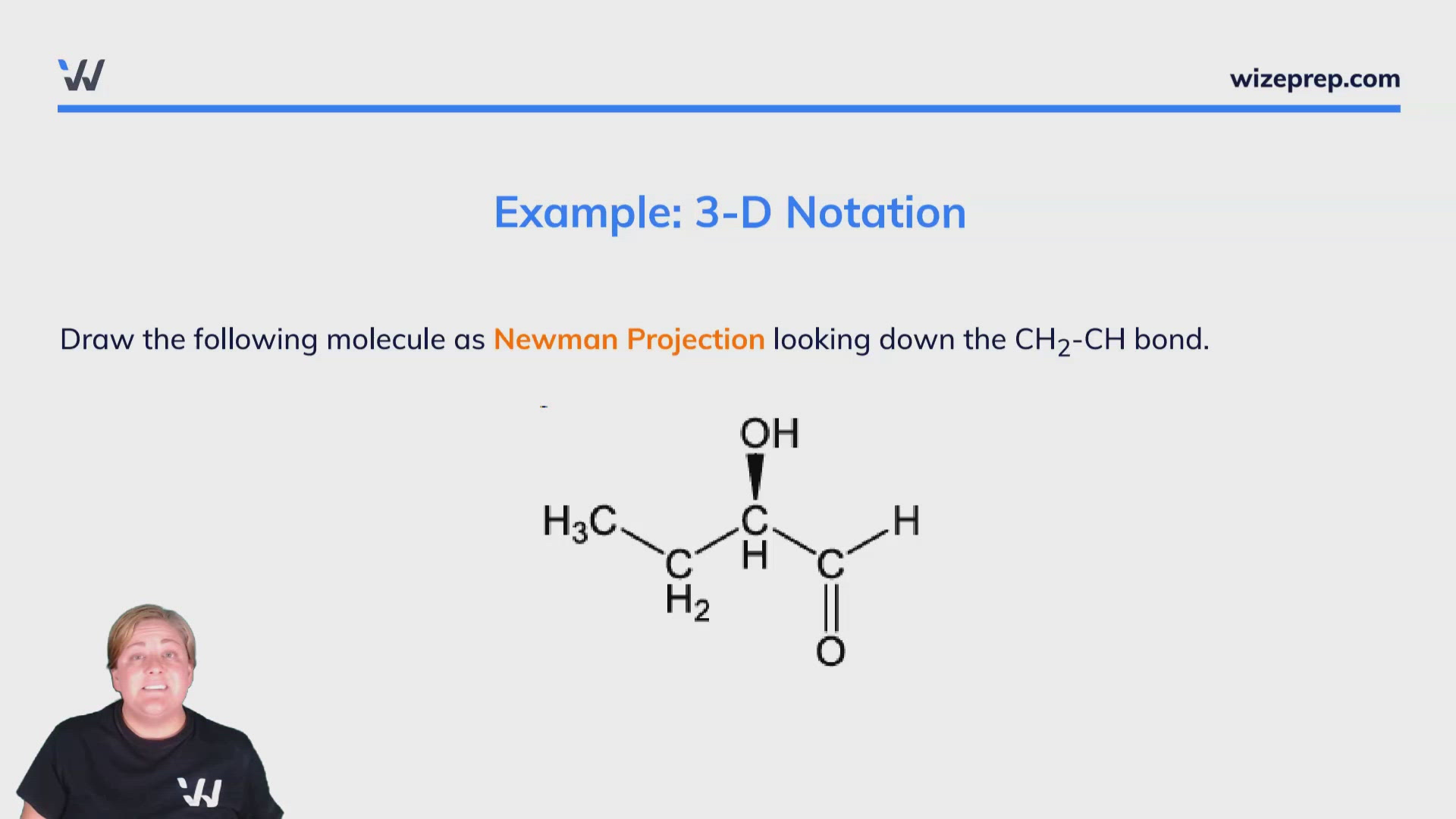
Example: 3-D Notation
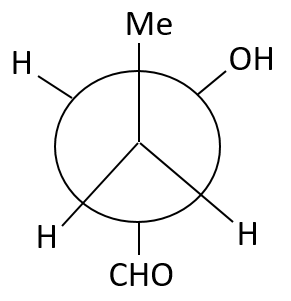
Draw the following molecule as Newman Projection looking down the CH2-CH bond.
Summary Sheet: Drawing in 3-Dimensions
Wedge/Dash Notation
This notation uses solid wedge bonds and dashed bonds to specify whether a bond is going into the page, or out of the page:
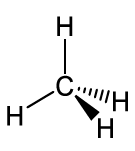
Bonds coming out of the page are shown as a wedge bond

Bonds going into the page are shown as a dashed bond

Newman Projections
Newman projections allow us to visualize conformational changes by looking "down" a C-C bond. By doing this, we observe a front carbon and its substituents and a back carbon with its substituents. This is very useful for looking at single bonds and rotation about them.
Example:

The front carbon is represented by the meeting of the 3 groups at the centre (looking like it forms 3 pie pieces).
The back carbon is represented by the large circle, with its 3 groups also attached.
Fischer Projections
Fischer projections use horizontal and vertical lines in order to depict whether atoms are going into the page or out of the page.
Example:

In a Fischer Projection the horizontal lines depict atoms coming out of the page, while the vertical lines depict atoms going into the page.
Remember that horizontal lines mean going out of the page... like the compound is giving you a hug.
This notation is commonly used in determining stereochemistry, particularly in compounds with more than one. Also, acyclic carbohydrates/sugars are most commonly depicted as Fischer Projections.
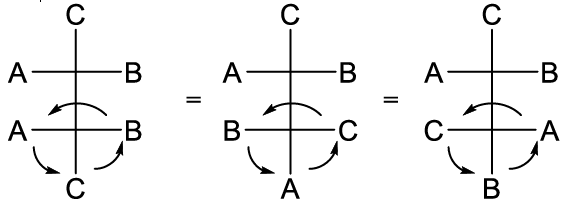
Note: The substituents can be easily moved around to compare stereochemistry: