Wize University Organic Chemistry Textbook > Stereochemistry & Isomers
Stereoisomers II - Geometric or Cis/Trans Isomers
Popular Courses
MCAT
General Course
CHEM 1301A/B
Western University
DAT
General Course
CHEM 2213A/B
Western University
Organic Chemistry
University Study Guides
Organic Chemistry
General Course
CHEM 233
University of British Columbia
CHEM 261
University of Alberta
Organic Chemistry
University Study Guides
CHEM 351
University of Calgary
CHEM 123
University of British Columbia
CHEM 281
Queen's University
CHM 1321
University of Ottawa
CHM136H1
University of Toronto
CHEM 212
McGill University
CHEM 231
University of Victoria
CHEM 2OA3
McMaster University
CHEM 2223B
Western University
CHM 2120
University of Ottawa
CHEM 282
Queen's University
0:00 / 0:00
Geometric or Cis/Trans Isomers
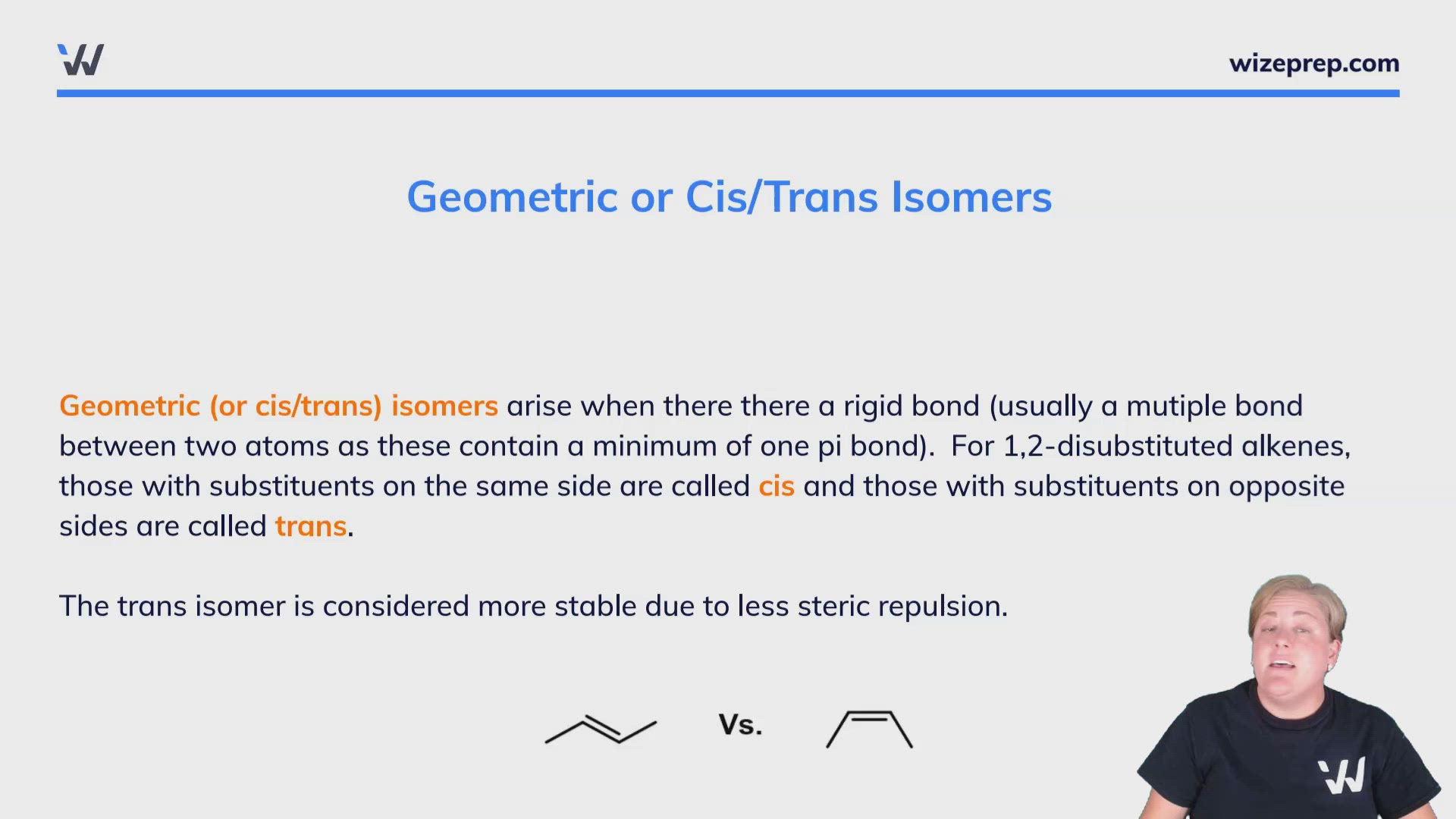
Geometric (or cis/trans) isomers arise when there there a rigid bond (usually a mutiple bond between two atoms as these contain a minimum of one pi bond). For 1,2-disubstituted alkenes, those with substituents on the same side are called cis and those with substituents on opposite sides are called trans.
The trans isomer is considered more stable due to less steric repulsion.

With tri- or tetrasubstituted alkenes, we use a different nomenclature called E and Z.
In order to assign E/Z:
- cut the alkene in half vertically.
- assign high/low priorities on the two substituents using the Cahn-Ingold-Prelog rules (see R/S nomenclature).
- if the high priority groups are on the same side, the alkene is (Z).
- if the high priority groups are on opposite sides, the alkene is (E).

Wize Tip
E/Z is easy to remember! Just remember that "Z is like zis so it's cis!".
0:00 / 0:00
Example: Geometric Isomers
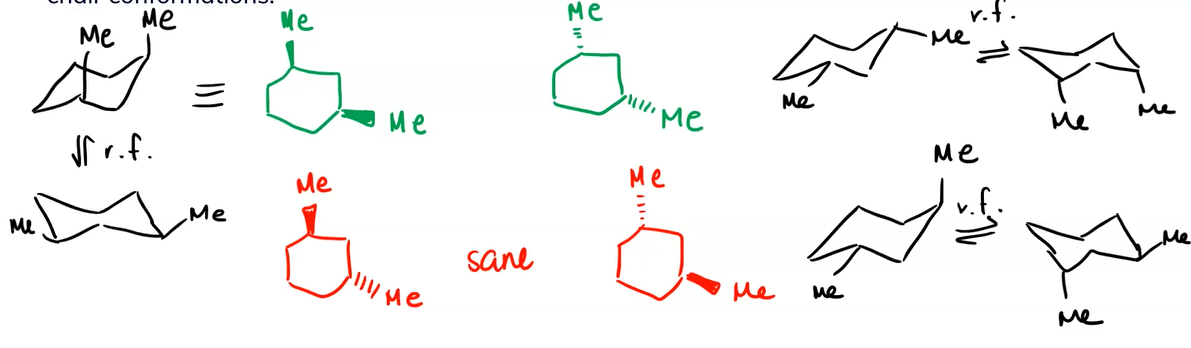
Draw both cis and trans isomers of 1,3-dimethylcylohexane using both wedge/dash structures and chair conformations.
Practice: Geometric Isomers
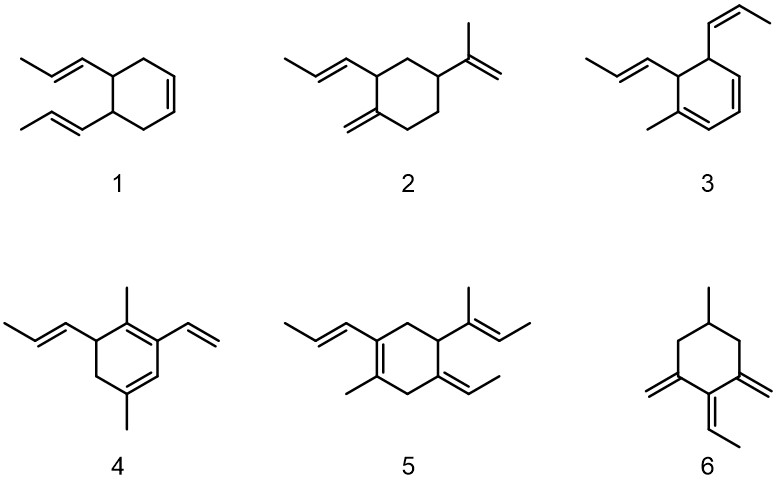
Which molecule has the most possible cis/trans isomers?