Popular Courses
MCAT
General Course
CHEM 2213A/B
Western University
DAT
General Course
Organic Chemistry
University Study Guides
Organic Chemistry
General Course
CHEM 233
University of British Columbia
CHEM 261
University of Alberta
Organic Chemistry
University Study Guides
CHEM 351
University of Calgary
CHEM 123
University of British Columbia
CHEM 281
Queen's University
CHM 1321
University of Ottawa
CHM136H1
University of Toronto
CHEM 212
McGill University
CHEM 231
University of Victoria
CHEM 2OA3
McMaster University
CHEM 2223B
Western University
CHM 2120
University of Ottawa
CHEM 263
University of Alberta
CHEM 282
Queen's University
Summary Sheet: Chemical Equilibria and Acid/Base Chemistry
Important Terms
pH: The negative log of the concentration of H+ in solution. pH is an indicator of acidity, where pH values of less than 7 is considered acidic, pH values of greater than 7 is considered basic, and a pH of 7 is considered neutral.
Ka: The K value specifically referring to a reaction where H+ (or H3O+) is a product. If Ka is large, then the products are favored and the species is acidic:
Kb: The K value specifically referring to a reaction where OH- is a product. If Kb is large, then the products are favored and the species is basic.
pKa/pKb: The negative log of the Ka/Kb value for a species. It is used as an indicator of how acidic various protons in organic molecules are. The lower the value of pKa/pKb the more acidic/basic the compound!
Factor Influencing Acid/Base Equilibria
Basically it all comes down to one thing, this equilibrium:
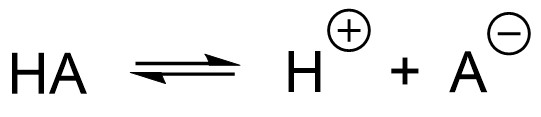
A strong acid needs to form a very stable conjugate base (A-, above). What are the factors that stabilize a conjugate base?
A strong base (A-) will grab a proton and form a conjugate acid (HA). So, a stronger base is essentially a more unstable A- (above). What are the factors that lead to a compound getting protonated?
Factors Influencing Acid/Base Strength
- Electronegativity: More electronegative atoms (in the same row) will be more stable as anions. Example: (more stable) F- > RO- > R2N- > R3C- (less stable)
- Atom Size: Bigger atoms (in the same group) will be more stable as anions. Example: (more stable) I- > Br- > Cl- > F- (less stable)
- Resonance: Delocalized charge is more stable than localized charge. Example: (more stable) RCO2- > RO- (less stable)
- Hybridization: Lone pairs (and negative charges) will be more tightly held when they are in more s-character hybrid orbitals. Example: (more stable) sp > sp2 > sp3 (less stable)
- Induction: Electronegative atoms and electron-withdrawing groups will stabilize negative charges (and lone pairs) - see lecture for more clarification
- Aromaticity: Be on the lookout for aromatic compounds. Protonation that breaks aromaticity is hard, deprotonation that creates an aromatic compound is easy.
pKa Values for Common Functional Groups
Below are the pKa values of some of the most important functional groups in organic chemistry (lower number is better acid). Memorizing an approximate value is more than adequate to predict the appropriate bases to deprotonate any of these acids.
Remember: The equilibrium between two of these structures will go in the direction where the stronger acid is deprotonated.
