Popular Courses
MCAT
General Course
DAT
General Course
CHEM 2213A/B
Western University
Organic Chemistry
University Study Guides
Organic Chemistry
General Course
CHEM 233
University of British Columbia
CHEM 261
University of Alberta
Organic Chemistry
University Study Guides
CHEM 351
University of Calgary
CHEM 281
Queen's University
CHM 1321
University of Ottawa
CHM136H1
University of Toronto
CHEM 212
McGill University
CHEM 231
University of Victoria
CHEM 2OA3
McMaster University
CHEM 2223B
Western University
CHEM 263
University of Alberta
CHEM 282
Queen's University
SC/CHEM 2020 3.00
York University
CHY 142
Toronto Metropolitan University
0:00 / 0:00
Hydroboration/Oxidation
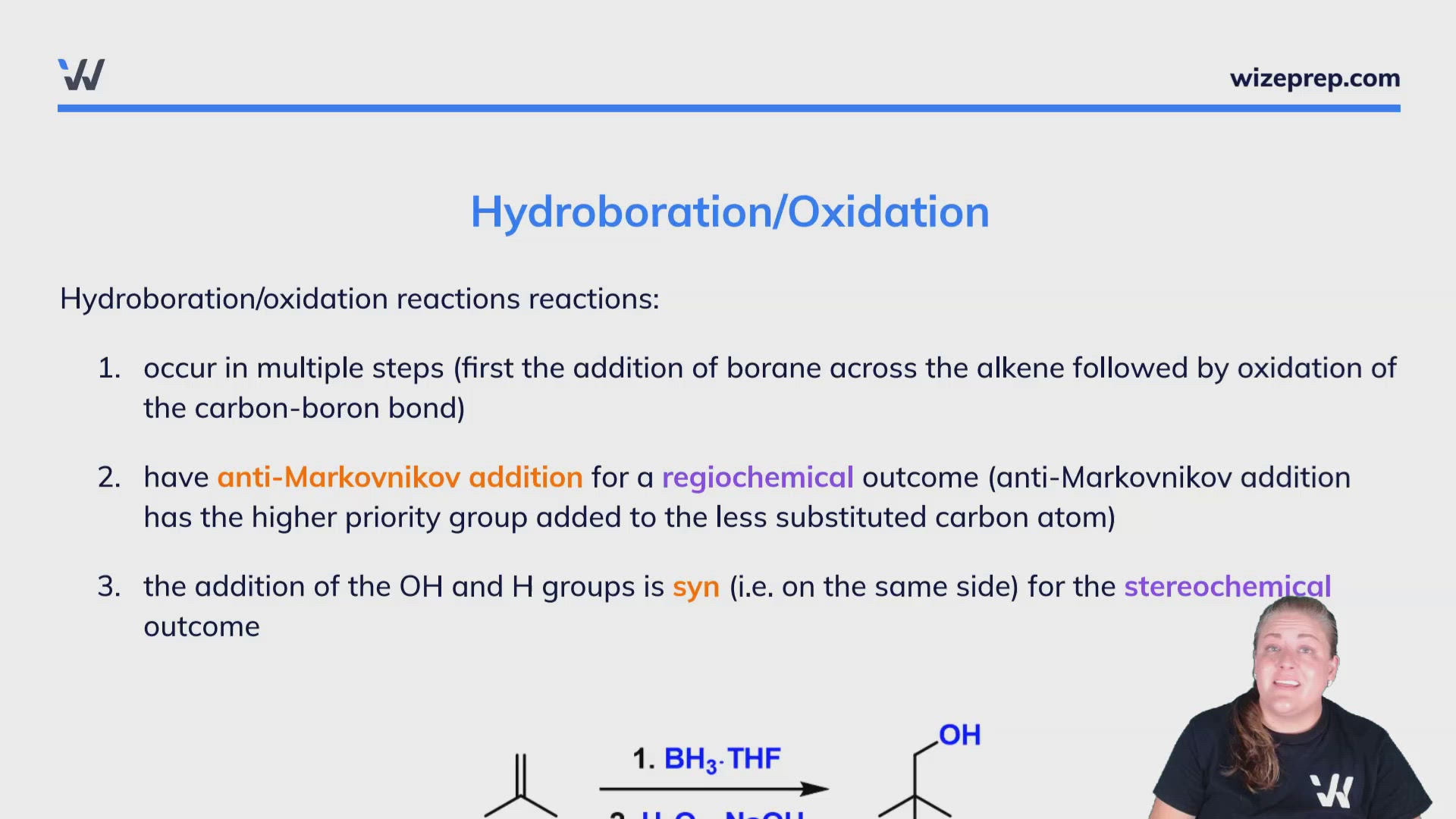
Hydroboration/oxidation reactions reactions:
- occur in multiple steps (first the addition of borane across the alkene followed by oxidation of the carbon-boron bond)
- have anti-Markovnikov addition for a regiochemical outcome (anti-Markovnikov addition has the higher priority group added to the less substituted carbon atom)
- the addition of the OH and H groups is syn (i.e. on the same side) for the stereochemical outcome
Wize Concept
Borane (BH3) exists in nature as a dimer (B2H6), which is unreactive. This is why you will see it as BH3.THF or BH3.Me2S. These are reactive borane species from Lewis acid (boron)/Lewis base (oxygen or sulfur) interactions!
Steps of a hydroboration/oxidation:
- syn addition of the B-H bond across the alkene via a four-membered ring transition state
- oxidation of the B-C bond to form the OH group
Mechanism:
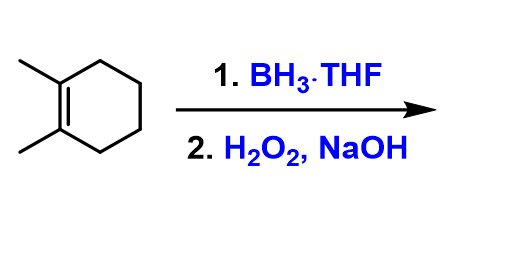
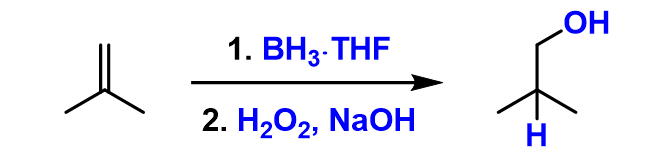
Example: predict the product of the hydroboration/oxidation reaction below.
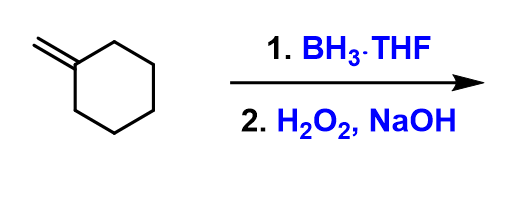

0:00 / 0:00
Example: Hydroboration
Hydroboration/oxidation reactions can also be used to produce aldehydes from terminal alkynes. Draw a mechanism for the hydroboration/oxidation reaction below.

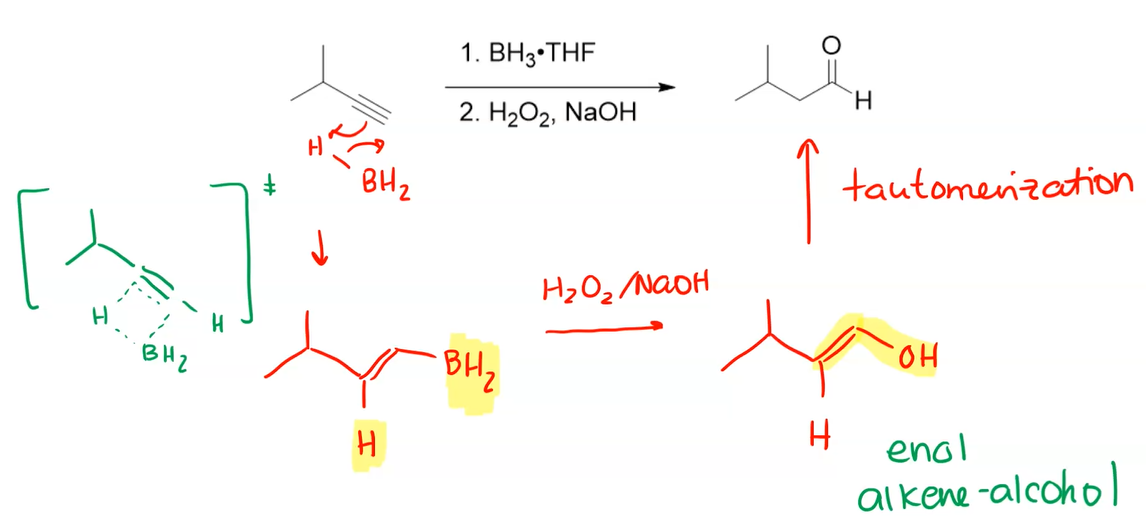
0:00 / 0:00
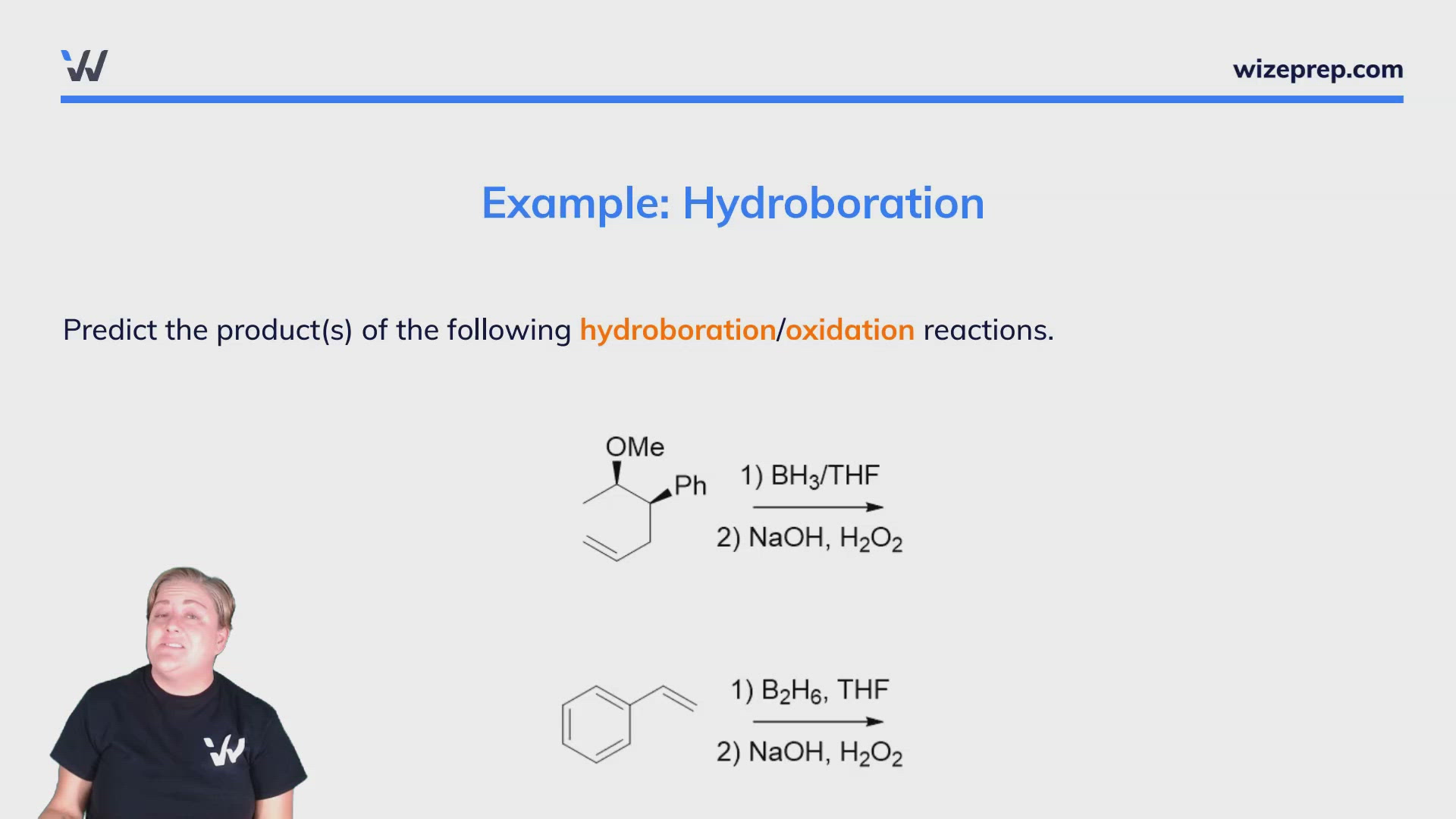
Example: Hydroboration
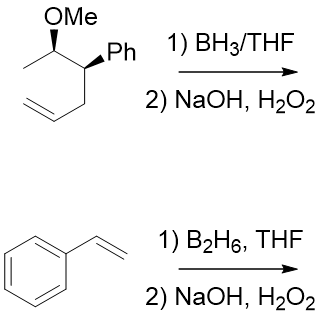
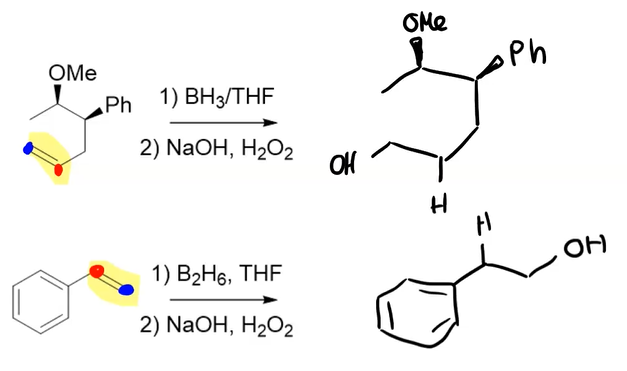
Predict the product(s) of the following hydroboration/oxidation reactions.