Popular Courses
MCAT
General Course
CHEM 2213A/B
Western University
Organic Chemistry
University Study Guides
Organic Chemistry
General Course
DAT
General Course
CHEM 233
University of British Columbia
CHEM 261
University of Alberta
Organic Chemistry
University Study Guides
CHEM 351
University of Calgary
CHEM 281
Queen's University
CHM 1321
University of Ottawa
CHM136H1
University of Toronto
CHEM 212
McGill University
CHEM 231
University of Victoria
CHEM 2OA3
McMaster University
CHEM 2223B
Western University
CHEM 282
Queen's University
CHEM 263
University of Alberta
SC/CHEM 2020 3.00
York University
CHY 142
Toronto Metropolitan University

0:00 / 0:00
Halogenation
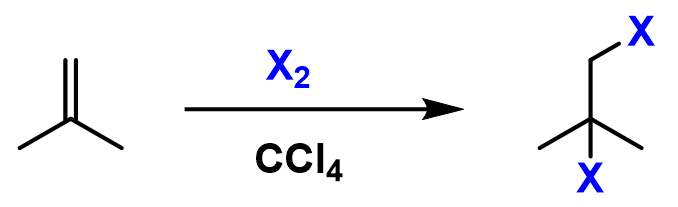
Halogenation reactions:
- occur in multiple steps
- proceed via a three-membered ring intermediate
- have neither Markovnikov addition or anti-Markovnikov addition for a regiochemical outcome
- the addition of the two X groups is anti (i.e. on the opposite side) for the stereochemical outcome
Wize Tip
The halogens that are most commonly used in this reaction are bromine (Br2, a liquid at room temperature) and chlorine (Cl2, a gas at room temperature) as they are reactive enough to do chemistry but not so reactive that they will lead to many undesired side-products.
Wize Concept
These reactions are done in very unreactive solvents to avoid side reactions with the halogen and solvent. The solvent used in halogenation reactions are benzene (C6H6) and carbon tetrachloride (CCl4).
Steps of a halogenation:
- nucleophilic and electrophilic attack of the halogen on the alkene to for a reactive three-membered ring
- nucleophilic attack of the halogen anion onto the three-membered ring
- opening up of the three-membered ring
Mechanism:

Watch Out!
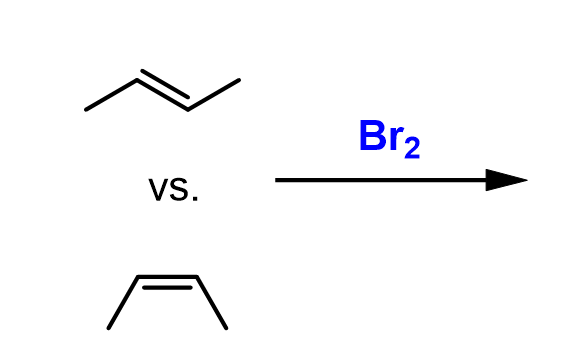
These reactions are stereospecific which means they maintain the geometry of the reagent. This means that cis double bonds stay cis and trans double bonds stay trans.
Example: predict the product of the following stereospecific halogenation reactions.

0:00 / 0:00
Example: Halogenation
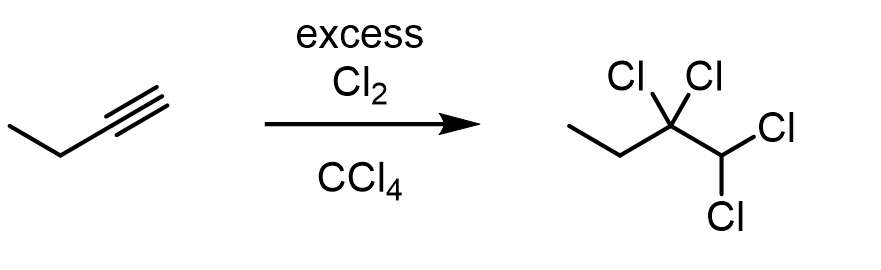
Draw a mechaism for the following halogenation reaction which yields a tetra-halogenated product.
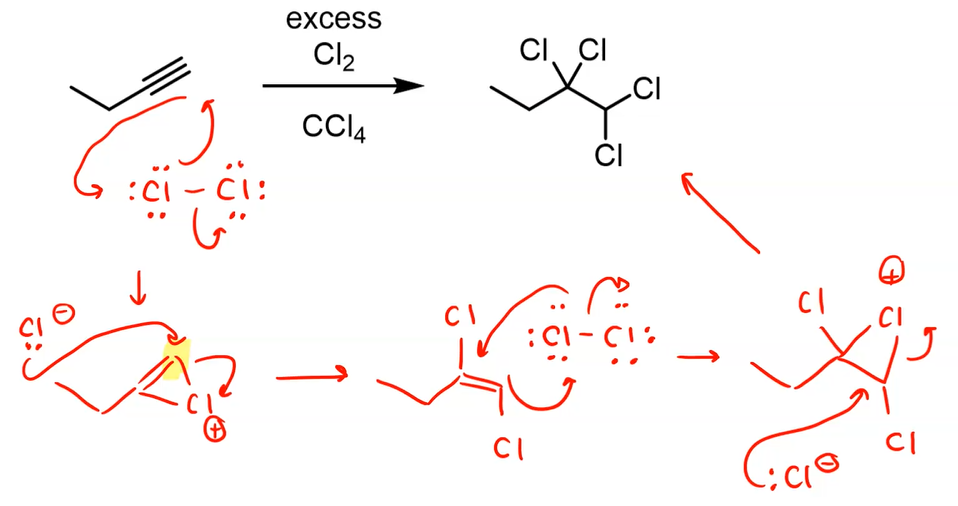

0:00 / 0:00
Example: Halogenation
Bromine, Br2, is a deep red dense liquid that can react with alkenes. As we know, one equivalent of Br2 reacts with one alkene. When all the Br2 has been consumed, a solution will become colourless.
There are four structures shown below (number 1-4, left to right). Which molecule would require exactly three equivalents of Br2 to change from deep red to colourless?
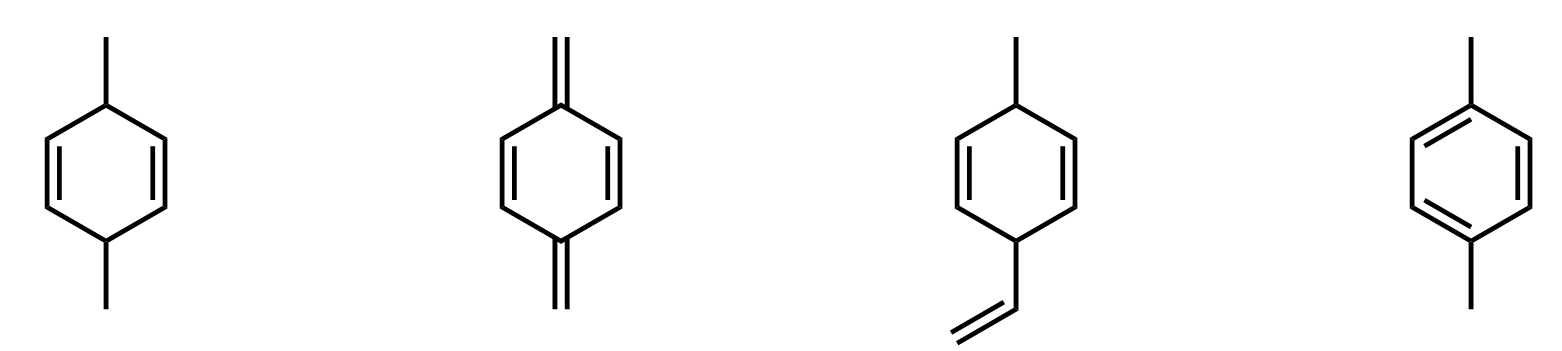
- molecule 1 has two double bonds
- molecule 2 has four double bonds
- while molecule 4 has three double bonds, it is aromatic which means it is unreactive
- this means that molecule 3 is the answer
0:00 / 0:00
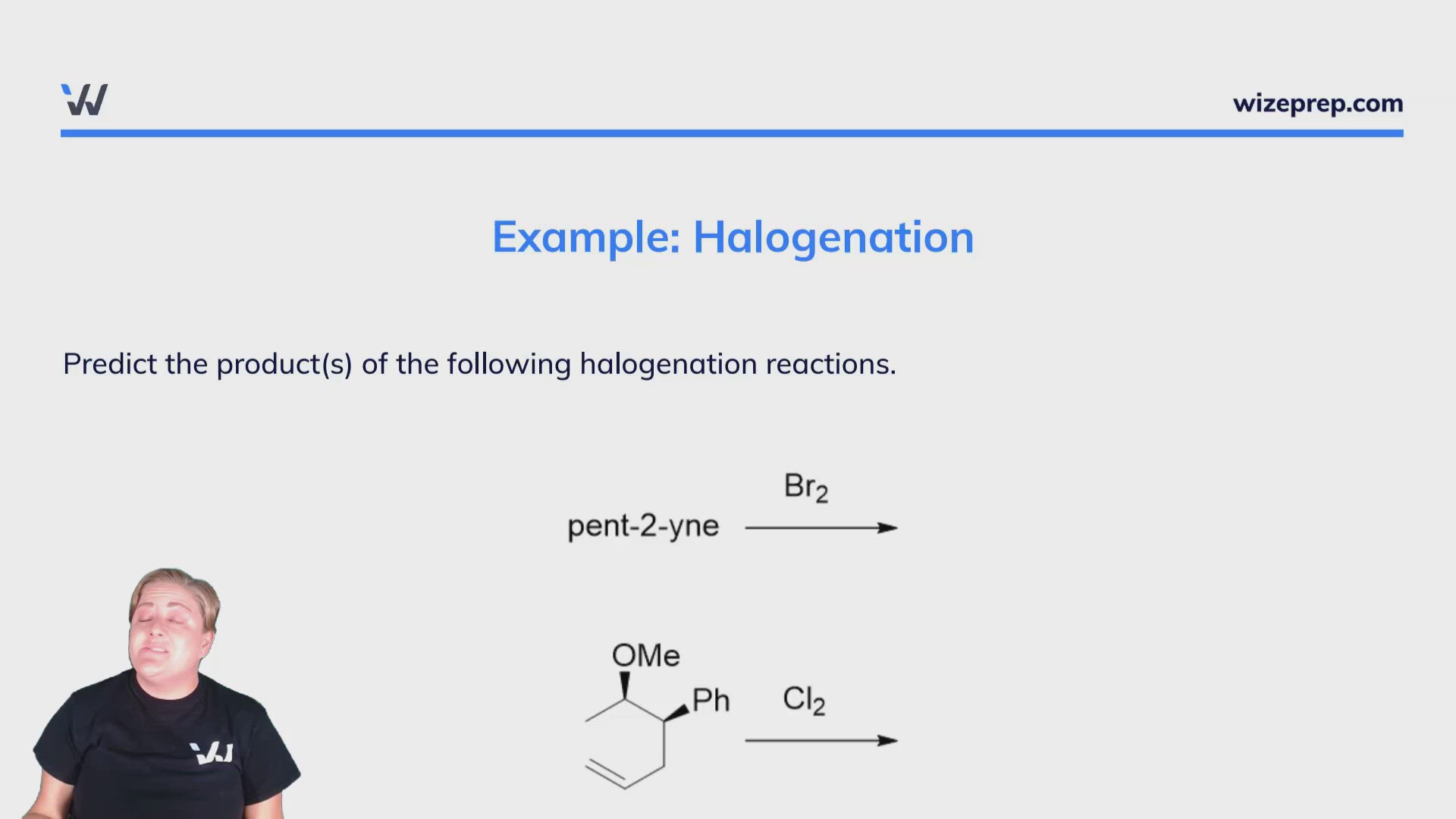
Example: Halogenation
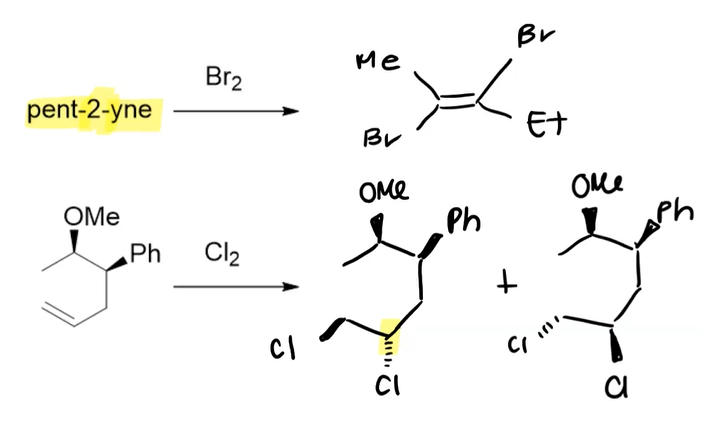
Predict the product(s) of the following halogenation reactions.