Wize University Organic Chemistry Textbook > Electrophilic Addition Reactions to Alkenes/Alkynes
Carbocation Rearrangements
Popular Courses
MCAT
General Course
CHEM 2213A/B
Western University
Organic Chemistry
University Study Guides
Organic Chemistry
General Course
CHEM 233
University of British Columbia
CHEM 261
University of Alberta
Organic Chemistry
University Study Guides
CHEM 351
University of Calgary
CHEM 281
Queen's University
CHM 1321
University of Ottawa
CHM136H1
University of Toronto
CHEM 212
McGill University
CHEM 231
University of Victoria
CHEM 2OA3
McMaster University
CHEM 2223B
Western University
CHEM 282
Queen's University
CHEM 263
University of Alberta
SC/CHEM 2020 3.00
York University
CHY 142
Toronto Metropolitan University
CHEM 353
University of Calgary

0:00 / 0:00
Carbocation Rearrangements
Carbocations are carbon atoms that carry a positive charge. They are formed when a leaving group departs (see the SN1, SN2, E1 and E2 reaction!) or when an alkene acts as a nucleophile.
- carbocations that are more substituted are more stable (tertiary > secondary > primary >>> methyl)
- carbocations can also be stabilized by resonance (i.e. vinylic and allylic)

Carbocation Rearragements
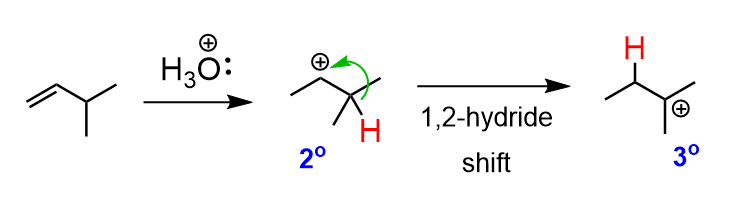
Sometimes, carbocations will rearrange in order to produce a more stable form. This can happen a few different ways with two being the most common:
- a 1,2-hydride shift
- a 1,2-methyl shift
Watch Out!
The important thing to know about these rearragements is that they lead to the production of multiple products! This is important to know when you are asked to draw the products of reactions and need to be accounted for when drawing mechanisms.
Wize Tip
Whenever you have a reaction that generates a carbocation, stop and ask yourself "is this the best carbocation, or can it be better?". If the answer is "no" - keep going! If the answer is "yes", draw the rearrangement and then predict the products from both the rearranged and non-rearranged carbocation!
Watch Out!
Don't try and draw too many rearrangements! You will only have one 1,2-hydride shift or 1,2-methyl shift in any given reaction! This can save you from drawing too much side pathways.
0:00 / 0:00
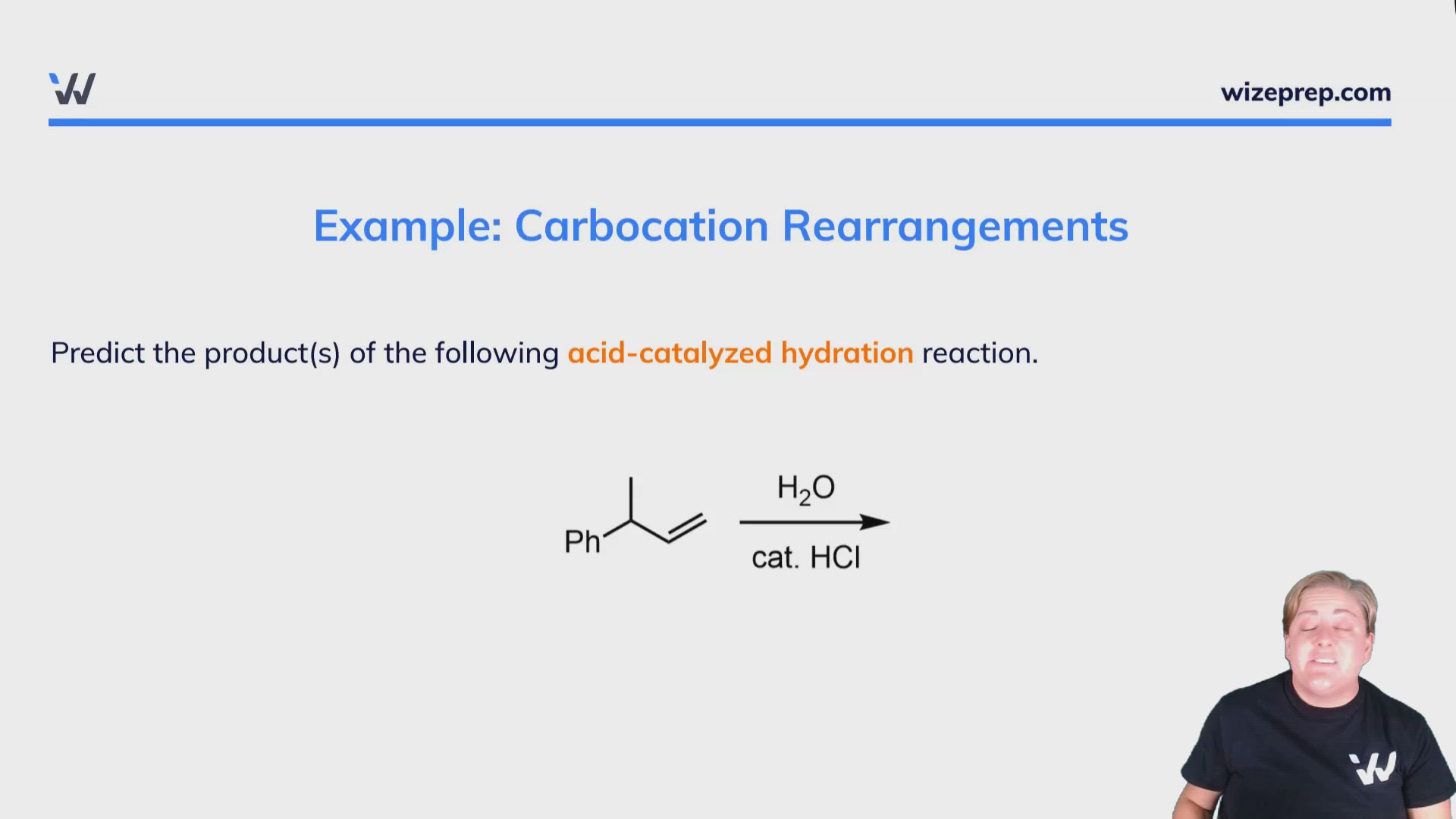
Example: Carbocation Rearrangements
Predict the product(s) of the following acid-catalyzed hydration reaction.


0:00 / 0:00
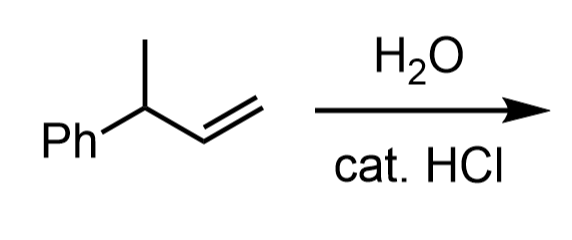
Example: Carbocation Rearrangements
Predict the product(s) of the following acid-catalyzed hydration reaction.

