Popular Courses
MCAT
General Course
CHEM 2213A/B
Western University
Organic Chemistry
University Study Guides
DAT
General Course
Organic Chemistry
General Course
CHEM 233
University of British Columbia
Organic Chemistry
University Study Guides
CHM 1321
University of Ottawa
CHEM 2223B
Western University
CHM 2120
University of Ottawa
CHEM 263
University of Alberta
CHEM 282
Queen's University
CHY 142
Toronto Metropolitan University
CHEM 222
McGill University
CHEM 353
University of Calgary
CHEM 2E03
McMaster University
CHEM 2OB3
McMaster University
CHEM 250
University of Saskatchewan
CHEM-2300
University of Windsor
CHM247H1
University of Toronto
0:00 / 0:00
Claisen Reaction
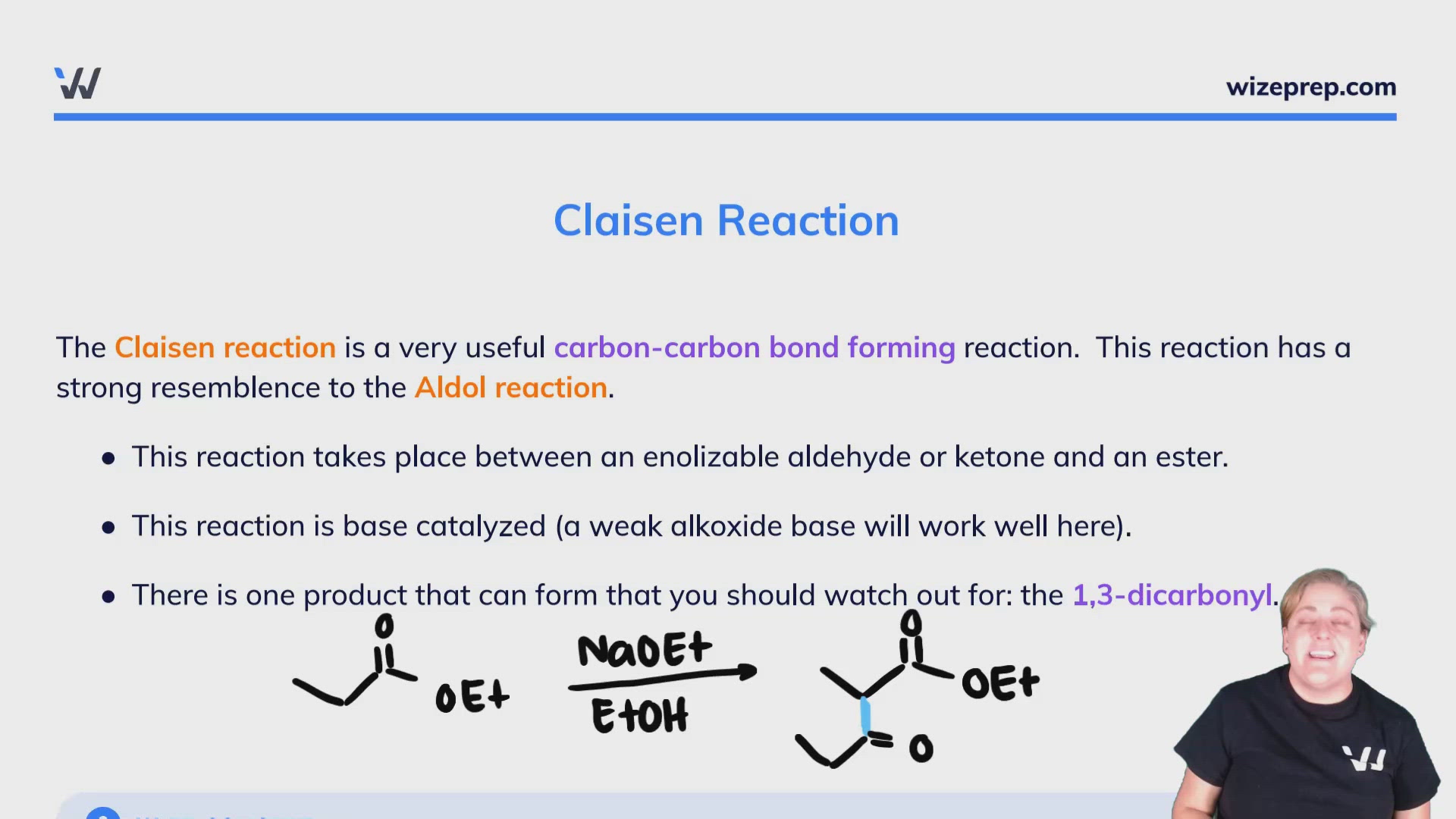
The Claisen reaction is a very useful carbon-carbon bond forming reaction. This reaction has a strong resemblence to the Aldol reaction.
- This reaction takes place between an enolizable aldehyde or ketone and an ester.
- This reaction is base catalyzed (a weak alkoxide base will work well here).
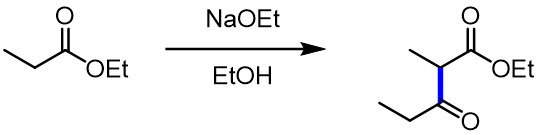
- There is one product that can form that you should watch out for: the 1,3-dicarbonyl.
Wize Concept
Recall: the Aldol Reaction produces beta-hydroxycarbonyl and alpha, beta-unsaturated carbonyl products. The Claisen reaction makes a 1,3-dicarbonyl product

0:00 / 0:00
Example: Claisen Reactions
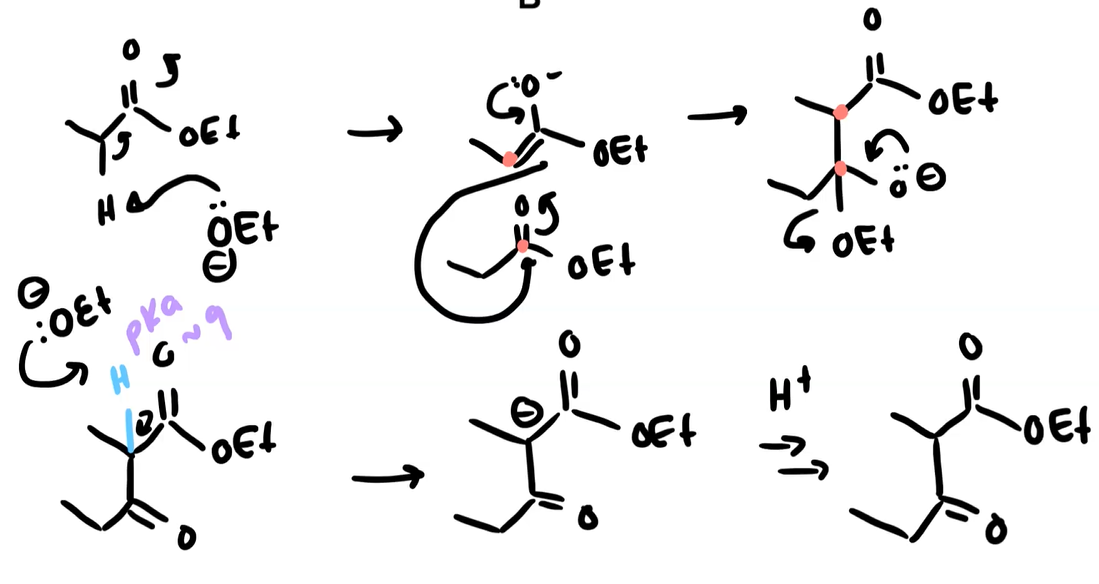
An important consideration for Claisen reactions is that we need two alpha-protons on the ester reactant! For example, the reaction A will proceed as written, but reaction B will not proceed. Why?

0:00 / 0:00
Example: Claisen Reactions
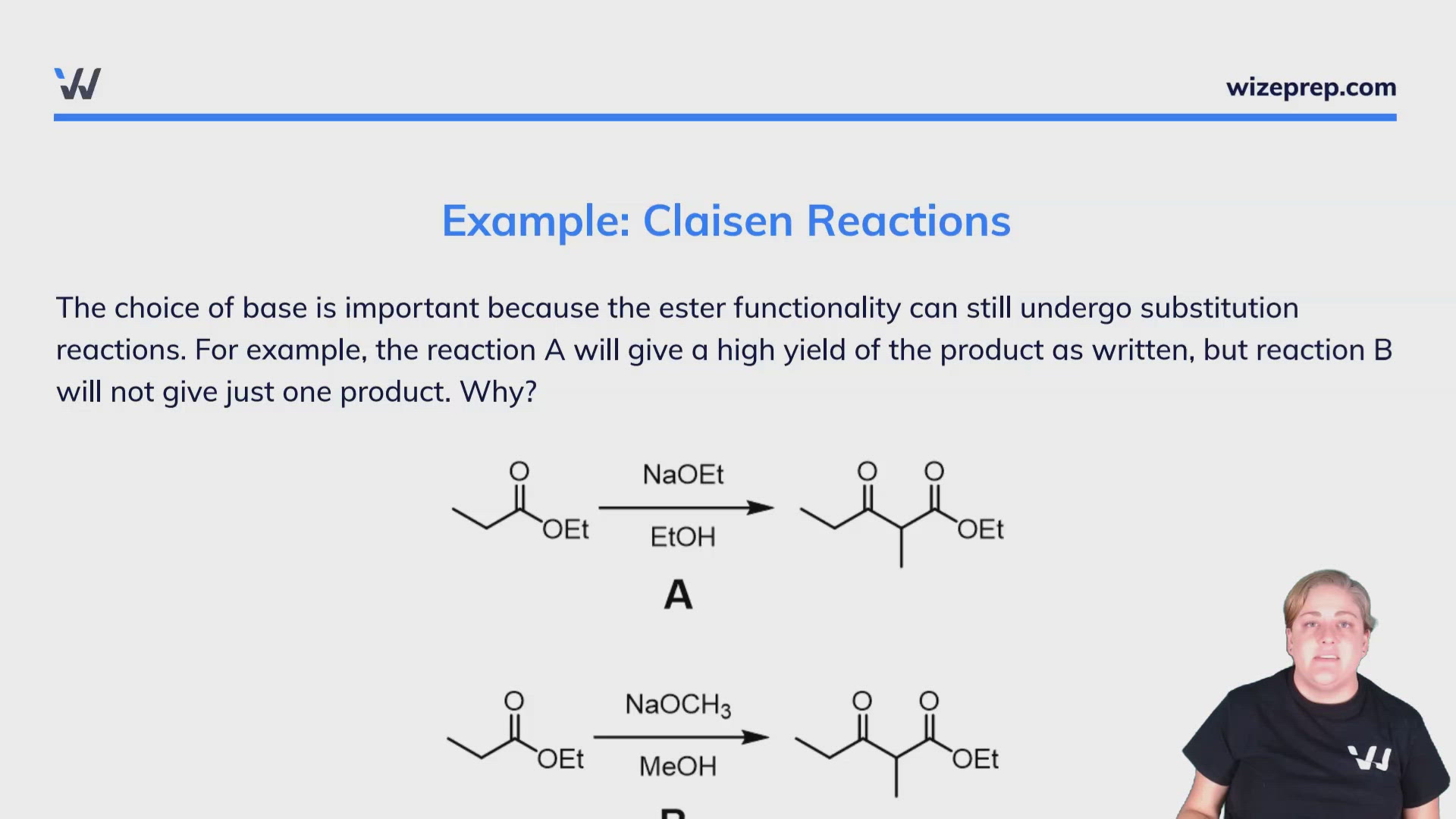
The choice of base is important because the ester functionality can still undergo substitution reactions. For example, the reaction A will give a high yield of the product as written, but reaction B will not give just one product. Why?

If you are to use a base/alcoholic solvent that is different than the ester (i.e., MeONa vs. RCO(OEt)), then you get a major competing reaction (the transesterification) instead of the desired Claisen pathway leading to a reduced yield.

0:00 / 0:00
Dieckmann Condensation
A special named reaction is the Dieckmann condensation, which is just an intramolecular Claisen reaction. Predict the product of the following Dieckmann condensation reaction. Draw the mechanism in full.