Popular Courses
DAT
General Course
CHEM 2213A/B
Western University
Organic Chemistry
University Study Guides
Organic Chemistry
General Course
Organic Chemistry
University Study Guides
CHEM 351
University of Calgary
CHEM 231
University of Victoria
CHEM 2OA3
McMaster University
CHEM 2223B
Western University
CHEM 282
Queen's University
CHY 142
Toronto Metropolitan University
CHEM 222
McGill University
CHEM 2401
Dalhousie University
CHEM 2E03
McMaster University
CHEM 281
Simon Fraser University
CHEM 266
University of Waterloo
CHEM 250
University of Saskatchewan
CHM247H1
University of Toronto
CHEM 213
University of British Columbia
CHEM 40A
University of California - San Diego
0:00 / 0:00
Carbon (13C) NMR
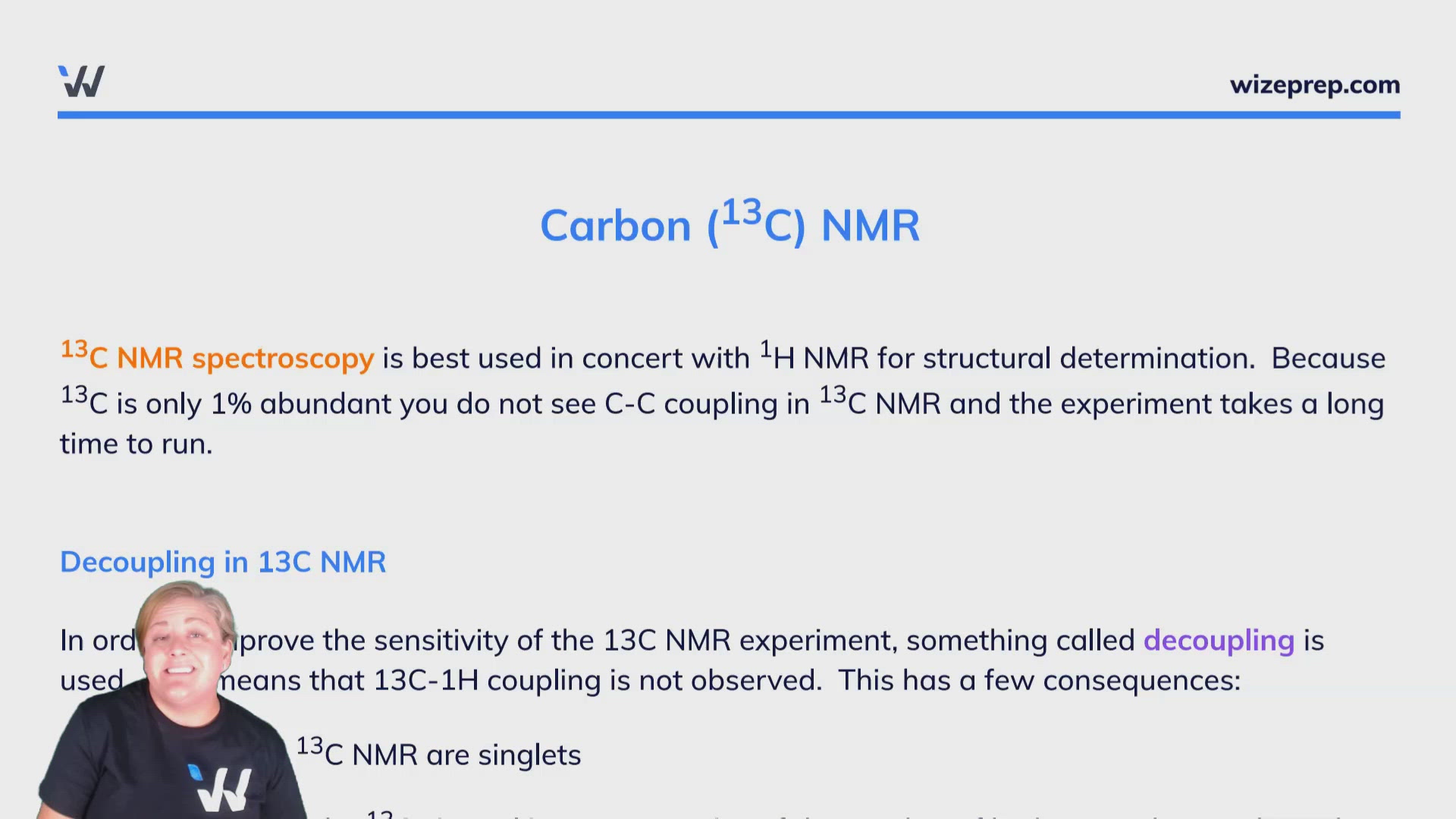
13C NMR spectroscopy is best used in concert with 1H NMR for structural determination. Because 13C is only 1% abundant you do not see C-C coupling in 13C NMR and the experiment takes a long time to run.
Decoupling in 13C NMR
In order to improve the sensitivity of the 13C NMR experiment, something called decoupling is used. This means that 13C-1H coupling is not observed. This has a few consequences:
- all peaks in 13C NMR are singlets
- the height of the 13C singnal is representative of the number of hydrogens that are bound to that carbon
- CH3 are tallest
- quaternary carbons are shortest
Example: determine the number of signals you would see for each of the molecules below.

Common 13C NMR Shifts

0:00 / 0:00
Example: 13C NMR
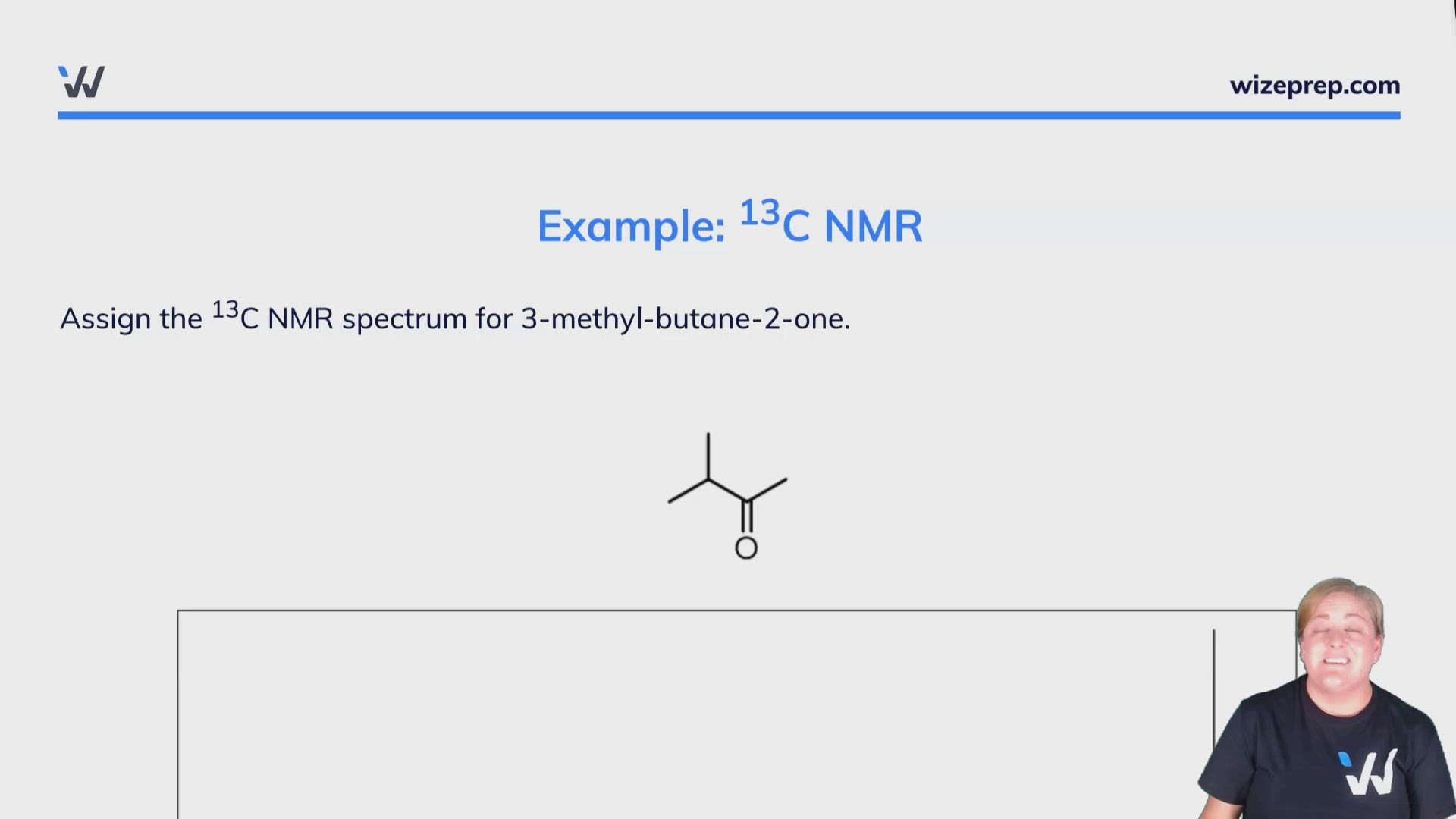
Assign the 13C NMR spectrum for 3-methyl-butane-2-one.

- the signal at ca. 215 ppm is the carbonyl carbon
- the signal at ca. 41 ppm is the C-H carbon
- the signal at ca. 28 ppm is the CH3 carbon bonded to the carbonyl
- the signal at ca. 18 ppm is the CH3 carbon (for the two CH3's)
0:00 / 0:00
Example: 13C NMR
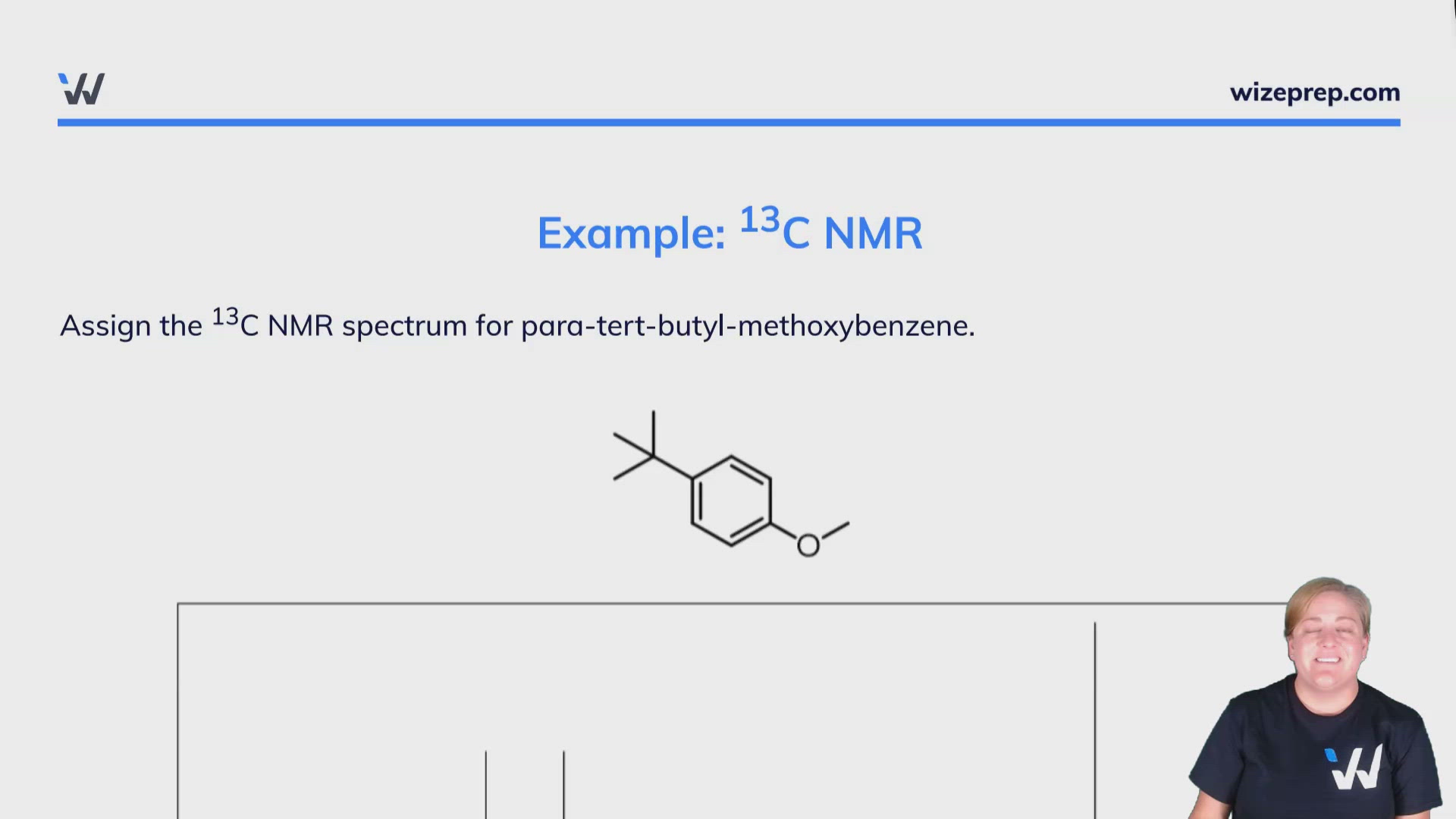
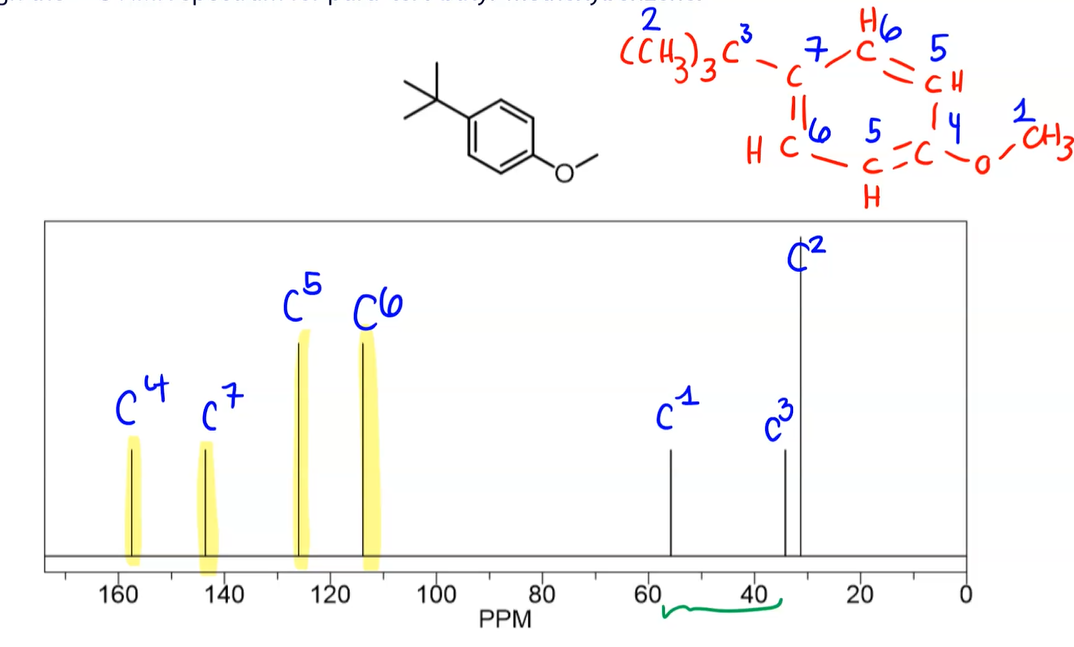
Assign the 13C NMR spectrum for para-tert-butyl-methoxybenzene.

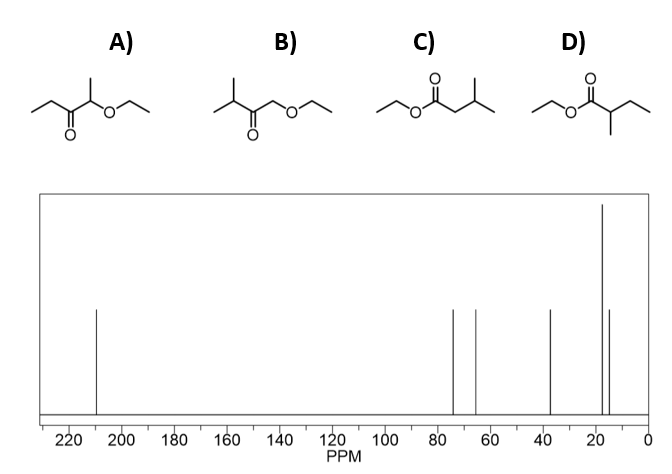
The 13C NMR spectrum provided belongs to which of the following molecules?
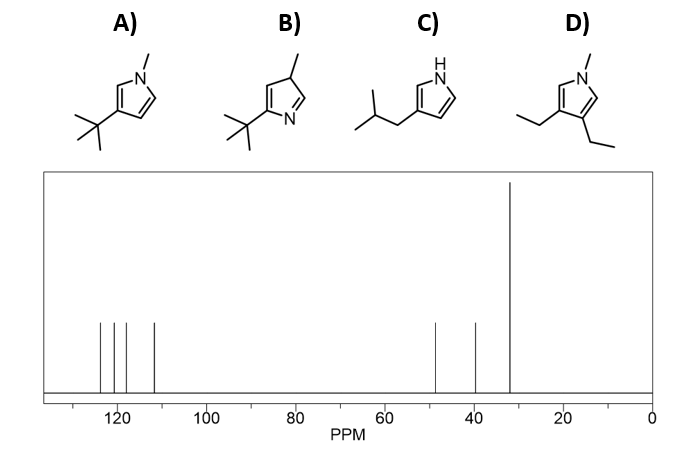
The 13C NMR spectrum provided belongs to which of the following molecules?