Popular Courses
DAT
General Course
Organic Chemistry
University Study Guides
Organic Chemistry
General Course
Organic Chemistry
University Study Guides
CHEM 351
University of Calgary
CHM 1321
University of Ottawa
CHM136H1
University of Toronto
CHEM 212
McGill University
CHEM 231
University of Victoria
CHEM 2223B
Western University
CHEM 282
Queen's University
CHY 142
Toronto Metropolitan University
CHEM 353
University of Calgary
CHEM 203
University of British Columbia
CHEM 281
Simon Fraser University
CHEM 266
University of Waterloo
CHEM 2OB3
McMaster University
CHEM 250
University of Saskatchewan
CHEM 260
University of British Columbia
CHEM 221
Concordia University
0:00 / 0:00
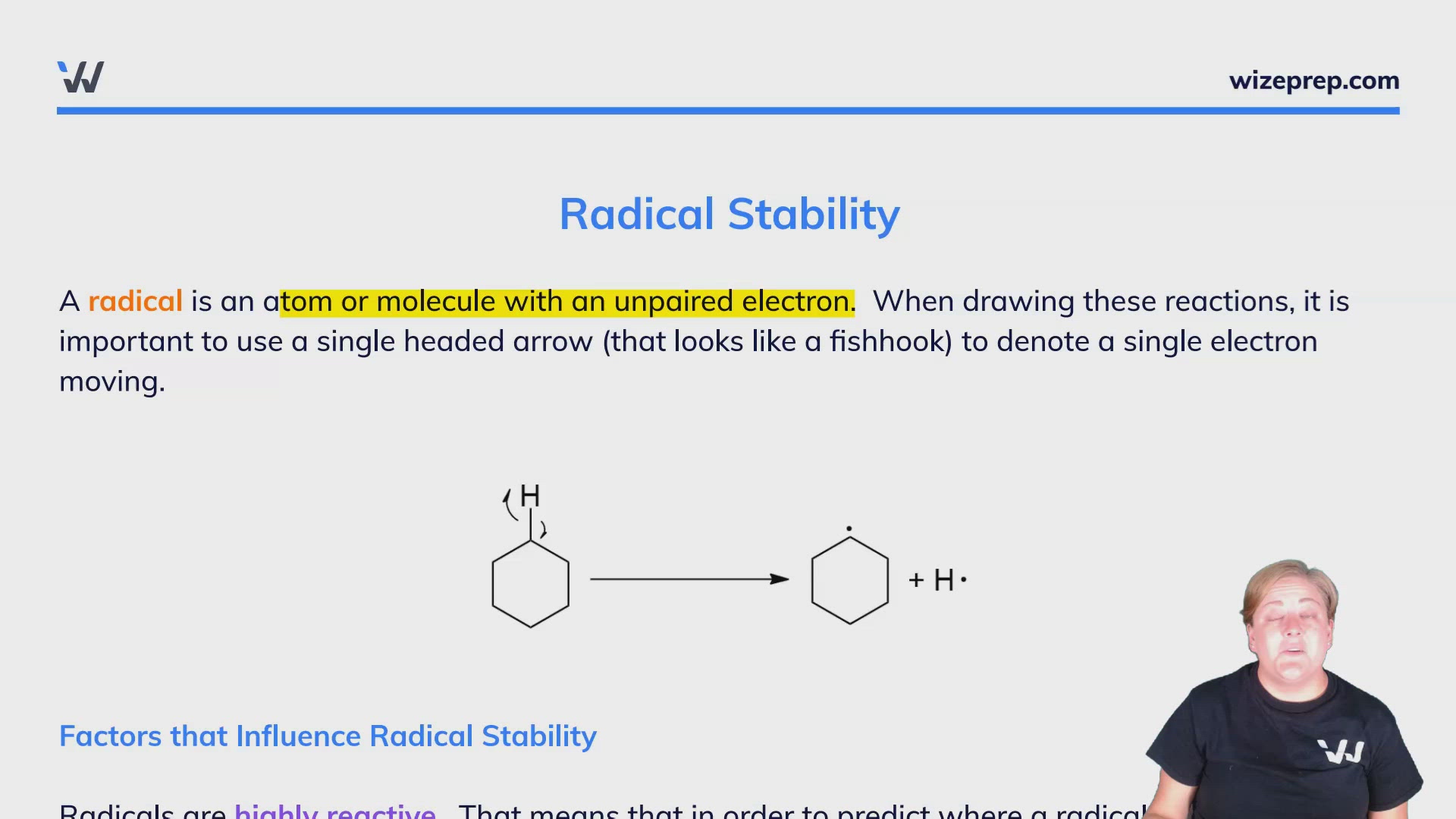
Radical Stability
A radical is an atom or molecule with an unpaired electron. When drawing these reactions, it is important to use a single headed arrow (that looks like a fishhook) to denote a single electron moving.

Factors that Influence Radical Stability
Radicals are highly reactive. That means that in order to predict where a radical reaction will occur, you need to be able to predict where the radical is most stable. There are three things to consider.
1. Hyperconjugation: Tertiary (3°) radicals are more stable than secondary (2°) radicals and primary (1°) radicals are the least stabilized.

2. Resonance: delocalizing a radical by resonance stabilized the radical. This can be done with a double bond or a heteroatom.

3. Hybridization: the less s-character there is on a carbon atom, the more stable the radical.

Wize Tip
The great news about radical stability is it follows the same trends as the carbocation! So everything you know about carbocations, you observe here!
0:00 / 0:00
Example: Radical Stability
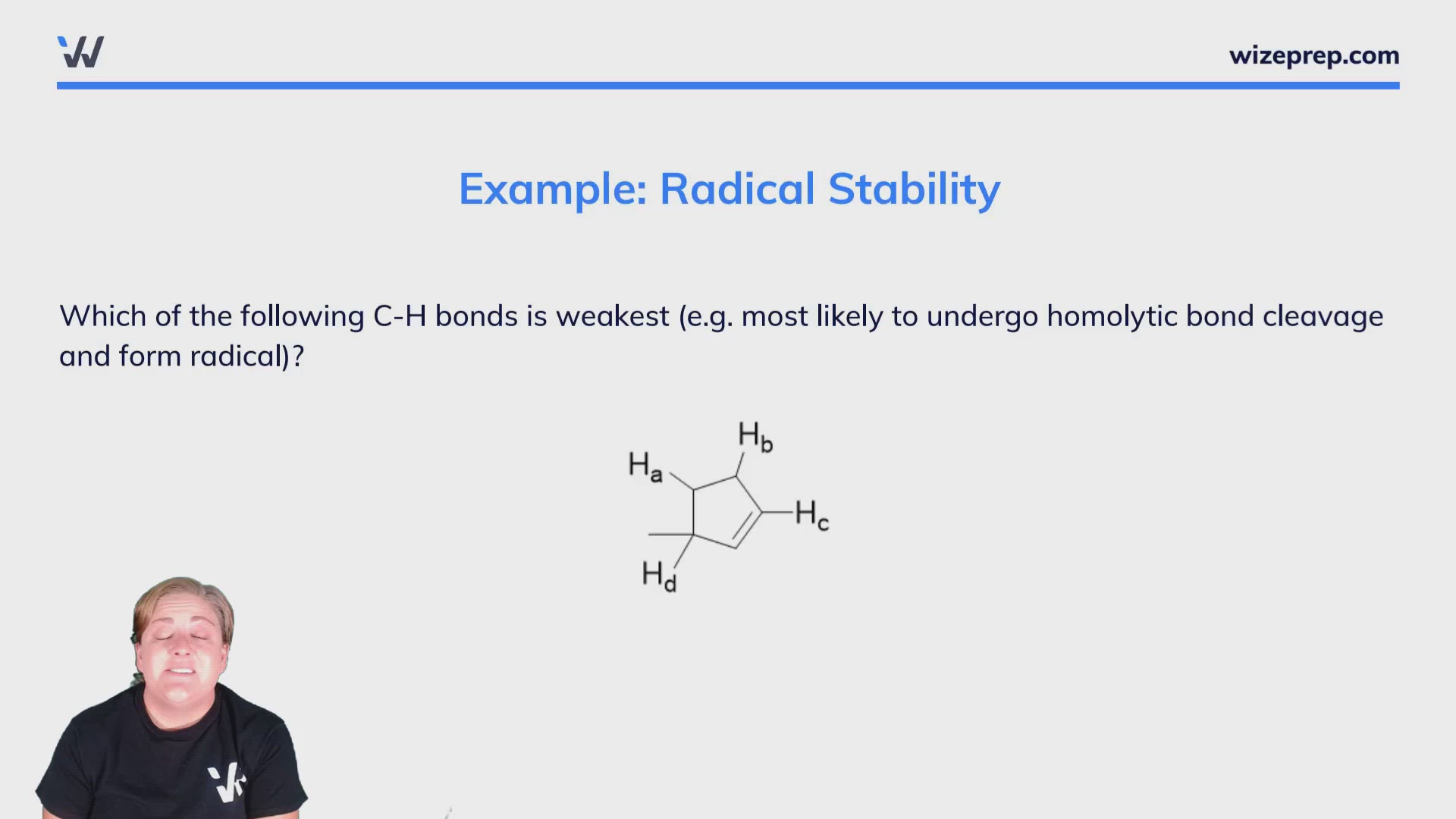
Which of the following C-H bonds is weakest (e.g. most likely to undergo homolytic bond cleavage and form radical)?

Remember: Radical stability - (least stable) sp < sp2 < sp3 (primary) < sp3 (secondary) < sp3 (tertiary) < resonance (most stable)
Answer: C-Hd - the resulting radical is on an sp3 tertiary carbon atom and is resonance stabilized. C-Hb also gives a resonance stabilized radical, but it's two contributing structures put radicals on sp3 secondary carbon atoms.
0:00 / 0:00
Example: Radical Stability
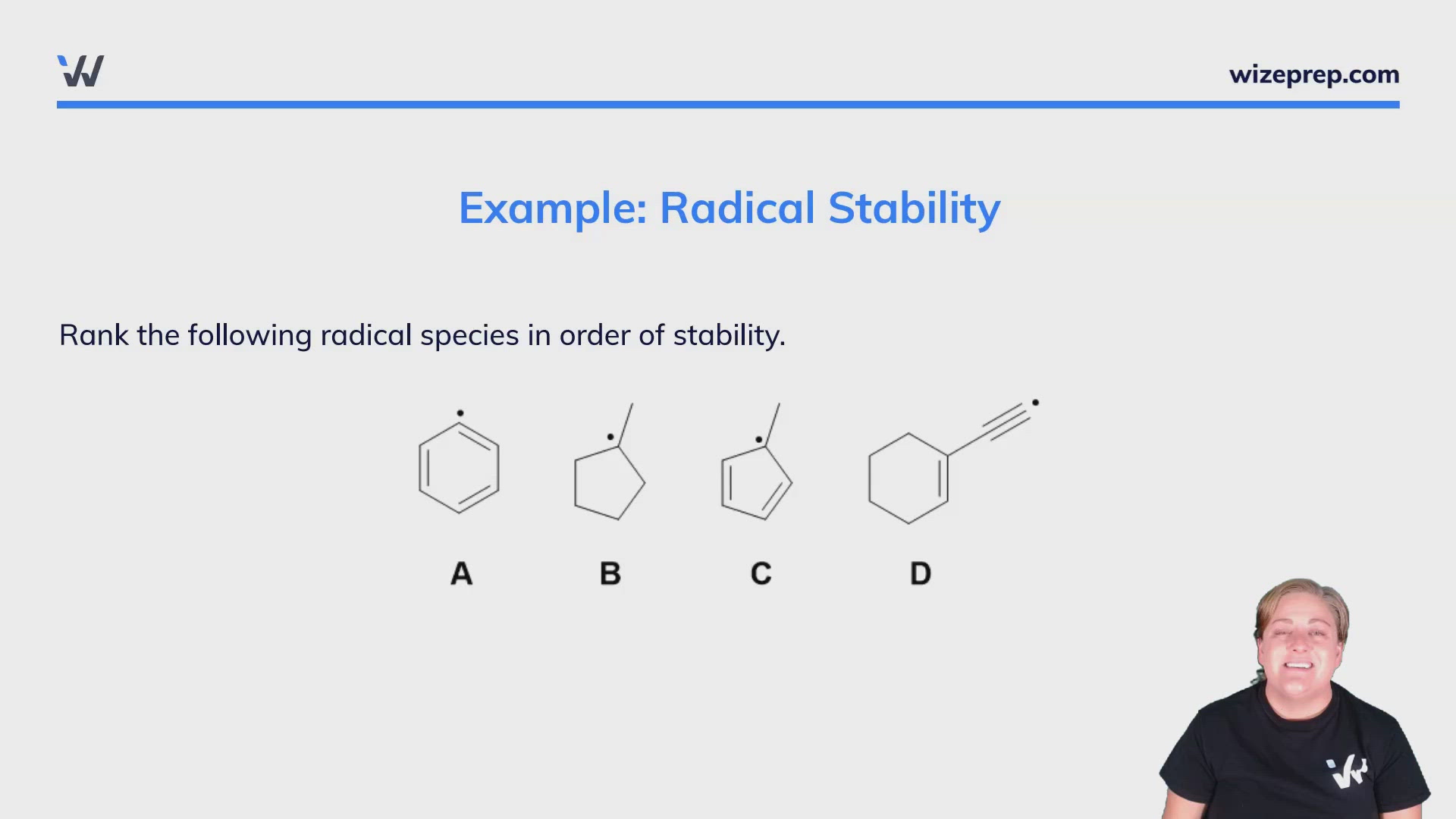
Rank the following radical species in order of stability.

Remember: Radical stability - (least stable) sp < sp2 < sp3 (primary) < sp3 (secondary) < sp3 (tertiary) < resonance (most stable)
Answer: (least stable) D (sp carbon), A (sp2 carbon), B (sp3 tertiary carbon), C (sp3 tertiary carbon and resonance!)
Which of the following radical species is most stable?
