Popular Courses
MCAT
General Course
Organic Chemistry
University Study Guides
Organic Chemistry
General Course
CHEM 233
University of British Columbia
Organic Chemistry
University Study Guides
CHEM 2223B
Western University
CHEM 282
Queen's University
CHY 142
Toronto Metropolitan University
CHEM 2OB3
McMaster University
CHEM 250
University of Saskatchewan
CHM247H1
University of Toronto
CHEM 213
University of British Columbia
CHEM 2100
University of Manitoba
CHEM*2700
University of Guelph
CHEM 280
Simon Fraser University
CHEM 164
University of Alberta
CHM249H1
University of Toronto
CHMB41H3
University of Toronto
CHM 26100
Purdue University
CHM138H1
University of Toronto
Classification of Carbohydrates
- Chain Length: Carbohydrates are named according to the number of carbon atoms in the main chain (carbon atoms in a row). They have similar prefixes to those used in IUPAC naming: 3 (tri), 4 (tetr), 5 (pent), 6 (hex), 7 (hept), and will all end in 'ose.'
- Aldose or Ketose: Carbohydrates are classified as aldose (aldehyde) or ketose (ketone) depending on the carbonyl group present within the molecule.
- D Versus L: Carbohydrates are classified as D or L. To do so: (1) the Fischer projection is drawn so the highest oxidation state carbon is at the top, (2) the -CH2OH group is on the bottom, (3) if the next OH up is on the Left = L, Right = D.
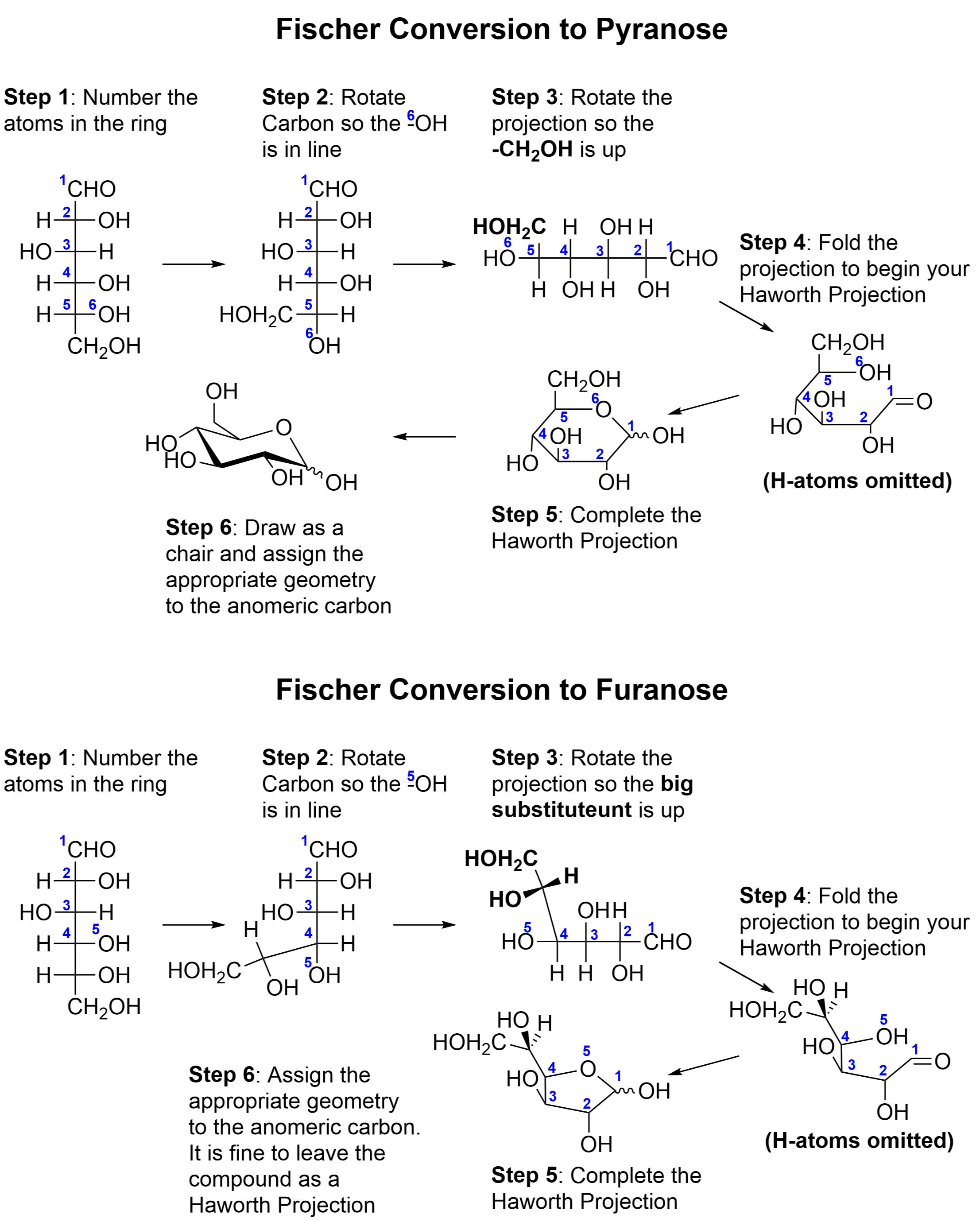
- The most common ring sizes are six-member (Pyranose) and five-member (Furanose).
- Anomeric carbon is named by orientation of the (1) oxygen off the ring and the (2) CH2OH group on the other side of the molecules. Alpha = opposite (vowels), Beta = same: