Wize University Organic Chemistry Textbook > Carbohydrates
Carbohydrate Reactions
Carbohydrate Reactions: Formation of Glycosidic Bonds
Carbohydrate Reactions: Hydrolysis of Glycosidic Bonds
Carbohydrate Reactions: Reducing Sugars
Practice: Carbohydrates in Solution
Example: Tollen's Reagent and Reducing Sugars
Example: Identifying Reducing Sugars
Example: Ketoses with the Tollen's Test
Popular Courses
MCAT
General Course
Organic Chemistry
University Study Guides
Organic Chemistry
General Course
CHEM 233
University of British Columbia
Organic Chemistry
University Study Guides
CHEM 2223B
Western University
CHEM 282
Queen's University
CHY 142
Toronto Metropolitan University
CHEM 2OB3
McMaster University
CHEM 250
University of Saskatchewan
CHM247H1
University of Toronto
CHEM 213
University of British Columbia
CHEM 2100
University of Manitoba
CHEM*2700
University of Guelph
CHEM 164
University of Alberta
CHEM 280
Simon Fraser University
CHM249H1
University of Toronto
CHMB41H3
University of Toronto
CHM 26100
Purdue University
CHM138H1
University of Toronto

0:00 / 0:00
Carbohydrate Reactions: Formation of Glycosidic Bonds
The formation of a glycosidic bond is just like the formation of an acetal or ketal. This reaction is acid catalyzed to promote the bad -OH leaving group to water (an excellent leaving group!).
Wize Tip
The nucleophile in this reaction can either be an alcohol (like methanol (MeOH) or ethanol (EtOH)) or another monosaccharide to form a disaccharide or a polysaccharide
Example: Provide a product and mechanism for the following reaction:


0:00 / 0:00
Carbohydrate Reactions: Hydrolysis of Glycosidic Bonds
Unlike hemiacetals and hemiketals which can reversibly open to the linear form, acetals and ketals cannot. In order to hydrolyze the glycosidic bonds, an acid catalyst and heat is required.
Wize Tip
Remember, hydrolysis is the addition of water!

0:00 / 0:00
Carbohydrate Reactions: Reducing Sugars
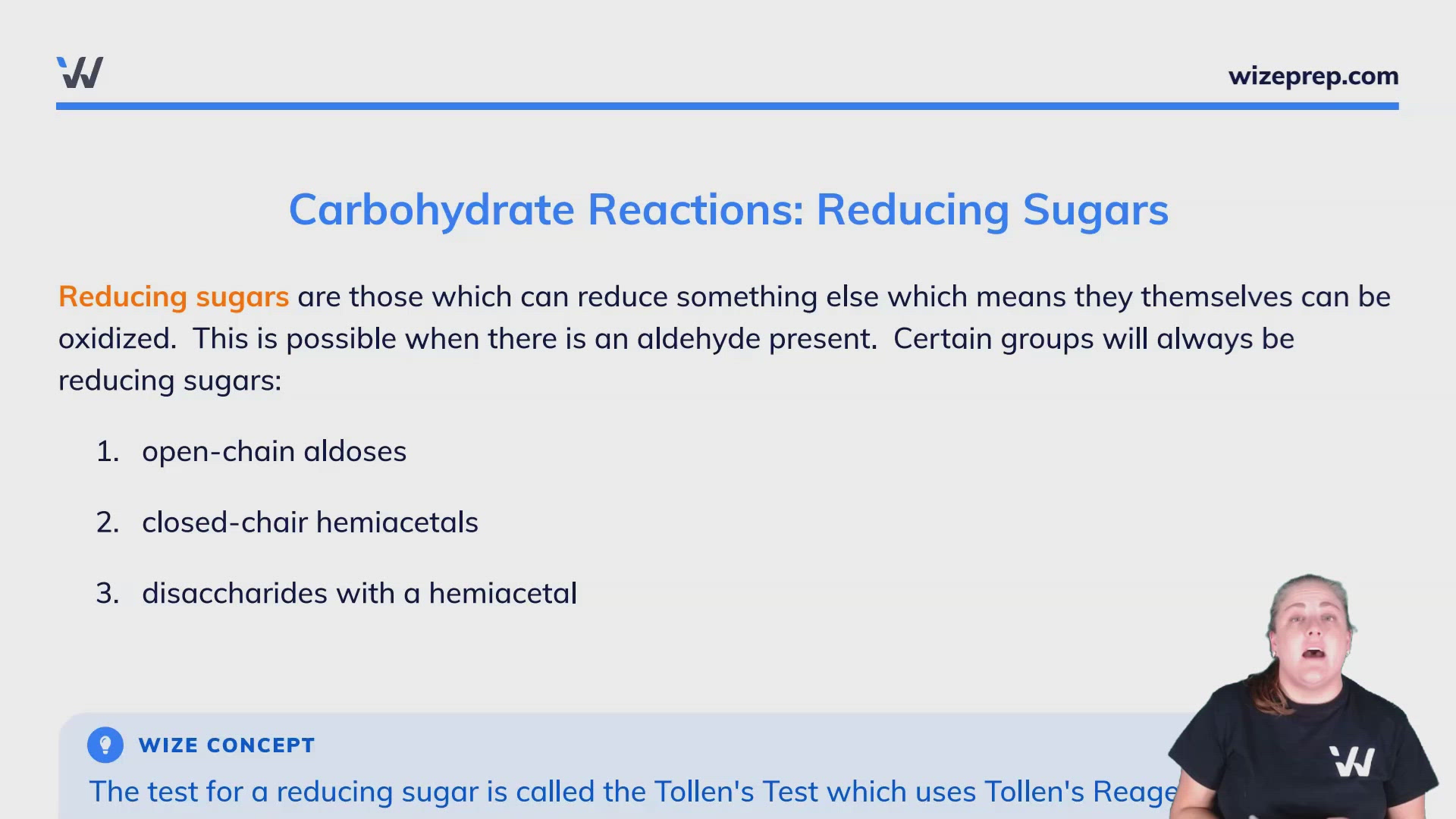
Reducing sugars are those which can reduce something else which means they themselves can be oxidized. This is possible when there is an aldehyde present. Certain groups will always be reducing sugars:
- open-chain aldoses
- closed-chair hemiacetals
- disaccharides with a hemiacetal
Wize Concept
The test for a reducing sugar is called the Tollen's Test which uses Tollen's Reagent (AgNO3/base) to produce a "silver mirror" if the sugar is a reducing sugar.

Mark Yourself Question
- Grab a piece of paper and try this problem yourself.
- When you're done, check the "I have answered this question" box below.
- View the solution and report whether you got it right or wrong.
Pure β-D-mannopyranose (shown below) has optical activity (specific rotation, α, = -17.0°). In water, the optical activity rapidly changes until after 3 hours α = +14.6°. What is going on? Hint: use pictures to explain.

0:00 / 0:00
Example: Tollen's Reagent and Reducing Sugars
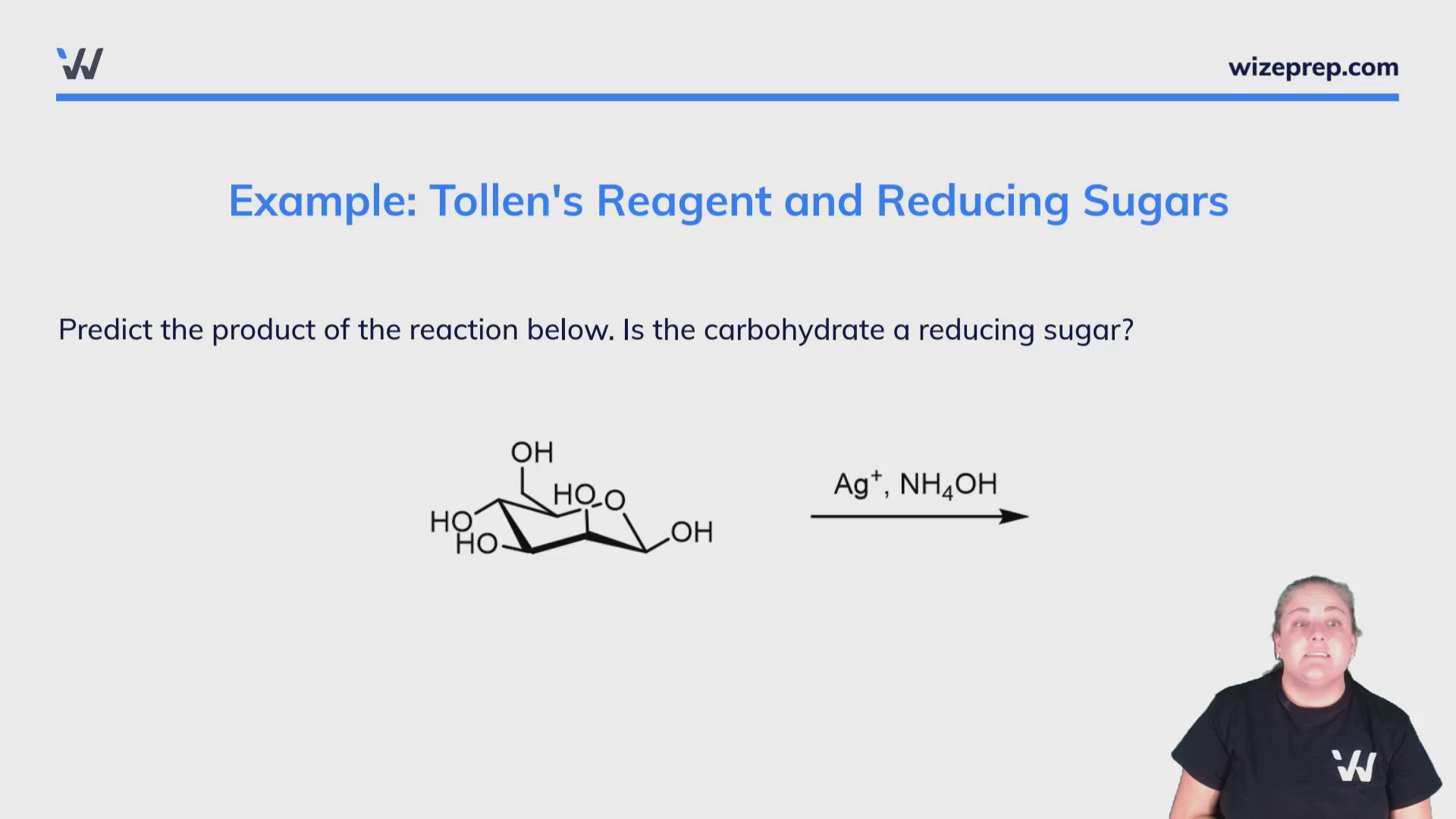
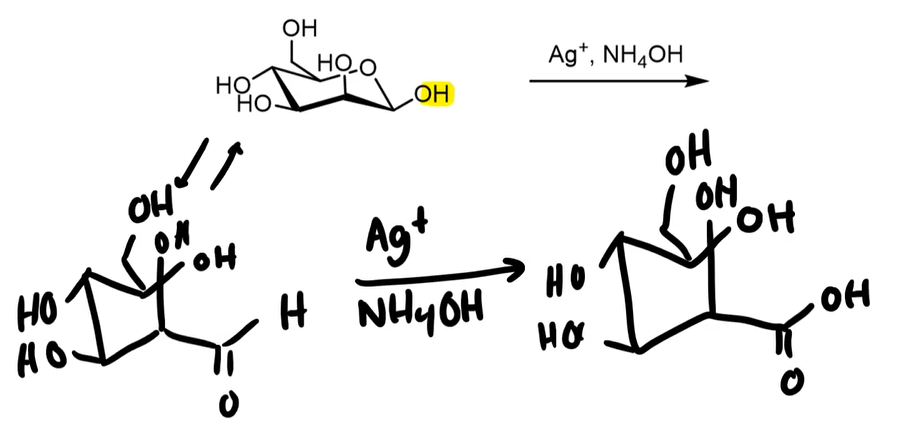
Predict the product of the reaction below. Is the carbohydrate a reducing sugar?

Yes, this is a reducing sugar.
0:00 / 0:00
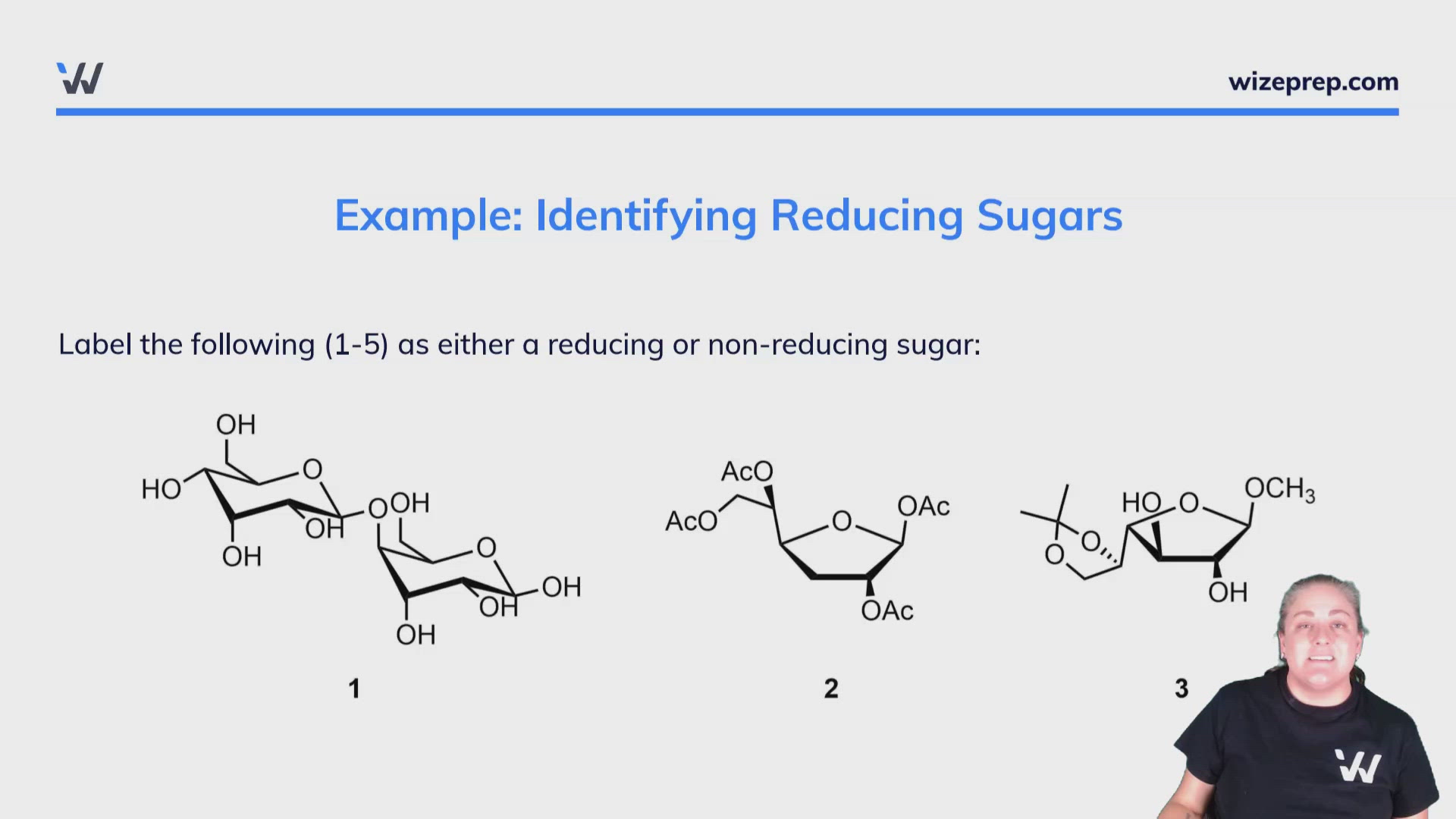
Example: Identifying Reducing Sugars
Label the following (1-5) as either a reducing or non-reducing sugar:
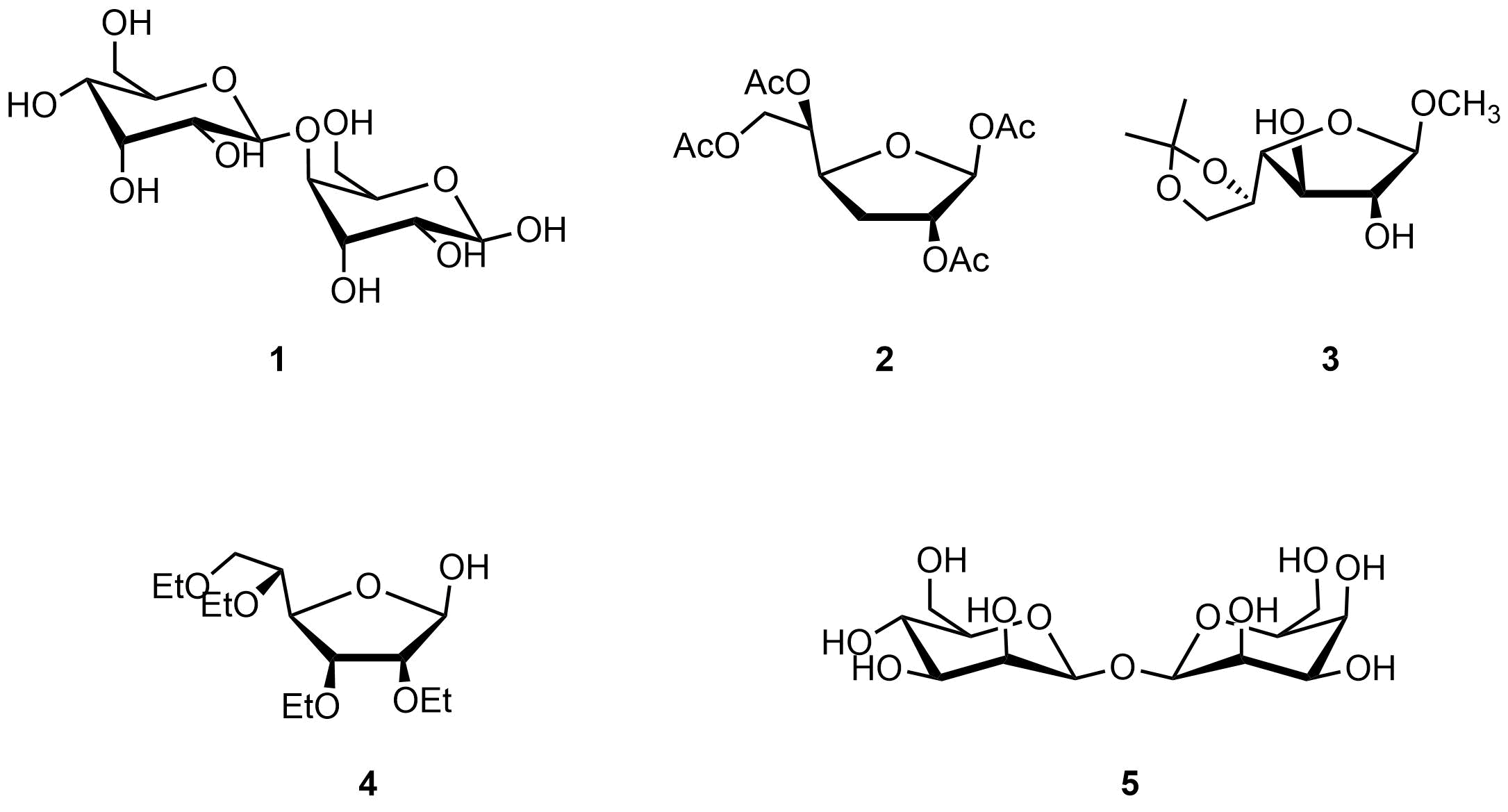
- Reducing - remember you only need one hemi-acetal to be a reducing sugar
- Non-reducing
- Non-reducing
- Reducing
- Non-reducing
0:00 / 0:00
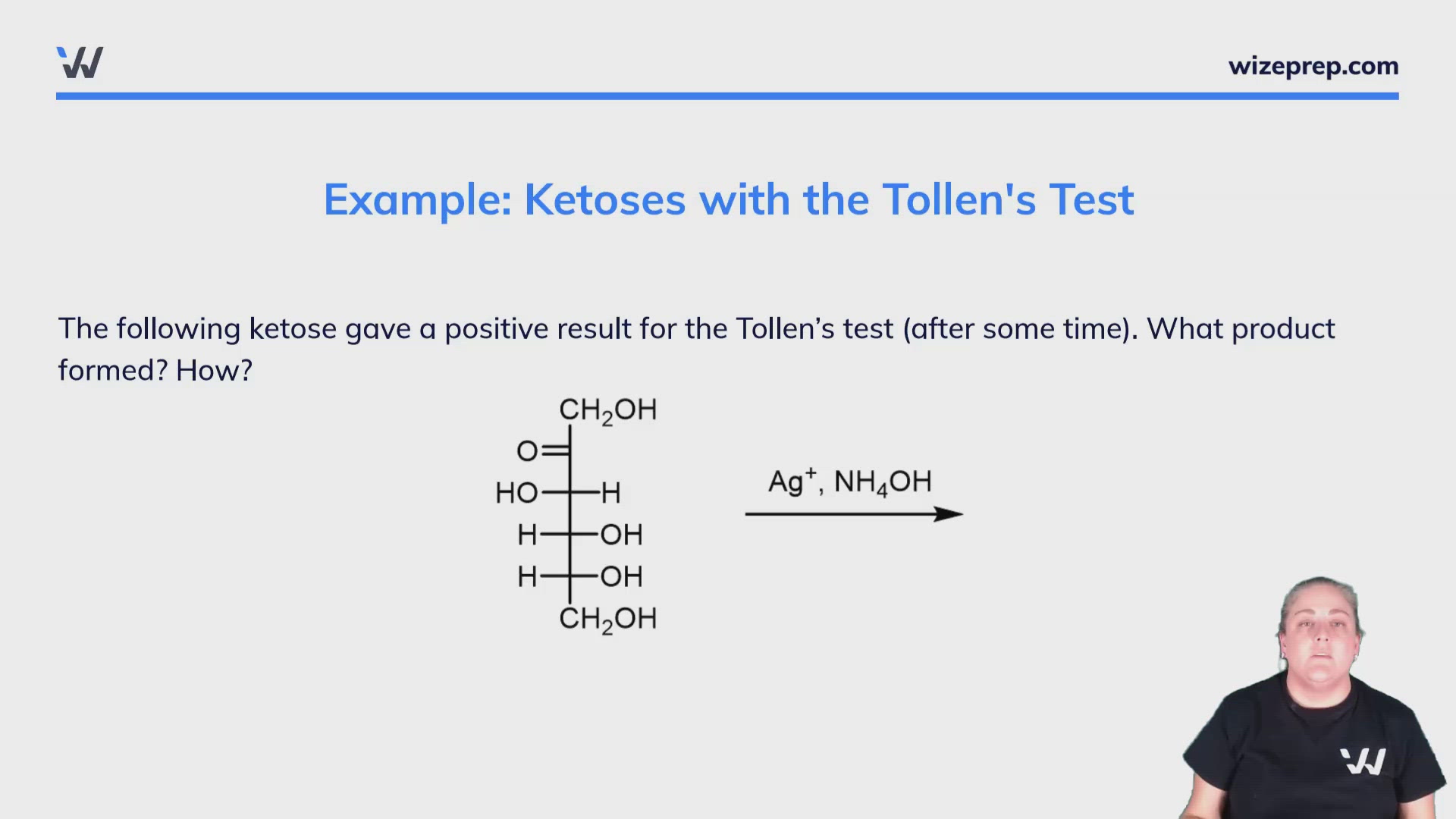
Example: Ketoses with the Tollen's Test
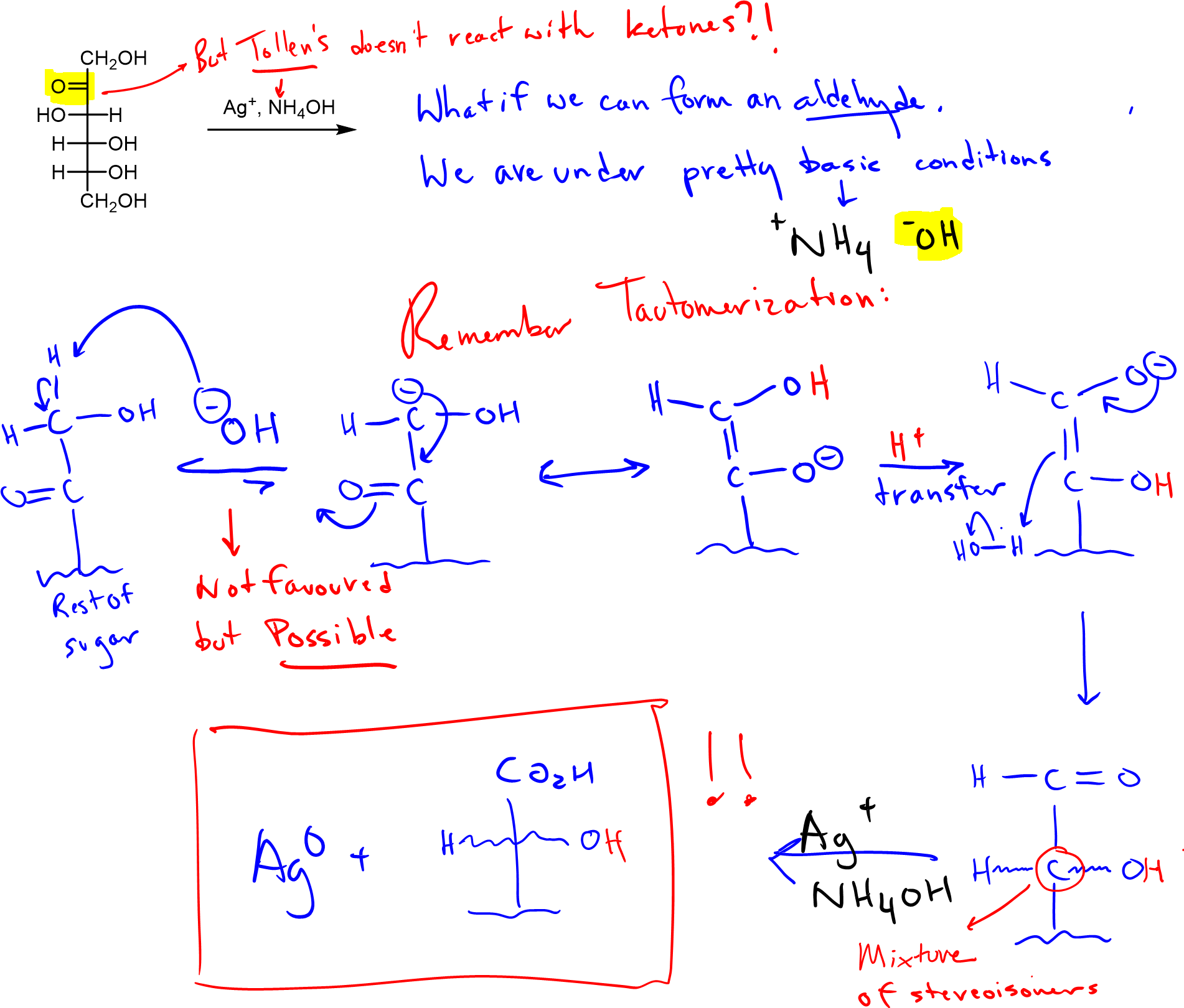
The following ketose gave a positive result for the Tollen’s test (after some time). What product formed? How?