Wize University Organic Chemistry Textbook > Carbohydrates
Converting Fischer Structures
Popular Courses
MCAT
General Course
Organic Chemistry
University Study Guides
Organic Chemistry
General Course
CHEM 233
University of British Columbia
Organic Chemistry
University Study Guides
CHM136H1
University of Toronto
CHEM 2223B
Western University
CHEM 282
Queen's University
CHY 142
Toronto Metropolitan University
CHEM 266
University of Waterloo
CHEM 2OB3
McMaster University
CHEM 250
University of Saskatchewan
CHM247H1
University of Toronto
CHEM 213
University of British Columbia
CHEM 2100
University of Manitoba
CHEM*2700
University of Guelph
CHEM 164
University of Alberta
CHEM 280
Simon Fraser University
CHM249H1
University of Toronto
CHMB41H3
University of Toronto
0:00 / 0:00
Converting Fischer Structures
Carbohydrates are interesting molecules because they can rapidly interconvert between their closed and open forms to form either a pyranose (6-membered) or furanose (5-membered) ring:
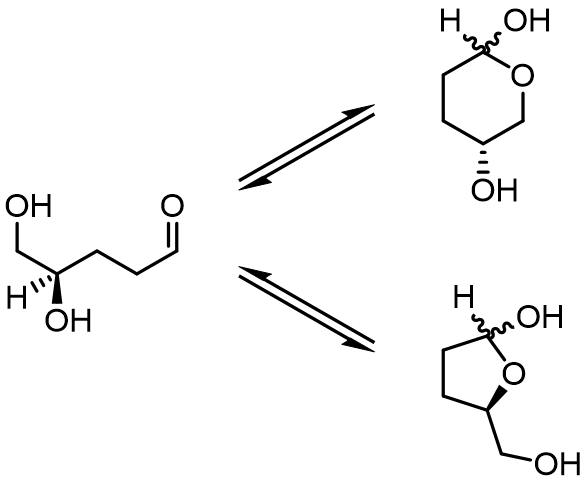
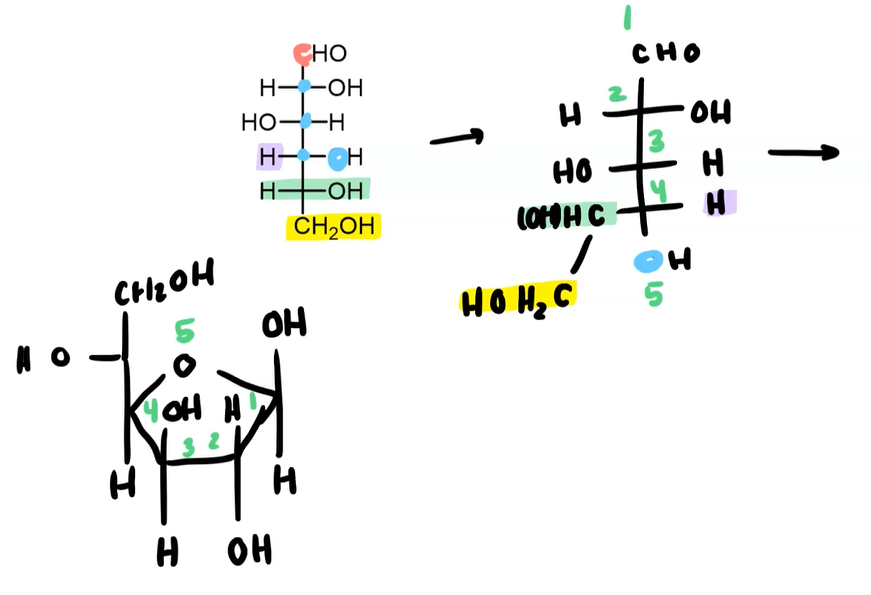
You will need to be able to draw the cyclized version of monosaccharides from Fischer projections. The steps are as follows:
- rotate the bottom chiral carbon so that the -OH group is on the bottom
- rotate the -CH2OH and the -H group appropriately (this will depend on the D vs. L forms)
- groups on the left of the Fischer projection point up on the chair conformation
- groups on the right of the Fischer projection point down on the chair conformation
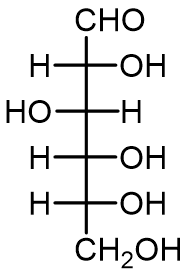
Example: draw the alpha and beta versions of the monosaccharide below in chair conformations
0:00 / 0:00
Example: Converting Fischer Structures
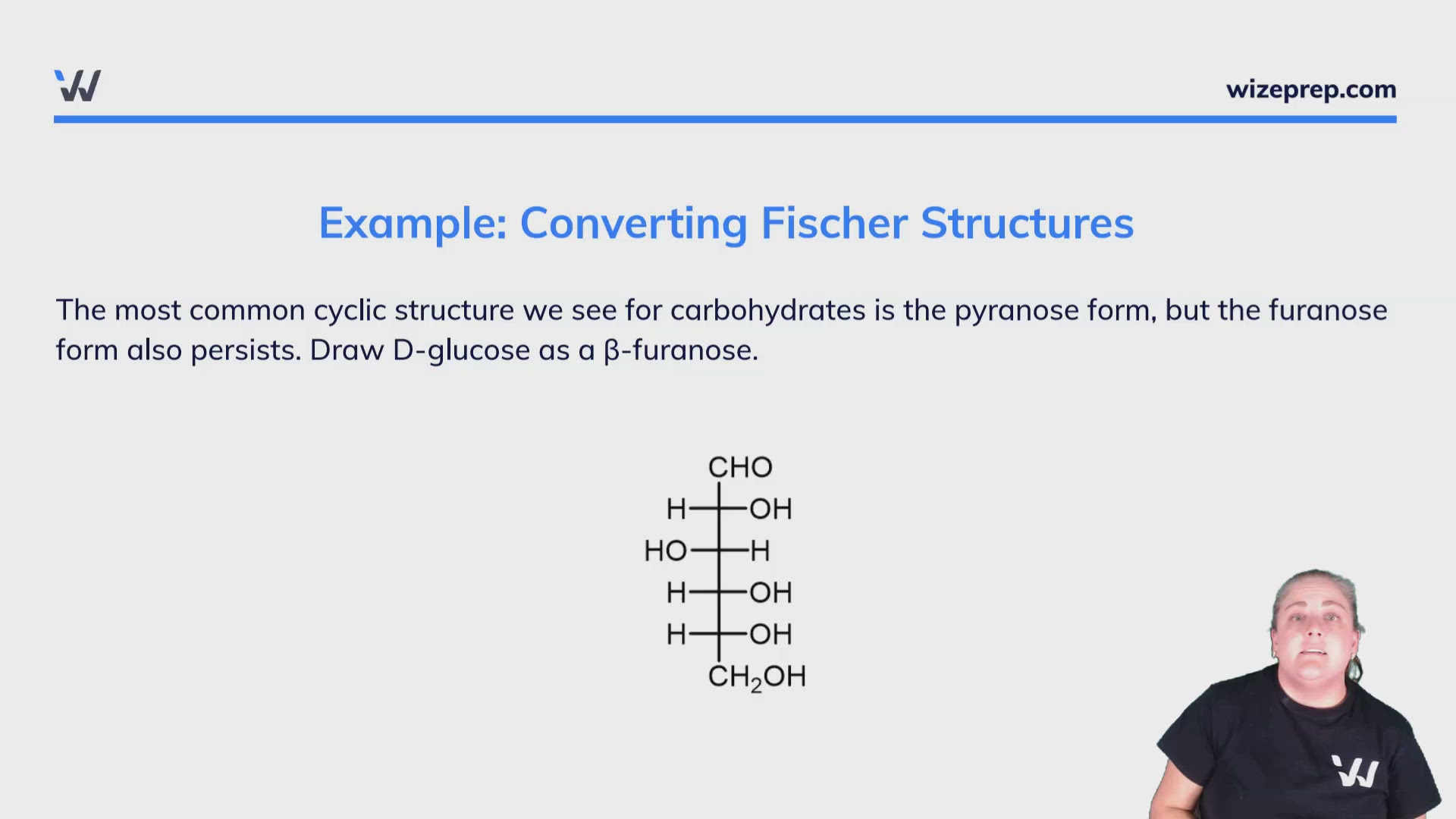
The most common cyclic structure we see for carbohydrates is the pyranose form, but the furanose form also persists. Draw D-glucose as a β-furanose.
0:00 / 0:00
Example: Converting Fischer Structures
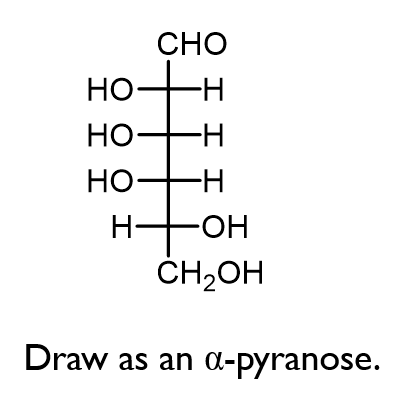
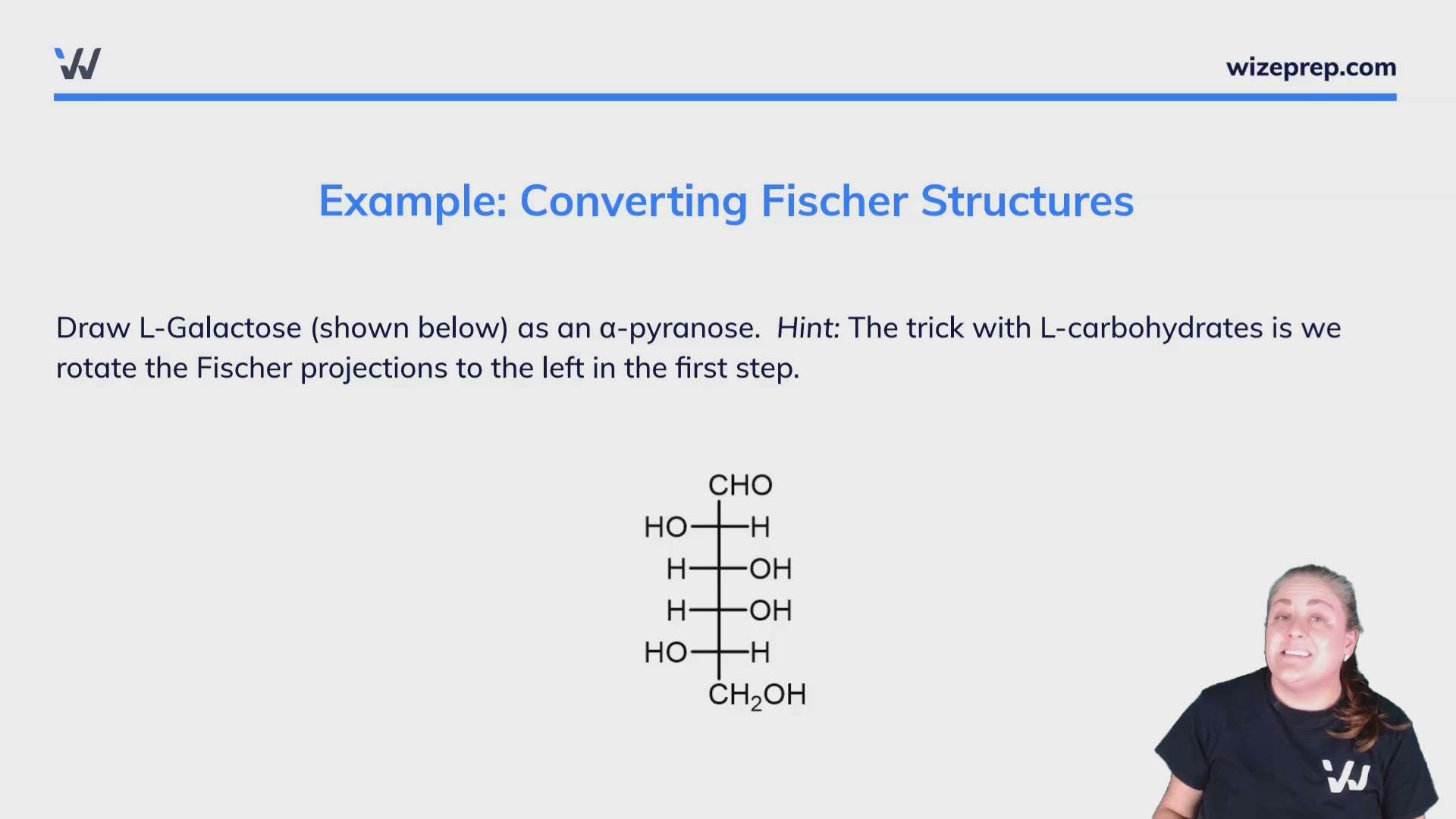
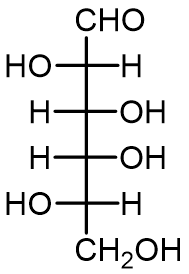
Draw L-Galactose (shown below) as an α-pyranose. Hint: The trick with L-carbohydrates is we rotate the Fischer projections to the left in the first step.


Mark Yourself Question
- Grab a piece of paper and try this problem yourself.
- When you're done, check the "I have answered this question" box below.
- View the solution and report whether you got it right or wrong.
Draw the molecule below as a chair conformation.