Popular Courses
MCAT
General Course
DAT
General Course
CHEM 2213A/B
Western University
Organic Chemistry
University Study Guides
Organic Chemistry
General Course
CHEM 233
University of British Columbia
CHEM 233
University of British Columbia
CHEM 261
University of Alberta
Organic Chemistry
University Study Guides
CHEM 351
University of Calgary
CHEM 123
University of British Columbia
CHEM 281
Queen's University
CHEM 281
Queen's University
CHM 1321
University of Ottawa
CHM136H1
University of Toronto
CHEM 212
McGill University
CHEM 231
University of Victoria
CHEM 2223B
Western University
CHM 2120
University of Ottawa
CHY 142
Toronto Metropolitan University
0:00 / 0:00
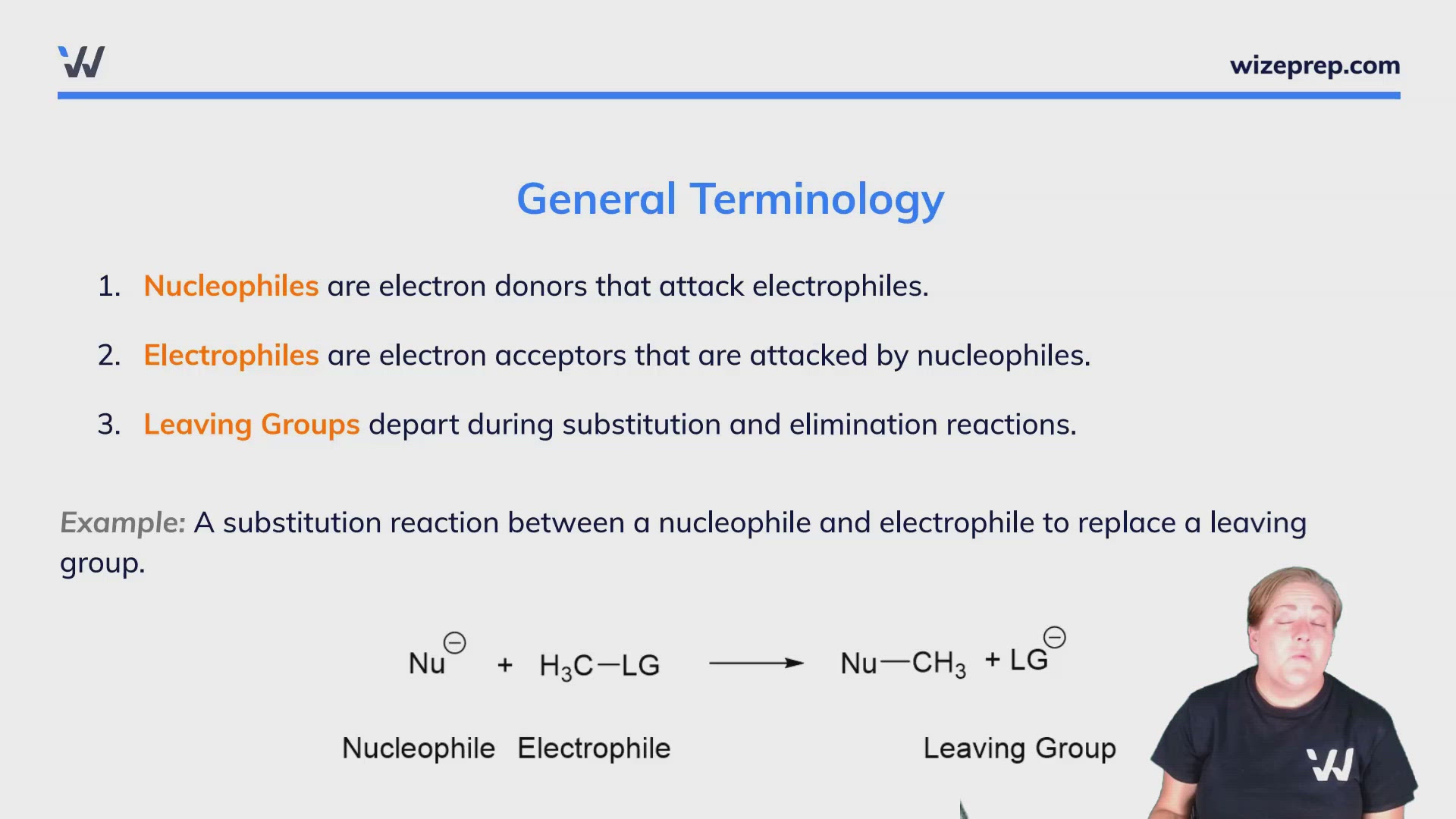
General Terminology
- Nucleophiles are electron donors that attack electrophiles.
- Electrophiles are electron acceptors that are attacked by nucleophiles.
- Leaving Groups depart during substitution and elimination reactions.
Example: A substitution reaction between a nucleophile and electrophile to replace a leaving group.

Wize Tip
Nucleophiles and leaving groups are just fancy conjugate bases!
A good nucleophile is a bad leaving group. They are both unstable/reactive conjugate bases!
A bad nucleophile is a good leaving group. They are both stable/unreactive conjugate bases!
0:00 / 0:00
Nucleophiles
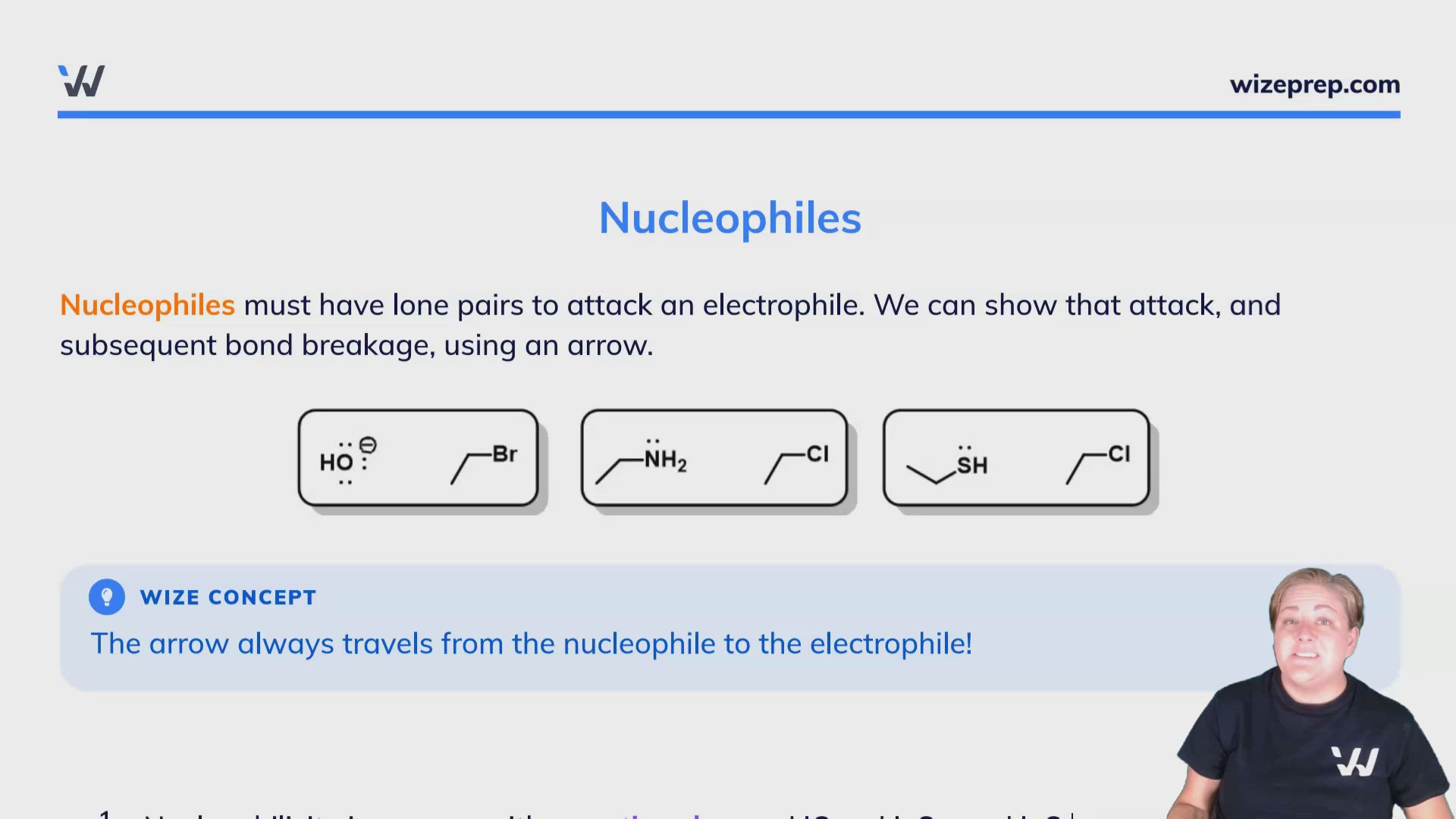
Nucleophiles must have lone pairs to attack an electrophile. We can show that attack, and subsequent bond breakage, using an arrow.

Wize Concept
The arrow always travels from the nucleophile to the electrophile!
- Nucleophilicity increases with negative charge: HO– > H2O >>> H3O+
- Nucleophilicity increases with basicity in general: H3C– > H2N– >HO– > F–
- Nucleophilicity increases with more polarizable atoms (size): I– > Br– > Cl– > F–
0:00 / 0:00
Electrophiles
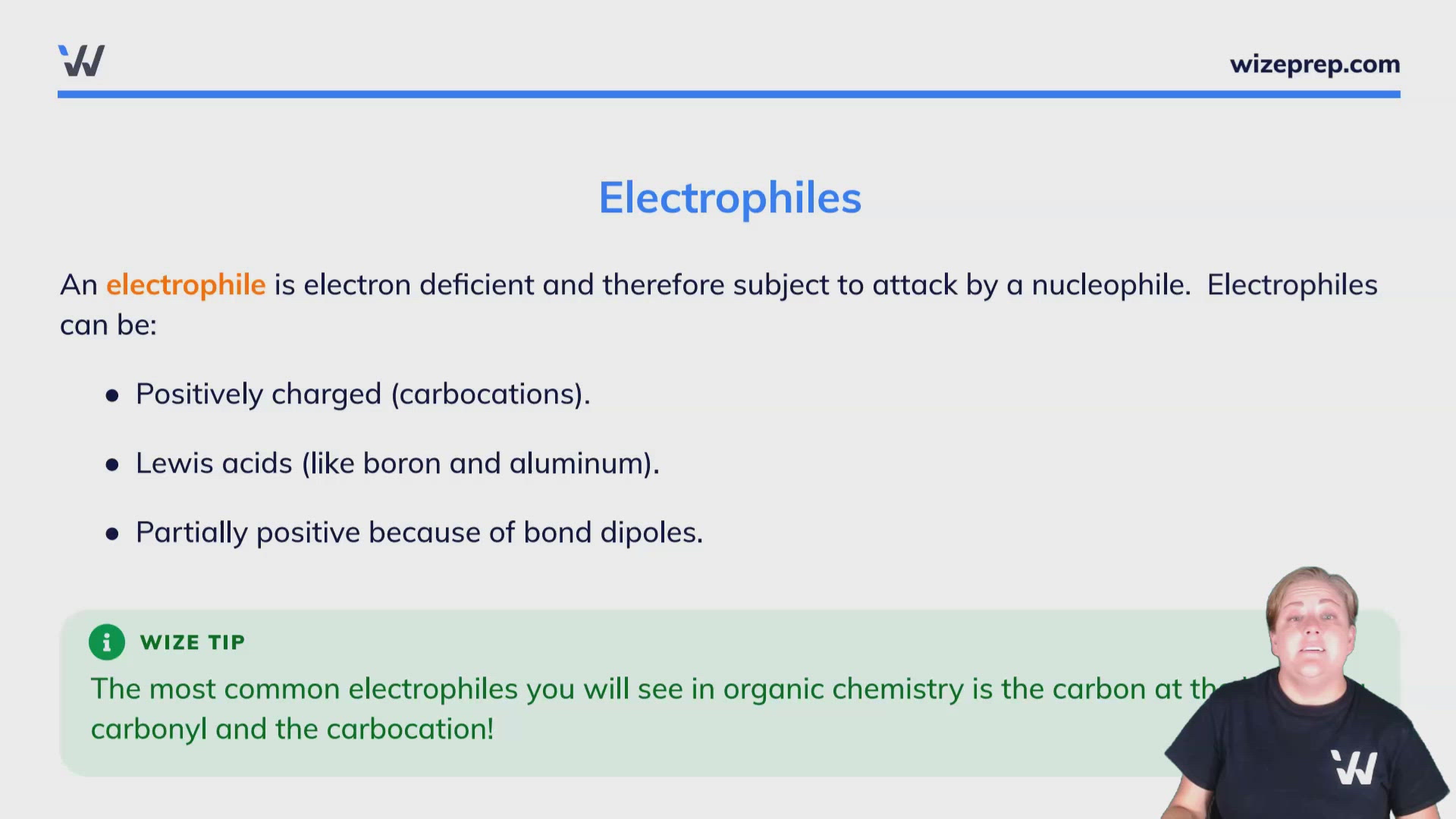
An electrophile is electron deficient and therefore subject to attack by a nucleophile. Electrophiles can be:
- Positively charged (carbocations).
- Lewis acids (like boron and aluminum).
- Partially positive because of bond dipoles.
Wize Tip
The most common electrophiles you will see in organic chemistry is the carbon at the base of a carbonyl and the carbocation!
0:00 / 0:00
Leaving Groups
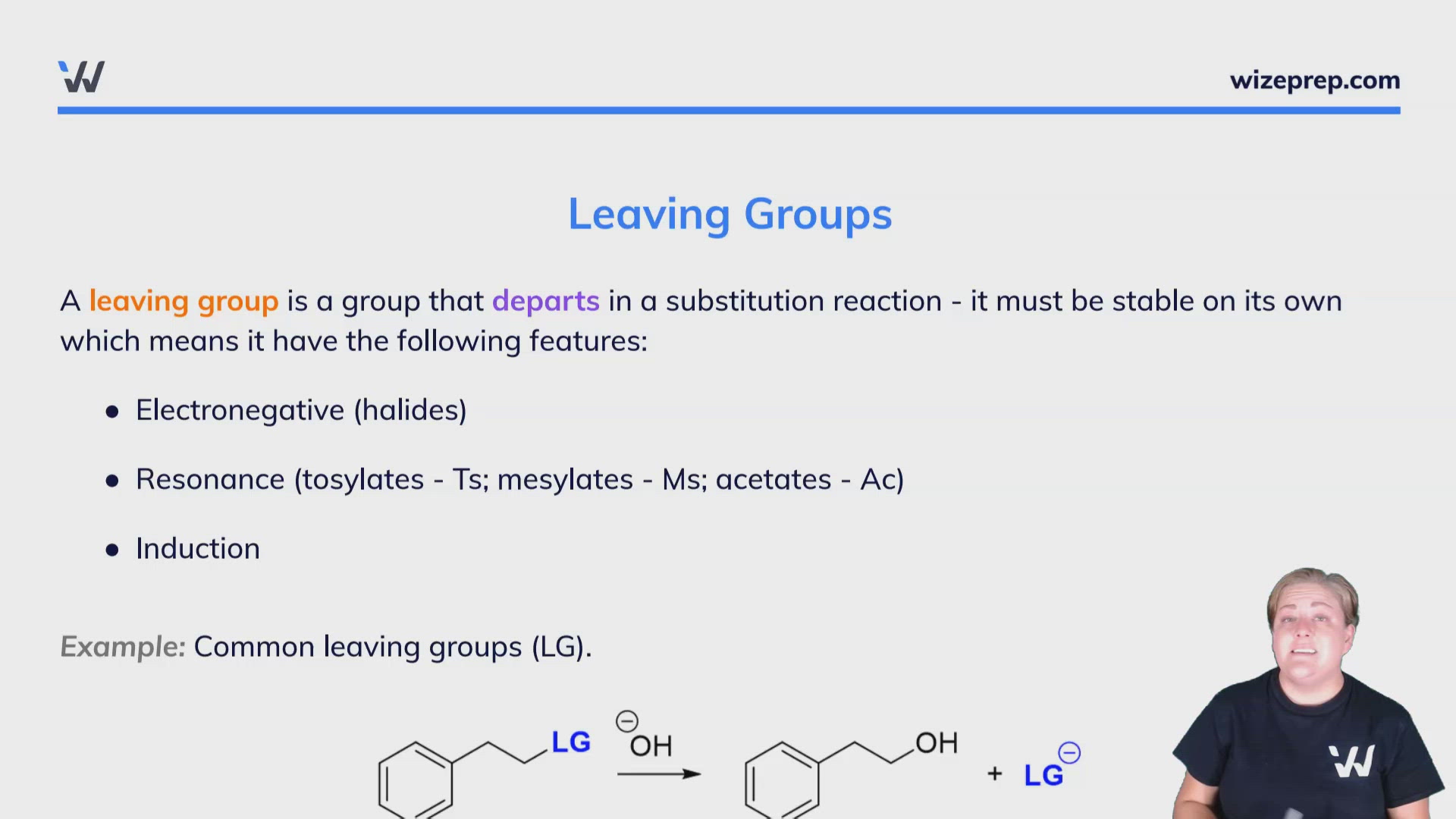
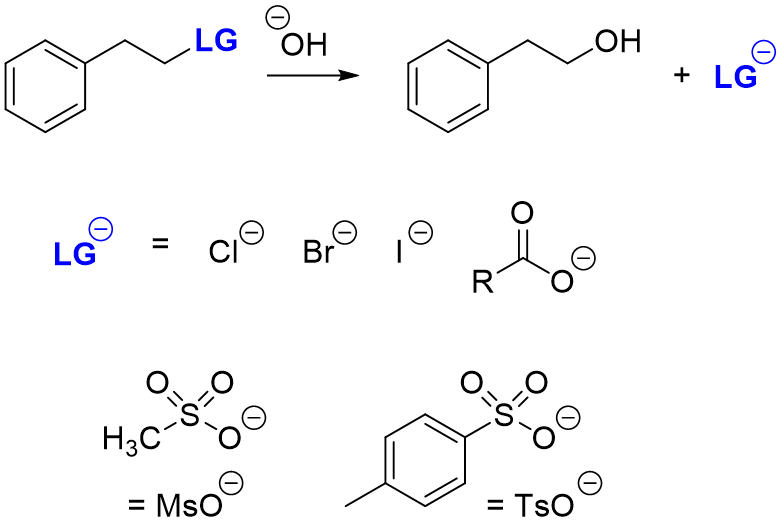
A leaving group is a group that departs in a substitution reaction - it must be stable on its own which means it have the following features:
- Electronegative (halides)
- Resonance (tosylates - Ts; mesylates - Ms; acetates - Ac)
- Induction
Example: Common leaving groups (LG).
0:00 / 0:00
Substitution vs. Elimination
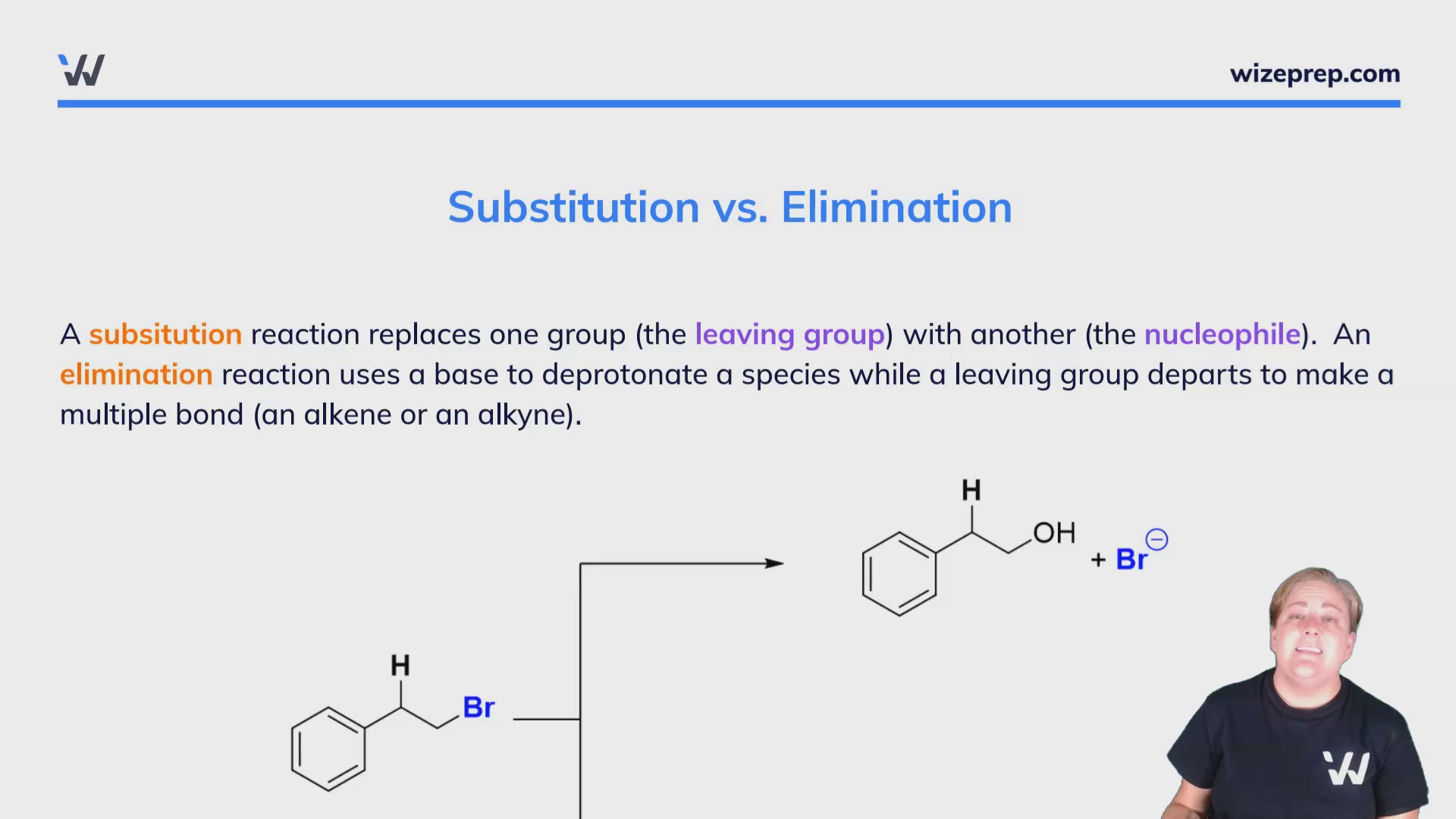
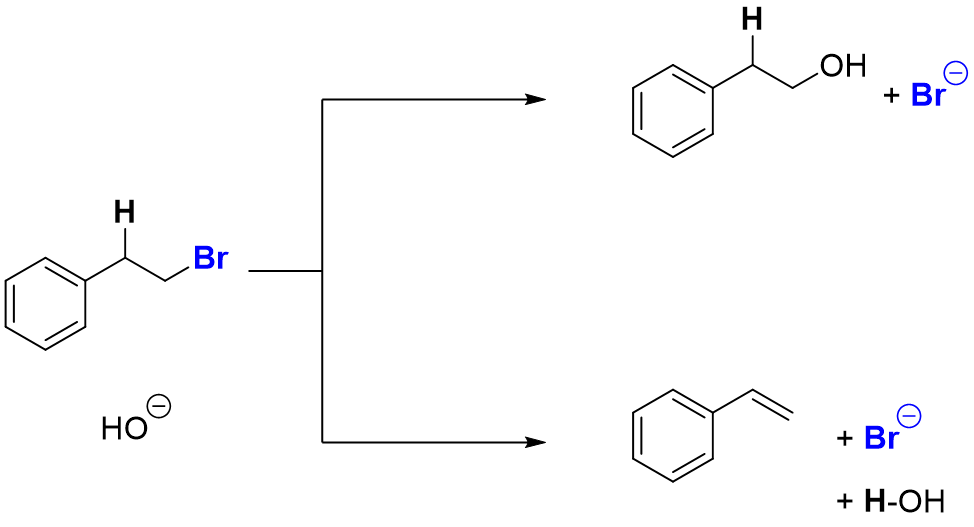
A subsitution reaction replaces one group (the leaving group) with another (the nucleophile). An elimination reaction uses a base to deprotonate a species while a leaving group departs to make a multiple bond (an alkene or an alkyne).
0:00 / 0:00
Example: Substitution vs. Elimination
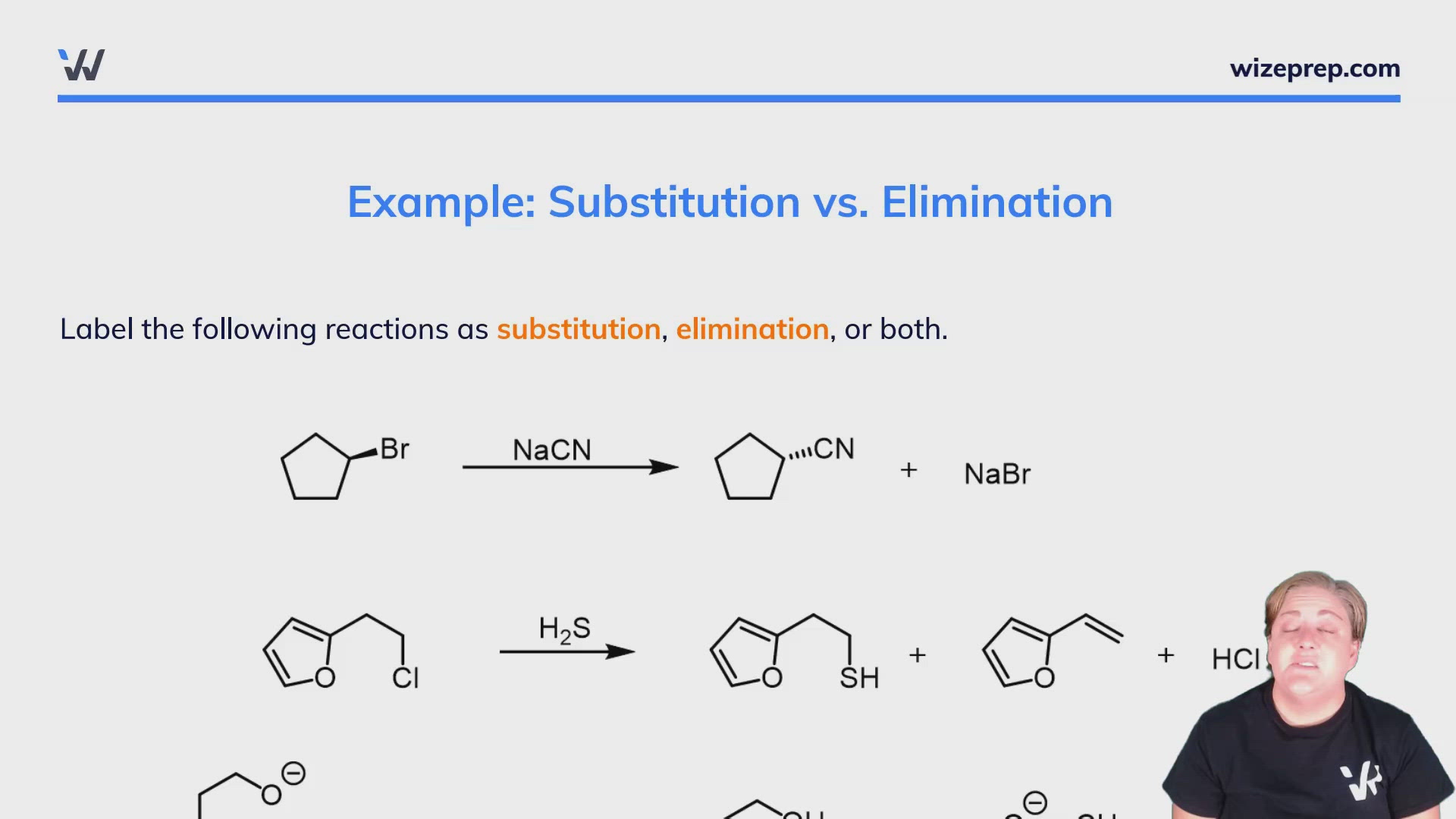
Label the following reactions as substitution, elimination, or both.

- Substitution
- Both
- Elimination